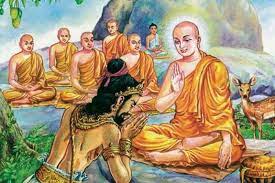
The arrival of Arahat Mahinda in Sri Lanka is arguably the most transformative event in the island’s history. It marked not just the introduction of a new religion, but the foundation of a civilization that would define the Sinhalese identity for millennia.
The Mission from Ashoka
Mahinda was no ordinary monk; he was the son of the great Indian Emperor Ashoka, who had renounced violence and dedicated his life to spreading the Dhamma. Sent on a mission to Sri Lanka, Mahinda arrived at a time when the island was ripe for spiritual change.
The Meeting at Mihintale
On the full moon day of Poson (June) in 247 BC, King Devanampiya Tissa was hunting deer in the forests of Mihintale. There, he encountered the monk Mahinda, who called him by name. To test the king’s wisdom and readiness to receive the teachings, Mahinda posed a famous riddle about mango trees. The king’s sharp answers proved his intellect, and he and his retinue converted to Buddhism on the spot.
A Cultural Revolution
Mahinda’s influence extended far beyond religion. He introduced the art of writing (Brahmi script), Mauryan art and architecture, and a code of ethics that shaped the legal and social systems of the kingdom. The introduction of Buddhism unified the people under a common faith and inspired the construction of the great stupas and reservoirs that would become the hallmark of ancient Sri Lanka.