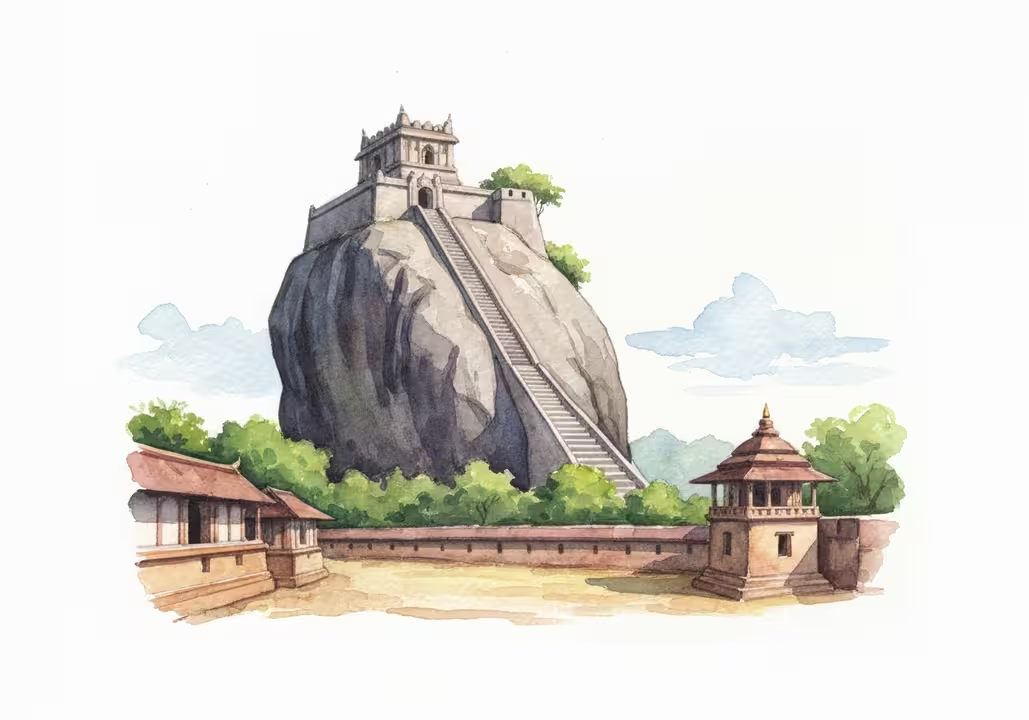
Rising dramatically from the lowland plains of northwestern Sri Lanka, the granite monolith of Yapahuwa stands as a testament to an age of turmoil, ambition, and sacred duty. For just over a decade in the late 13th century, this 90-meter rock fortress served as the kingdom’s capital—a defiant stronghold built to protect the island’s most precious treasure from the covetous eyes of South Indian invaders.
The Genesis of a Fortress
The story of Yapahuwa begins not with kings, but with a military commander named Subha. In the early 13th century, as the fearsome Kalinga Magha swept across the island with an army of 24,000 soldiers, devastating the ancient capital of Polonnaruwa, General Subha recognized the strategic brilliance of this isolated rock outcrop. The locals knew it by various names—Subhapabbata, Sundarapabbata, Subhacala—all reflecting its association with this resourceful defender.
From his fortress perch, Subha successfully held back the tide of Magha’s invasion between 1215 and 1236, preventing the invader’s hordes from penetrating into the western territories. The rock’s natural defenses—sheer cliffs rising almost vertically from the surrounding countryside—made it nearly impregnable. Yapahuwa became one of several mountain strongholds where Sinhalese resistance coalesced during those dark decades of foreign occupation.
A King’s Calculated Move
By 1272, Sri Lanka had endured more than half a century of instability. The Kingdom of Dambadeniya had emerged as the seat of power following the eventual expulsion of Magha’s forces, but the threat from South India remained ever-present. When King Vijayabahu IV was assassinated, his brother ascended the throne as Bhuvanekabahu I, inheriting a kingdom under constant pressure from Dravidian invasions.
The new king made a momentous decision. Dambadeniya, though functional as a capital, lacked the natural defenses needed in such perilous times. In 1273, Bhuvanekabahu I ordered the transfer of the capital to Yapahuwa. More significantly, he brought with him the Dalada—the Sacred Tooth Relic of the Buddha—whose possession had long been regarded as the ultimate symbol of rightful sovereignty in Sri Lanka.
The rock fortress, already proven in battle, would now serve dual purposes: military stronghold and sacred shrine. The king strengthened the site further with ramparts and defensive trenches, transforming Subha’s military outpost into a fortified royal residence worthy of housing both a monarch and a relic of the Enlightened One.
An Architectural Marvel
What Bhuvanekabahu I created at Yapahuwa was nothing short of spectacular. The king commissioned architects and artisans to construct a grand ornamental stairway that would lead from the base of the rock to the palace and Temple of the Tooth at its summit. This wasn’t merely a functional structure—it was a bold artistic statement, a stone symphony celebrating power, faith, and aesthetic sophistication.
The stairway was built in three stages, each ascending section growing more elaborate. The final flight consisted of 35 ornate steps, their risers and balustrades adorned with some of the finest sculptural work medieval Sri Lanka would ever produce. Master craftsmen carved intricate friezes depicting dancers frozen in graceful motion, their bodies swaying to silent rhythms. Musicians played stone instruments—drums, flutes, and cymbals—in an eternal concert. Mythological beings—makaras, lions, and celestial guardians—flanked the stairs, protecting the sacred path.
The artistic style showed a fascinating blend of influences. Some observers have noted a distinctly Cambodian flavor to the stonework, suggesting either the presence of foreign artisans or the influence of Khmer artistic traditions that had reached Sri Lanka through maritime trade networks. The carvings possessed an almost animate quality, so lifelike that one could nearly hear the rhythm of the dancers’ ankle bells.
At the gatehouse, crowning the stairway, stood architectural gems that epitomized the sophistication of Yapahuwa’s craftsmen. On either side of the doorway, beautifully ornamented perforated stone windows allowed light and air to filter through in geometric patterns. One of these windows—the Sivumenduru Kavuluwa—would become legendary. Carved from a solid slab 1.4 meters thick, it featured 45 precisely pierced circles arranged in an intricate pattern. When discovered during excavations in 1850, experts immediately recognized it as perhaps the finest example of medieval stone carving in all of Sri Lanka. Today, this masterpiece resides in the National Museum in Colombo, allowing visitors to marvel at the skill of Yapahuwa’s anonymous artisans.
At the summit, Bhuvanekabahu I constructed a palace complex and, most importantly, a shrine—the daladage—to house the Sacred Tooth Relic. From this elevated position, one could survey the entire surrounding countryside, watching for any approaching threats while dwelling in the protective presence of the Buddha’s relic.
The Golden Years
For over a decade, Yapahuwa flourished as the kingdom’s political and spiritual heart. The rock fortress buzzed with activity: courtiers conducting state affairs, monks performing rituals around the Tooth Relic, soldiers maintaining vigilant watch from the heights, and artisans continually embellishing the royal residence.
Archaeological evidence reveals that Yapahuwa was far from isolated during this period. Excavations have uncovered Chinese ceramics, including exquisite celadon pottery with its distinctive jade-green glaze—prized luxury items in the medieval world. More than 1,000 coins have been discovered at the site, indicating robust economic activity. These finds demonstrate that Yapahuwa participated actively in the maritime trade networks connecting the Indian Ocean world, with commercial links extending as far as the Chinese empire.
Stone sculptures of Hindu deities—Vishnu and Kali—found at the site reflect the religious pluralism characteristic of medieval Sinhalese kingdoms, where Buddhism coexisted with Hindu worship, particularly among the ruling elite who often invoked Hindu gods as protectors of the realm.
The fortress capital represented a particular moment in Sri Lankan architectural and political evolution. Unlike the sprawling administrative cities of earlier Anuradhapura and Polonnaruwa periods, Yapahuwa embodied a new reality: the rock fortress capital, built for defense first and grandeur second. Yet Bhuvanekabahu I had managed both—creating a stronghold that was also a work of art.
The Catastrophe of 1284
But the king’s hopes for an impregnable capital would prove tragically misplaced. In 1284, Bhuvanekabahu I died, leaving the kingdom vulnerable at a crucial moment. The Pandyan dynasty of South India, which had long cast envious eyes toward Sri Lanka’s wealth and sacred treasures, saw their opportunity.
Pandyan forces invaded swiftly. Despite Yapahuwa’s formidable defenses, the invaders succeeded in their primary objective: capturing the Sacred Tooth Relic. The Pandyan king Kulasekera triumphantly carried the Dalada back to South India, dealing a devastating blow to Sinhalese sovereignty and morale. In the Buddhist political theology of Sri Lanka, the loss of the Tooth Relic was more than a military defeat—it was a cosmic catastrophe, a sign that the rightful order had been overturned.
With the relic gone, Yapahuwa’s raison d’être evaporated. The capital was abandoned, its grand staircases leading nowhere, its palace empty, its temple devoid of the sacred presence it had been built to protect. The rock that had witnessed such concentrated activity and ambition fell suddenly silent.
The Relic’s Return and Yapahuwa’s Twilight
The story, however, had one more chapter. Bhuvanekabahu I’s successor, Parakramabahu III, who became king in 1286, refused to accept the loss of the Tooth Relic as permanent. Rather than launching a military campaign he likely couldn’t win, the young king pursued a different strategy: diplomacy.
Through negotiations and discussions with the Pandyan king—the details of which are lost to history—Parakramabahu III achieved what force of arms could not. In 1288, just four years after its capture, the Sacred Tooth Relic returned to Sri Lanka. The king, however, did not restore it to Yapahuwa. The rock fortress had proven unable to protect the Dalada, and the capital was moved once again, this time to Polonnaruwa, before eventually settling at other locations over the succeeding centuries.
Yapahuwa, its moment of glory past, entered a long twilight. The abandoned fortress found new inhabitants: Buddhist monks and religious ascetics who appreciated its isolation and established meditation hermitages among the ruins. The ornate stairway that once echoed with royal processions now heard only the footsteps of contemplatives seeking enlightenment in solitude.
Rediscovery and Legacy
Centuries passed. The jungle gradually reclaimed portions of the site. Local villagers continued to revere the rock, but the details of its royal past faded into legend and folk memory.
In the late 19th century, British colonial interest in Sri Lankan archaeology led to Yapahuwa’s rediscovery by the wider world. H.C.P. Bell, Sri Lanka’s first Archaeological Commissioner, who served from 1890 to 1912, conducted the first formal excavations at the site. Bell’s work uncovered the grand staircases, documented the sculptures, and initiated much of what we know today about Yapahuwa’s brief but brilliant moment as a capital.
The excavations revealed layer upon layer of history: Subha’s original fortifications, Bhuvanekabahu I’s palace complex, the Chinese ceramics and coins testifying to international trade, and the exquisite stone carvings that rank among Sri Lanka’s greatest artistic achievements.
Today, Yapahuwa stands as a monument to ambition, faith, and the precarious nature of power in medieval Sri Lanka. The rock fortress represents a pivotal moment when the island’s political center was shifting southward and westward, away from the ancient heartlands in the north-central plains, driven by the relentless pressure of South Indian military interventions.
Visitors who climb the ornamental stairway—carefully, for the steps are steep and worn—can still feel the grandeur of Bhuvanekabahu I’s vision. The dancers and musicians carved in stone continue their eternal performance. The lions and makaras still guard the path. At the summit, where the palace and Temple of the Tooth once stood, only foundations remain, but the view is spectacular: endless green plains stretching to distant horizons, a landscape largely unchanged since the 13th century.
Yapahuwa lasted as a capital for barely more than a decade—a mere moment in Sri Lanka’s millennia-long history. Yet in that brief time, it embodied the essential tensions of its era: the need for defensive strength against foreign threats, the sacred duty to protect the Buddha’s relic, the desire to create beauty even in times of turmoil, and the inescapable reality that no fortress, however magnificent, could guarantee permanence in an age of invasions and shifting power.
The rock remains, silent and patient, a granite witness to the rise and fall of kingdoms, the passage of sacred relics, the creativity of forgotten artisans, and the enduring human impulse to build monuments that might outlast mortality—even when those monuments shelter, in the end, only the wind and the monks who seek in solitude what kings once sought through power: a refuge from the suffering of the world.