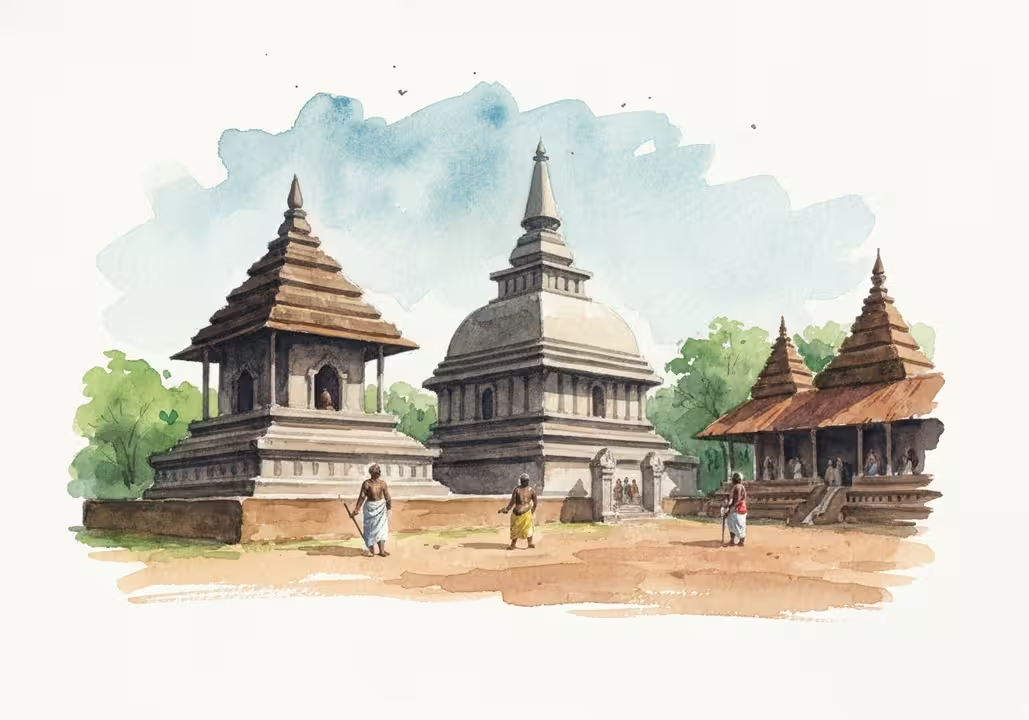
In the heart of ancient Anuradhapura, around 140 BCE, one of the most ambitious architectural projects in human history began to take shape. King Dutugemunu, fresh from his legendary victory over the Chola King Elara, turned his warrior’s determination toward a new conquest: the construction of a monument so magnificent that it would stand as an eternal symbol of Buddhist devotion and Sinhalese engineering prowess.
The Ruwanwelisaya, known also as the Mahathupa (Great Stupa), would become far more than a building. It would embody the very soul of a civilization, a physical manifestation of faith constructed through extraordinary technical ingenuity and collective devotion that would challenge the boundaries of what ancient engineers thought possible.
A King’s Sacred Vision
King Dutugemunu’s motivation for building the Ruwanwelisaya stemmed from deep religious devotion and a desire to create a monument worthy of housing sacred relics of the Buddha. According to the Mahavamsa, Sri Lanka’s great historical chronicle listed on UNESCO’s Memory of the World Programme, the king envisioned a stupa that would surpass all others in magnificence and spiritual significance. The structure would eventually house one dona (two quarts) of the Buddha’s corporeal relics, making it the largest collection of such relics anywhere in the world.
The Mahavamsa chronicles every detail of this monumental undertaking with remarkable precision, from the preparation of the ground to the final consecration ceremonies. This level of documentation was unprecedented for ancient construction projects, ensuring that the story of Ruwanwelisaya’s creation would be preserved for millennia. Without these meticulous records, the engineering achievements and spiritual significance of this great stupa might have been lost to time.
Engineering the Foundation: A Masterpiece Beneath the Surface
The true genius of Ruwanwelisaya’s construction lay in its foundation, a sophisticated multi-layered system that demonstrated remarkable understanding of structural engineering for the 2nd century BCE. According to the ancient Dipavamsa chronicle, King Dutugemunu employed an extraordinarily complex foundation system that would support the massive weight of the structure for over two millennia.
The foundation consisted of multiple protective and structural layers, each serving a specific purpose. The base began with chunam work and clay bricks laid over fine clay, followed by rough plaster. Over this came a layer of quartz, then a network of iron for structural reinforcement. Above the iron network, builders spread fragrant clay, then white stones, followed by rock-crystal, and slabs of stones. To waterproof and protect these layers, a mixture of mercury, resin of the wood-apple, and fine clay was spread over the stone slabs. Finally, bronze sheets eight inches thick were laid over these protective layers, creating an almost impenetrable barrier against the elements.
Additional layers included copper, silver, and even eight layers of rock stones, demonstrating that no expense was spared in ensuring the stupa’s longevity. This multi-material approach showed sophisticated understanding of load distribution, waterproofing, and structural integrity that would not be seen again in the region for centuries.
The Scale of Ambition
The original Ruwanwelisaya stood approximately 55 meters (180 feet) tall, with a base diameter of 91 meters. To put this in perspective, the structure required millions of bricks, each carefully crafted and laid by skilled artisans. The sheer volume of materials needed for construction was staggering, representing one of the largest brick structures ever attempted in the ancient world.
The stupa was constructed primarily of clay bricks, covered with lime plaster that gave it a characteristic gleaming white appearance visible for miles across the plains of Anuradhapura. The lime plaster not only protected the brick core from weathering but also created the stunning visual effect that made the structure appear to glow in the tropical sunlight.
At the base of the stupa, a raised platform was constructed, upon which the dome rested. This platform itself was a significant engineering achievement, designed to distribute the enormous weight of the structure evenly across the foundation. The entire complex was designed with both structural necessity and aesthetic beauty in mind, creating a harmonious blend of form and function.
An Army of Devoted Builders
The construction of Ruwanwelisaya mobilized thousands of laborers, artisans, and Buddhist monks who participated with great devotion. According to historical accounts, the work was considered a sacred act of merit-making, and workers approached their tasks with religious reverence rather than mere labor.
Buddhist monks played crucial advisory roles throughout the construction. When challenges arose, King Dutugemunu consulted with learned monks for solutions. Present at the laying of the foundation were several eminent monks from both Sri Lanka and India, including Indagutta Maha Thera, Dharmasena Maha Thera the great preacher, Mahadeva, Uttara Thera, and the learned Dhammarakkitha Maha Thera who had come from Jambudweepa (India).
According to legend, even supernatural forces contributed to the construction. The Mahavamsa recounts stories of divine interventions and miraculous events that aided in completing this massive project, reflecting the deep spiritual significance the stupa held for the ancient Sinhalese people.
One remarkable account tells of two novice monks (Samaneras) who were selected to bring special stones from Kuru Country in Northern India. They successfully transported six massive stones measuring 80 cubits in length and breadth and eight inches thick, an achievement that would have been extraordinarily difficult even with modern technology.
The chronicles even record that two female workers who labored on the Ruwanwelisaya were reborn in heaven after their deaths and later descended from heaven to pay homage to the completed stupa, demonstrating the belief in the spiritual merit gained through participating in its construction.
The Wall of Elephants: Symbols of Strength
One of the most distinctive features of the Ruwanwelisaya is the decorative elephant wall constructed by King Saddhatissa (137-119 BCE). This remarkable architectural element originally featured 400 sculpted elephants, 100 on each side, carved into the stone fence surrounding the stupa.
These elephants were not merely decorative. They symbolically supported the weight of the stupa, representing strength, stability, and guardianship of the sacred space. The elephants also held deep spiritual significance in Buddhism, as the elephant is associated with mental strength, dignity, and the Buddha himself.
A preserved section of the original elephant wall remains visible today just outside the Salapathala Maluwa (stone-paved upper terrace), offering modern visitors a glimpse of the ancient craftsmanship. Additionally, hundreds of full-sized elephant sculptures were integrated into the outer wall, creating a powerful visual statement about the stupa’s importance and permanence.
According to legend, a stone-carved replica of the entire Ruwanwelisaya stupa, lying on a platform surrounded by elephants and sculpted from a single rock, was created as a preliminary design for King Dutugemunu before the actual stupa was built, demonstrating the careful planning that preceded construction.
The Sacred Heart: Enshrining the Relics
The relic chamber at the center of Ruwanwelisaya represents the spiritual heart of the entire structure. King Dutugemunu personally supervised the installation of the Buddha’s relics with elaborate ceremony. According to the Mahavamsa, he circumambulated the relic chamber three times, entered it from the East, and placed the relic casket on a silver couch worth one koni, arranged on the North side.
The relics were placed atop a golden throne said to be crafted by Visvakarman, the divine artificer of Hindu mythology, and brought by Indra himself. The chamber was adorned with golden and silver caskets, and by royal order, the people of Sri Lanka enshrined thousands more relics alongside many precious objects. A Bodhi tree made of jewels was placed at the center, surrounded by countless jewels and pearls.
This extraordinary treasure chamber, which has never been archaeologically excavated, is believed to remain intact within the structure, a sealed time capsule of ancient devotion and craftsmanship. The sanctity of the relic chamber has been so scrupulously maintained that it remains undisturbed even during modern restoration efforts.
A King’s Farewell
As the great stupa neared completion, King Dutugemunu fell gravely ill. The monarch, who had devoted the latter part of his reign to this magnificent project, desperately wished to see his vision realized before death. However, the structure remained incomplete.
In one of the most poignant stories in Sri Lankan history, King Dutugemunu’s brother Saddhatissa devised a compassionate deception. He ordered workers to cover the entire dome in white cloth and construct the upper portion in bamboo painted in imitation gold. The dying king was then carried to the site to see what appeared to be the completed stupa.
The great King Dutugemunu, who had reigned for twenty-four years, had his record of meritorious deeds read to him. While gazing upon what he believed was his completed monument to Buddhism, he passed away peacefully, his final wish apparently fulfilled.
True to his brother’s vision, King Saddhatissa succeeded to the throne and completed the remaining work on the Great Stupa, ensuring that Dutugemunu’s legacy would stand for millennia. The completed stupa was consecrated with elaborate ceremonies befitting its status as one of Buddhism’s most sacred sites.
Centuries of Transformation
Over the centuries, successive kings renovated and expanded the Ruwanwelisaya. Through these additions, the stupa grew from its original height of 55 meters to its current impressive height of 103 meters (338 feet), with a circumference of 290 meters (951 feet). These renovations reflected both the ongoing devotion to the site and the desire of subsequent rulers to add their own contributions to this national and religious treasure.
However, by the 19th century, centuries of neglect had taken their toll. The great stupa was covered by wilderness, its white surface obscured by vegetation, its glory hidden beneath the jungle. The monument that had once dominated the landscape of Anuradhapura had been reclaimed by nature.
Modern Restoration: A Nation’s Devotion Renewed
The modern restoration of Ruwanwelisaya represents one of the most significant cultural preservation efforts in Sri Lankan history. In 1873, initial restoration efforts began, but it was the establishment of the Ruwanweli Seya Restoration Society in August 1902 by Venerable Naranvita Sumanasara Thera that truly launched the systematic restoration of the ancient monument.
The restoration project attracted extraordinary support from the Sri Lankan people. Most notably, Hendrick Appuhamy (also known as Heenagama Appuhamy), one of the largest landowners in 20th century Ceylon, donated Rs 20 million in 1912 for restoration works. This sum, approximately equivalent to 611 million USD in 2021 adjusted for inflation, represented one of the largest individual philanthropic contributions in Sri Lankan history.
The restoration was a monumental undertaking spanning 67 years. Thousands of workers carefully reconstructed damaged portions, re-plastered the surface, and restored the elephant wall and other architectural features. The project required not only financial resources but also archaeological expertise to ensure that restoration work remained faithful to the original design while employing modern techniques to ensure the structure’s longevity.
On June 17, 1940, the modern crowning of the stupa was completed, marking the culmination of decades of devoted labor. The restored Ruwanwelisaya once again gleamed white across the plains of Anuradhapura, reclaiming its place as one of Sri Lanka’s most important spiritual and architectural landmarks.
Legacy of the Great Stupa
Today, the Ruwanwelisaya stands as one of the world’s tallest ancient monuments and remains an active pilgrimage site drawing hundreds of thousands of devotees annually. The stupa represents far more than an architectural achievement; it embodies the continuity of Buddhist tradition in Sri Lanka, the technical sophistication of ancient Sinhalese civilization, and the enduring power of collective devotion.
The construction techniques employed in building Ruwanwelisaya, particularly its sophisticated multi-layered foundation system, influenced architectural practices throughout South and Southeast Asia. The stupa’s successful preservation of sacred relics for over two millennia demonstrates the effectiveness of ancient engineering solutions that modern science is only beginning to fully understand and appreciate.
The story of Ruwanwelisaya, from King Dutugemunu’s vision through centuries of transformation to modern restoration, illustrates the capacity of human ambition guided by faith to create works that transcend individual lifetimes. It stands as proof that the combination of spiritual devotion, technical expertise, and collective effort can produce monuments that speak across millennia.
As pilgrims circumambulate the great white dome today, following the same path that King Dutugemunu walked over two thousand years ago, they participate in an unbroken tradition that connects ancient and modern Sri Lanka. The Ruwanwelisaya remains not just a monument to the past, but a living testament to the enduring power of faith, community, and human creativity to shape the physical world in pursuit of the transcendent.