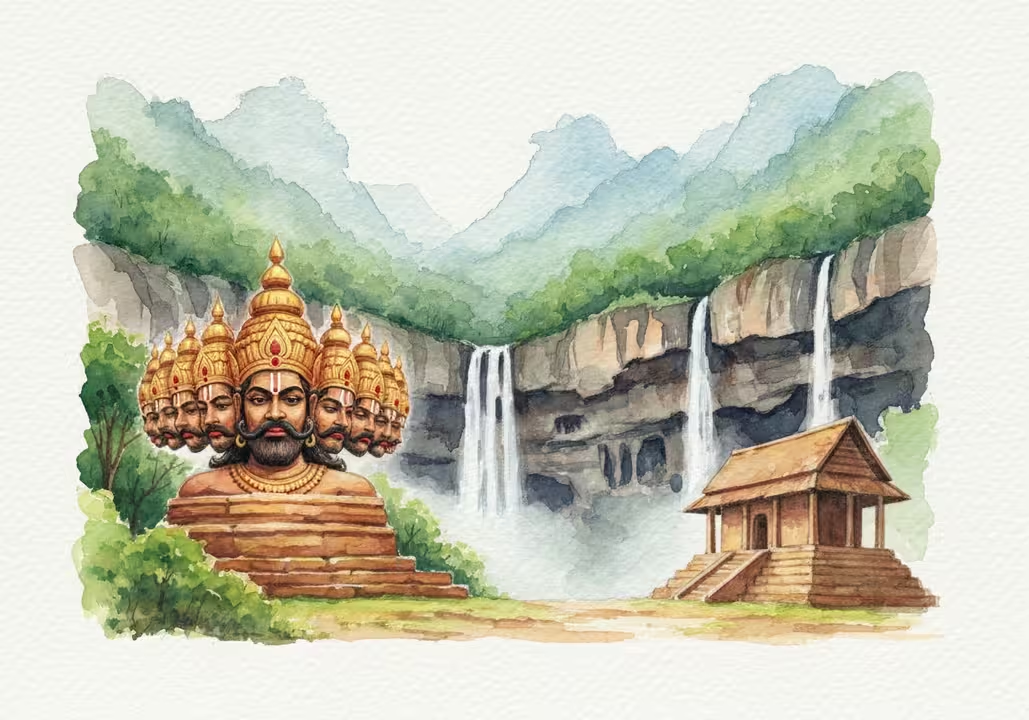
In the mist-shrouded highlands of Sri Lanka, where waterfalls cascade down ancient rock faces and caves bore deep into mountainsides, the legend of Ravana continues to captivate imaginations and spark scholarly debate. Was he the demon king of Hindu mythology, or a wise and powerful ruler of an advanced civilization? The story of Ravana stands at the fascinating intersection of mythology, folklore, and archaeological inquiry.
The Mythological Ravana
According to the ancient Hindu epic Ramayana, composed by the sage Valmiki between the 7th-5th or 5th-4th century BCE, Ravana was the principal antagonist—a ten-headed rakshasa (demon) king who ruled the kingdom of Lanka. His name, derived from Sanskrit meaning “roaring,” perfectly captured his fearsome reputation.
Yet Ravana was no simple villain. The epic portrays him as a complex figure of immense learning and power. He was well-versed in the six shastras (sciences) and the four Vedas, and is considered one of the most devoted followers of Lord Shiva. His ten heads, according to scholarly interpretation, symbolized his mastery of the six Shastras and four Vedas, representing his command over 64 types of knowledge and all arts of weaponry.
As a highly learned Brahmin, Ravana authored over a dozen texts including Arkaprakasha, Kumaratantra, and Ravana Samhita. He compiled the Sama Veda with musical notations and composed the famous Shiva Tandava Stotra, a devotional hymn still recited today. His intellectual capabilities were said to be ten times that of ordinary people.
The narrative of Ravana’s downfall centers on his abduction of Sita, wife of Prince Rama, which led to an epic war culminating in Ravana’s defeat. Yet even in death, the Ramayana acknowledges his greatness—Rama himself is said to have honored Ravana’s knowledge and devotion.
The Archaeological Quest
For those seeking tangible evidence of this legendary king, Sri Lanka offers numerous sites connected to Ravana’s story, though the archaeological reality proves far more complex than the myths suggest.
Ravana Ella Cave
Located near Ella in the Uva Province, the Ravana Cave sits 1,370 meters above sea level, measuring 50 feet wide, 150 feet long, and 60 feet high. Local legend claims Ravana used this cave to hide Sita during her captivity, as part of a network of caves and tunnels constructed for strategic purposes.
Excavations at Ravana Cave have indeed revealed evidence of human habitation—but dating back 20,000-25,000 years, far predating any possible historical Ravana. While the archaeological findings confirm ancient human presence, researchers note that nothing directly ties the site to Ravana himself.
Sigiriya: Ravana’s Palace or Kasyapa’s Fortress?
The magnificent rock fortress of Sigiriya, with its massive citadel adorned with intricate frescoes and sophisticated hydraulic systems, is sometimes associated with Ravana’s kingdom. The site’s monumental architecture and strategic location seem fitting for a legendary king.
However, archaeological evidence tells a different story. Sigiriya’s citadel was built by King Kasyapa in the 5th century CE—nearly 2,000 years after the Ramayana’s estimated setting. Some scholars suggest that caves in the Sigiriya region contain ancient paintings depicting scenes from the Ramayana, including the abduction of Sita, though these murals date to ancient times rather than the events they portray.
Other Associated Sites
Sita Kotuwa in Hasalaka is believed to be one of the first places where Ravana held Sita captive. Archaeological remains such as foundations of buildings, walls, and ponds are visible in the area, though their connection to the Ramayana remains speculative.
In 2012, a team from the Archaeological Department of Sri Lanka mapped Ravana’s mythical sites for cultural tourism purposes but reached a sobering conclusion: none could be definitively authenticated.
The Scholarly Perspective
Modern scholarship approaches the Ravana question with careful nuance. H.D. Sankalia, a pioneer of Indian archaeology, noted that none of the surviving Ramayana manuscripts predate the eleventh century CE, indicating that current versions are late codifications of older oral narratives.
Yardi, in his statistical study “The Ramayana: Its Origin and Growth,” claims the original Valmiki Ramayana contained only 8,121 verses, compared to the critical edition’s 17,868 verses, suggesting extensive later interpolations and additions.
Most scholars agree that Rama, Hanuman, and Ravana probably never met in historical reality. Valmiki likely used the story of an unnamed king, preserved in the Anamaka Jataka, as a foundation to weave these characters into a single narrative. Notably, Buddhist versions of the story do not include Sita’s abduction or Ravana at all, suggesting the character evolved over time.
The critical finding remains unchanged: there is no definitive inscription or artifact in Sri Lanka explicitly mentioning Ravana.
Cultural Reinterpretations: Hero or Villain?
What makes Ravana truly fascinating is how different cultures interpret his legacy. In India, effigies of Ravana are burned on Vijayadashami to symbolize Rama’s triumph over evil. For two thousand years, the Ramayana has profoundly influenced Indian culture, politics, religion, and art.
Yet in Sri Lanka, Ravana’s story takes on different dimensions. In recent decades, he has been reinterpreted as the Hela king, symbolizing an ancient Sri Lankan history distinct from Indian influences. Many Sri Lankan Hindus and Buddhists developed a sympathetic view of Ravana’s character from the 14th century onwards, depicting him as a wise and powerful ruler with exceptional intellect and prowess—a formative figure of civilizational antiquity.
Some Sri Lankan communities claim descent from Ravana, and caves like Ravana Ella remain important to living traditions. Many Sinhala Buddhists believe Ravana was a real historical figure who ruled Sri Lanka, though this conviction rests on cultural tradition rather than archaeological evidence.
As Hinduism and Buddhism spread throughout Southeast Asia, Ravana’s legend underwent further transformations. Different regions adapted his story to local mythologies—in some Southeast Asian cultures, he is revered as a hero or noble figure; in others, he remains the embodiment of evil.
The Enduring Mystery
The story of Ravana illustrates a fundamental truth about ancient history: the line between myth and reality often blurs beyond recovery. While archaeological evidence has not confirmed Ravana’s historical existence, the sites associated with him reveal genuine ancient human activity and sophisticated civilizations in Sri Lanka.
Perhaps the more important question is not whether Ravana existed, but why his legend endures. His story explores timeless themes: the corruption of power, the complexity of knowledge without wisdom, the fine line between devotion and obsession. As Ravana lay dying in the epic, one of his greatest regrets was possessing all this knowledge yet being unable to harness his powers for good.
Today, Ravana-related sites remain important cultural and tourist destinations in Sri Lanka, blending mythology with archaeological findings of ancient human habitation. They serve as reminders that history and legend are not always opposed—sometimes, legends preserve cultural memory in ways that pure archaeology cannot capture.
Whether demon or king, villain or hero, Ravana’s legacy continues to influence South Asian culture, art, and scholarly discourse. In the absence of definitive proof, he remains what he has always been: a powerful story that reveals as much about those who tell it as about the legendary king himself.