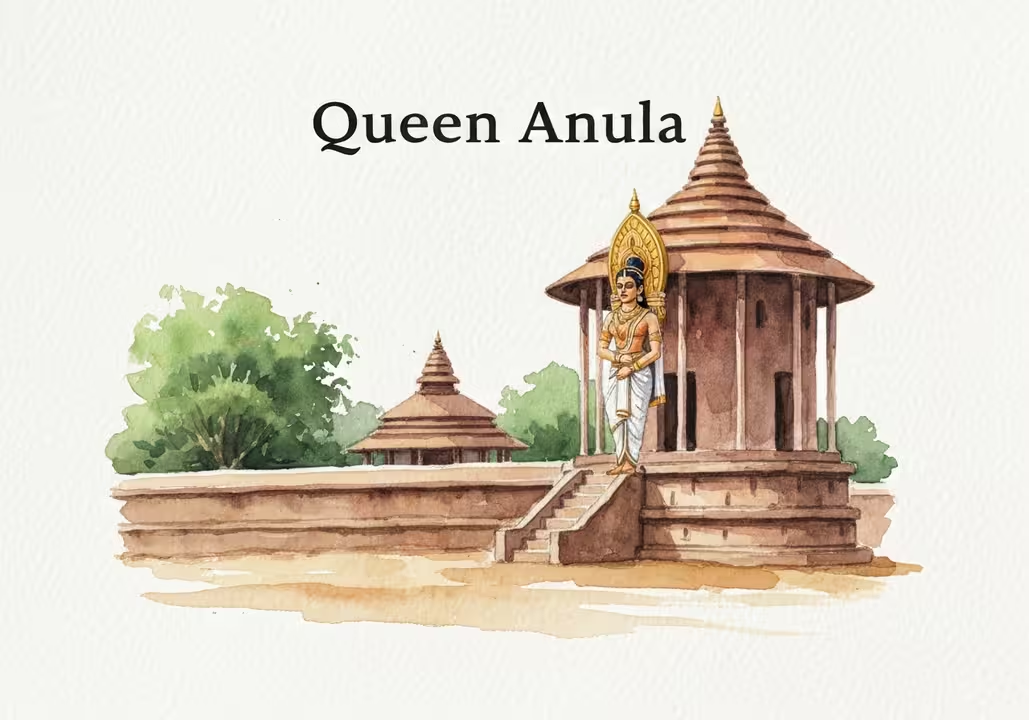
In the tumultuous first century BCE, as the ancient kingdom of Anuradhapura struggled through political instability and religious conflict, a woman seized the throne and became the first documented female head of state in all of Asia. Her name was Anula, and her five-year reign would spark controversy that echoes through the centuries—not merely for what she did, but for how her story was told.
A Kingdom in Turmoil
To understand Queen Anula’s rise to power, one must first understand the chaos that gripped Anuradhapura in the decades before her reign. The kingdom had endured waves of Tamil invasions from South India, which forced King Valagambahu to flee his throne in 103 BCE, a mere five months after his coronation. For fourteen years, seven Tamil chieftains ruled parts of the island before Valagambahu finally reclaimed his kingdom in 89 BCE.
But Valagambahu’s restoration brought little stability. His reign witnessed fierce doctrinal disputes between two powerful Buddhist monastic institutions: the conservative Mahavihara and the more progressive Abhayagiri. This religious schism would prove crucial to how history would later judge his descendants—including his grandson’s wife, Anula.
When Valagambahu died, the throne passed through his lineage, eventually reaching his grandson, Chora Naga (also known as Coranaga), who ruled from 62 to 50 BCE. It was Chora Naga who took Anula as his queen consort, bringing her into the inner circle of Anuradhapura’s royal power.
The Path to Power
What happened next has been recorded primarily in the Mahavamsa, a historical chronicle written by Buddhist monk Mahanama in the fifth or sixth century CE—some 500 years after Anula’s death. According to this account, Anula was not content to remain a mere consort. The chronicle paints her as ambitious and ruthless, claiming she poisoned her husband Chora Naga to clear her path to power.
After Chora Naga’s death in 50 BCE, his brother Kuda Tissa ascended to the throne and, according to the Mahavamsa, married Anula. His reign lasted only three years before he too died—allegedly by poison administered by his wife. What followed was an extraordinary period that the chronicle describes with evident disapproval: between 47 and 42 BCE, four more men briefly held the throne, each connected to Anula, and each meeting an untimely end.
The Mahavamsa names them: Siva, described as a palace guard; Vatuka, a carpenter; Darubhatika Tissa, a woodcutter; and Niliya, a palace Brahmin. According to the chronicle, Anula poisoned each of these men in turn, all within the span of a single year. After Niliya’s death, she dispensed with the pretense of male rule entirely and claimed the throne for herself, becoming queen regnant of Anuradhapura around 47 BCE.
A Reign Shrouded in Mystery
For approximately four to five years, Queen Anula ruled the kingdom of Anuradhapura in her own right. Remarkably, given the sensational accusations that preceded her sole rule, the Mahavamsa provides almost no details about what actually happened during her reign. There is no mention of political instability, no record of failed governance, no accounts of rebellions or economic collapse—the typical metrics by which ancient chronicles judged their rulers.
This silence is deafening. If Anula had been the chaotic, destructive force the chronicle implies through its lurid accounts of her personal life, surely her reign would have been marked by disorder. Instead, the historical record suggests a kingdom that continued to function, albeit one ruled by a woman—a reality that seems to have troubled the chroniclers more than any actual policy failures.
According to an alternative text called the Shramana Dootha Kavya, composed by a monk from the Abhayagiri monastery, Anula was crowned as queen with the acceptance and support of the kingdom’s generals—a detail conveniently omitted from the Mahavamsa. This same text reports that Anula performed religious rituals at Abhayagiri, indicating her support for that monastic faction rather than the Mahavihara.
The Fall of the Queen
Anula’s reign ended violently in 42 BCE when Kutakanna Tissa, the second son of King Mahaculi Mahatissa, who had fled Anuradhapura fearing Anula’s power, returned with an army. He invaded the royal palace and overthrew the queen after she had ruled alone for what some sources describe as “just four months”—though this may refer only to a specific period rather than her entire independent reign.
The Mahavamsa’s account of Anula’s death is as damning as its portrayal of her life. The chronicle states that Kutakanna Tissa “burned the licentious Anula in the palace.” Scholars debate whether this means she was killed and then cremated on a funeral pyre, or whether she was burned alive—a particularly brutal form of execution. After securing the throne, Kutakanna Tissa burned down the queen’s palace and built himself a new one, as if to purge the kingdom of her memory. He would go on to rule for twenty-two years.
The Question of Truth
Everything we know about Queen Anula comes from sources written centuries after her death, primarily the Mahavamsa, and this presents a fundamental problem for historians. The Mahavamsa was composed by monks affiliated with the Mahavihara monastery—the very institution whose rival, Abhayagiri, Anula had supported. The chronicle had already demonstrated its bias by referring to Anula’s first husband, Chora Naga, as a “thief” because he had demolished eighteen temples that opposed him and did not follow the Mahavihara sect.
Significantly, there is no archaeological or epigraphic evidence—no inscriptions, no artifacts, no independent verification—of Anula’s existence or her alleged crimes. As one modern analysis notes, “epigraphy, art, and archaeology seem to be completely silent with regards to Anula.” We have only the word of chroniclers writing centuries later with clear sectarian motivations.
The Mahavamsa itself is a problematic source. While it preserves invaluable historical information, scholars have long recognized that it blends historical fact with mythology and serves religious and political purposes. Large portions of the text deal more with the history of Buddhism than with Sri Lanka’s political or social history, and its reliability on many matters has been questioned by historians.
A Woman Who Broke the Rules
Modern scholarship has begun to reexamine Anula’s story with a more critical eye. What emerges is not necessarily the vindication of a saintly queen wrongly maligned, but rather a more nuanced understanding of how powerful women were portrayed in ancient chronicles—and what those portrayals reveal about the societies that created them.
Consider what the Mahavamsa inadvertently tells us: Anula chose partners from outside the traditional aristocracy—commoners, lower-caste men, even non-aristocratic individuals. In the rigid social hierarchy of ancient Anuradhapura, this was revolutionary and deeply threatening. She rejected the expectation that she would marry another high-ranking nobleman and instead exercised her own agency in choosing partners—and ultimately in dispensing with male partners entirely.
The chronicle’s obsessive focus on Anula’s personal relationships and alleged sexual misconduct follows a pattern familiar to historians who study powerful women throughout history. When a woman wielded power in ways that violated social norms, ancient (and not-so-ancient) chroniclers often attacked her through her sexuality and personal life rather than through documented failures of governance.
Legacy and Historical Memory
Queen Anula ruled Anuradhapura nearly 2,000 years ago, making her one of the earliest female heads of state in recorded Asian history. Yet her legacy remains contested, caught between a chronicle written by her political and religious opponents and the scant material evidence available to modern scholars.
Was she a ruthless poisoner who murdered six men to seize power? A capable ruler whose unconventional path to the throne and support for the “wrong” Buddhist faction earned her posthumous vilification? Or something more complex—a woman navigating the treacherous waters of royal politics in an era when female power was itself seen as transgressive?
The truth is that we may never know with certainty. What we can say is that Anula’s story—both what was recorded and what was left unrecorded—reveals the power of historical narrative. The Mahavamsa’s account has shaped how she is remembered for centuries, branding her as a figure of moral corruption rather than examining her as a political actor in her own right.
In recent years, scholars have increasingly questioned whether the historical record has been fair to Sri Lanka’s queens. The absence of any mention of political chaos or governance failures during Anula’s reign, combined with alternative accounts of her having support from military generals, suggests that her rule may have been more legitimate and stable than the Mahavamsa admits.
Queen Anula remains a controversial figure, but perhaps the most important question is not whether she was good or evil, but rather: whose story are we hearing, who chose to tell it that way, and what were their reasons for doing so? In answering that question, we learn not only about one ancient queen, but about how power, gender, and historical memory intersect across the centuries—lessons that remain remarkably relevant in our own time.
Her brief reign stands as a reminder that history is not merely a record of what happened, but a narrative constructed by those who survived to write it. And sometimes, the most powerful women in history are the ones whose stories were written by their enemies.