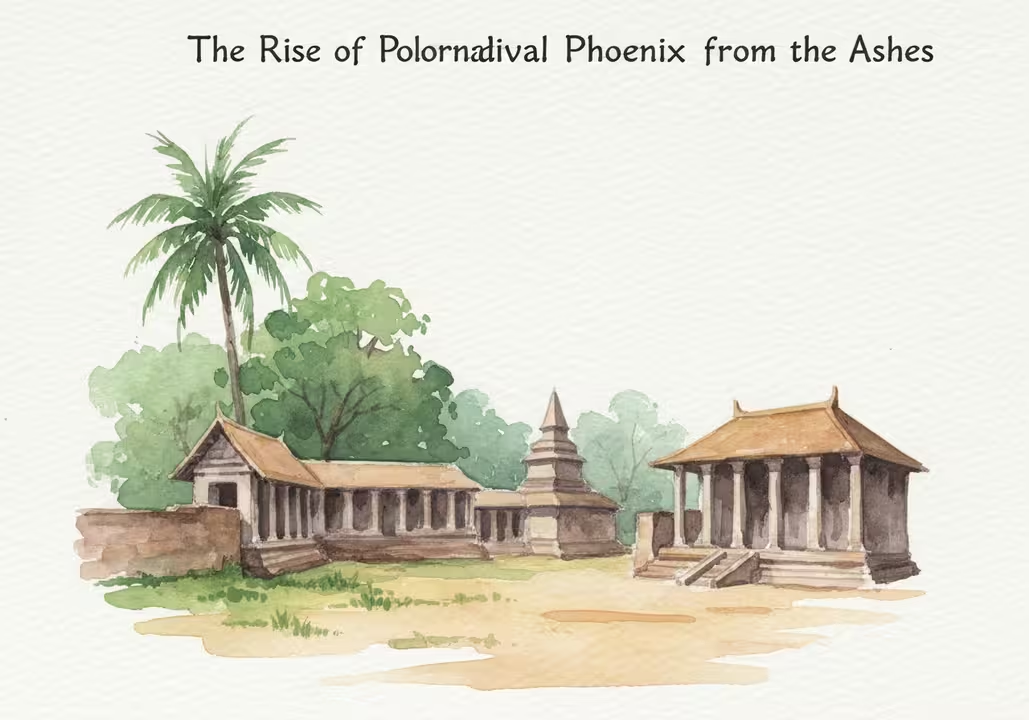
In the year 993 CE, the ancient city of Anuradhapura, which had served as Sri Lanka’s capital for over thirteen centuries, faced its darkest hour. The mighty Chola emperor Rajaraja I swept across the northern plains with devastating force, and the Culavamsa—the Great Chronicle of Sri Lanka—records that the sacred capital was “utterly destroyed in every way by the Chola army.” The streets that had witnessed the construction of magnificent stupas, the ceremonies of over a hundred kings, and the flowering of Buddhism itself, now lay in ruins. Yet from this catastrophe would emerge a new capital, one that would create some of the most spectacular achievements in medieval Sri Lankan history.
Birth of a Capital Under Foreign Rule
As smoke still rose from the ruins of Anuradhapura, the Chola conquerors made a strategic decision that would alter the course of Sri Lankan history. Rather than attempt to rebuild the devastated ancient capital, they moved their administrative center to Polonnaruwa, a settlement approximately 100 kilometers to the southeast. The location offered distinct military advantages—it was easier to defend and closer to the eastern ports that connected them to their South Indian homeland. They renamed it “Jananathamangalam” after their emperor, and for three-quarters of a century, this corner of Lanka would remain under the iron grip of the Chola dynasty.
The occupation that followed was not merely political. When Rajendra Chola I, son of Rajaraja, launched another massive campaign in 1014 CE, most of the island fell under Chola control. By 1017 CE, the conquered territories were formally incorporated as a province of the Chola Empire. For the Sinhalese people, these decades represented not just foreign rule, but a profound disruption of their Buddhist civilization and cultural identity. Temples were neglected, monasteries abandoned, and the ancient traditions that had defined the island’s character for centuries seemed destined for extinction.
The Liberation: Vijayabahu I and the Restoration
Yet resistance simmered beneath the surface. In the mid-11th century, a prince from Rohana in the southern reaches of the island began a campaign of liberation that would become legendary. For seventeen long years, Vijayabahu I fought a guerrilla war against the occupiers, rallying forces, building alliances, and gradually pushing northward. Finally, in 1070 CE, he achieved what had seemed impossible—the complete expulsion of Chola forces from Sri Lankan soil.
When the dust of battle settled, Vijayabahu I faced a crucial decision. He could return to Anuradhapura and attempt to revive the ancient capital, or he could embrace the new reality. With pragmatic wisdom, he chose the latter. Though he had himself crowned at Anuradhapura in deference to tradition, he established his permanent capital at Polonnaruwa. The strategic advantages that had appealed to the Cholas—defensibility and access to trade routes—made equal sense for a reunited kingdom that still faced potential threats from South India.
Vijayabahu I’s forty-year reign focused on healing the wounds left by foreign occupation. His priority was the restoration of Buddhism, which had suffered grievously during the Chola years. He invited monks from Burma (modern Myanmar) to reestablish the higher ordination, which had lapsed on the island. Temples and monasteries that had fallen into disrepair were renovated and endowed with lands and resources. The king understood that rebuilding the physical structures of religion was inseparable from rebuilding the nation’s soul.
The Golden Age: Parakramabahu the Great
If Vijayabahu I laid the foundations, it was his successor Parakramabahu I who would construct the magnificent edifice of Polonnaruwa’s glory. Ascending the throne in 1153 CE after consolidating power through strategic marriages and military campaigns, Parakramabahu I would reign for thirty-three transformative years that historians still regard as the zenith of medieval Sri Lankan civilization.
The king’s vision extended far beyond mere restoration. His famous dictum—that not a single drop of water that falls from the sky should flow into the sea without first serving humanity—encapsulated an ambitious program of agricultural development. The crowning achievement was the Parakrama Samudra, a massive artificial reservoir covering some 6,000 acres. This engineering marvel, created by connecting multiple smaller tanks with sophisticated canals and embankments, transformed the region into a fertile agricultural heartland. Even today, nearly a millennium later, the waters of the Parakrama Samudra continue to irrigate the fields around Polonnaruwa.
But Parakramabahu’s ambitions reached beyond irrigation. The royal palace he constructed was, according to contemporary chronicles, a seven-story wonder containing a thousand chambers. While the upper floors have long since crumbled, the surviving walls—standing some 80 feet high and 12 feet thick, extending 170 feet in length—still convey the structure’s imposing grandeur. This was architecture meant to awe, to demonstrate that Polonnaruwa could rival any capital in the known world.
The king’s patronage of Buddhism produced monuments of exquisite beauty. The Gal Vihara, originally known as Uttararama or “the northern monastery,” stands as perhaps the finest expression of Sinhalese rock sculpture. Here, carved from a single granite cliff face, four images of the Buddha capture different moments and moods: a large seated figure in meditation, a smaller seated Buddha within an artificial cave, a standing figure, and a magnificent reclining Buddha measuring over 46 feet in length, depicting the parinirvana—the Buddha’s final passing into nirvana. According to the renowned archaeologist Senarath Paranavithana, these statues were originally gilded, their golden surfaces gleaming in the tropical sun.
Parakramabahu I also convened a great council of monks at the Uttararama to reform and purify the Buddhist priesthood. The result was a historic unification of the island’s various monastic traditions under the orthodox Mahavihara tradition of Theravada Buddhism. Rock inscriptions still preserve the code of conduct established for monks, a testament to the king’s determination to strengthen religious institutions alongside secular ones.
The prosperity and strength of his kingdom allowed Parakramabahu to project power beyond the island’s shores. He launched military expeditions against the Pandyan kingdoms of South India, sent forces to aid his allies in Burma, and maintained diplomatic relations with distant lands. Chronicles describe ships laden with goods sailing from Polonnaruwa’s ports, weaving the island into the vibrant commercial networks of medieval Asia.
The Final Flowering: Nissanka Malla
After Parakramabahu’s death in 1186 CE, the kingdom experienced a brief period of instability before another remarkable monarch emerged. Nissanka Malla, who claimed descent from the ancient Kalinga dynasty and traced his lineage to Prince Vijaya himself, seized power in 1187 CE. Though his nine-year reign was short, it produced a final burst of architectural creativity.
Nissanka Malla’s constructions reflected both ambition and devotion. The Rankot Vihara, the fourth largest stupa in all of Sri Lanka, rose skyward as a golden dome visible for miles around. The Hatadage, a house built specifically to enshrine the sacred Tooth Relic of the Buddha, emphasized Polonnaruwa’s status as a center of Buddhist civilization. Perhaps most distinctive was the Nissanka Lata Mandapaya, an elegant pavilion where the king is said to have listened to Buddhist texts being chanted, its stone pillars carved to resemble lotus stems in full bloom.
Unlike his predecessor, Nissanka Malla focused on winning popular support through generosity rather than grand projects. He significantly reduced the heavy taxes imposed during Parakramabahu’s ambitious building programs, and distributed money, gold, cattle, and land to the people. His religious devotion led him to send Buddhist missionaries to Cambodia, helping to spread Theravada Buddhism throughout Southeast Asia. He even undertook a major refurbishment of the ancient Dambulla cave temple, gilding its interior so lavishly that it earned the name “Swarnagiri”—the golden rock.
Yet for all his efforts, Nissanka Malla could not establish a stable succession. When he died in 1196 CE, the kingdom plunged into chaos as rival claimants fought for the throne. The era of great kings had ended, and what followed was a procession of weak rulers unable to maintain the unity and strength that had made Polonnaruwa great.
The Catastrophe: Magha’s Invasion
The death blow came from an unexpected quarter. In 1214 CE, a warrior named Kalinga Magha set sail from the Kalinga region of eastern India with a force of 24,000 soldiers packed into a hundred ships. This was no ordinary raid. Magha came not to conquer and rule, but to destroy.
What followed was unlike any previous invasion in Sri Lankan history. While earlier conquerors like the Cholas had occupied territory and extracted tribute, Magha’s forces engaged in systematic devastation. Polonnaruwa, which had stood as a jewel of medieval civilization, was sacked and its population massacred. The great monuments were looted, religious sites desecrated, and the sophisticated irrigation systems that had sustained the region’s prosperity deliberately destroyed.
Magha’s “reign of terror,” as the chronicles describe it, lasted until 1255 CE—forty-one years of chaos that shattered not just a kingdom, but an entire civilization. The mass slaughter and destruction prompted a massive migration of survivors southward into the more mountainous interior regions. The Rajarata basin—the “King’s Country” of the northern dry zone that had supported Sri Lankan civilization for fifteen centuries, from Anuradhapura through Polonnaruwa—was effectively abandoned.
In 1232 CE, even before Magha’s final defeat, the Sinhalese resistance under Vijayabahu III had already established a new capital at Dambadeniya, some 70 miles southwest of Polonnaruwa. It marked an epochal shift in Sri Lankan history. Never again would the northern plains host the island’s capital. The era of great hydraulic civilizations sustained by elaborate irrigation networks had ended. What followed would be a period of smaller kingdoms in the wet zone of the southwest, marking what historians call the Transitional Period of Sri Lankan history.
Legacy of a Medieval Glory
Today, Polonnaruwa stands as one of Sri Lanka’s most visited archaeological sites, recognized by UNESCO as a World Heritage Site since 1982. The ruins that remain—royal palaces, soaring stupas, intricately carved stone temples, and the serene rock sculptures of the Gal Vihara—speak of an era when this city rivaled the great capitals of medieval Asia.
But beyond the stones and monuments, Polonnaruwa’s true legacy lies in what it represented: the resilience of a civilization that could rise from the ashes of Anuradhapura’s destruction, achieve new heights of artistic and engineering excellence, and establish a kingdom that would be remembered a millennium later. For roughly 160 years, from Vijayabahu I’s liberation in 1070 to the final abandonment in 1232, this capital witnessed the best of medieval Sri Lankan culture—its administrative sophistication, architectural genius, hydraulic engineering, religious devotion, and military prowess.
The fall of Polonnaruwa also serves as a sobering reminder of civilization’s fragility. A kingdom that seemed invincible under Parakramabahu I, capable of sending armies across the seas and engineering marvels that transformed landscapes, proved unable to withstand the perfect storm of internal divisions and external invasion. The irrigation systems that took generations to build were destroyed in years. The population centers that had thrived for centuries dispersed in a matter of decades.
Yet the memory endured. In later centuries, as new kingdoms rose in the south and southwest, they looked back to Polonnaruwa as a golden age, a standard of achievement to aspire to. The artistic styles pioneered in its temples influenced Sri Lankan art for centuries. The administrative systems developed by its kings provided templates for governance. And the ruins themselves, even in their decay, continued to inspire awe and national pride.
As the sun sets over the still waters of the Parakrama Samudra, casting long shadows across the ancient stones, Polonnaruwa remains a testament to both the heights of human achievement and the inexorable cycles of history. It rose as a phoenix from Anuradhapura’s ashes, blazed brilliantly for a few remarkable generations, and then passed into memory—leaving behind monuments that continue to tell the story of medieval Sri Lanka’s most glorious era.