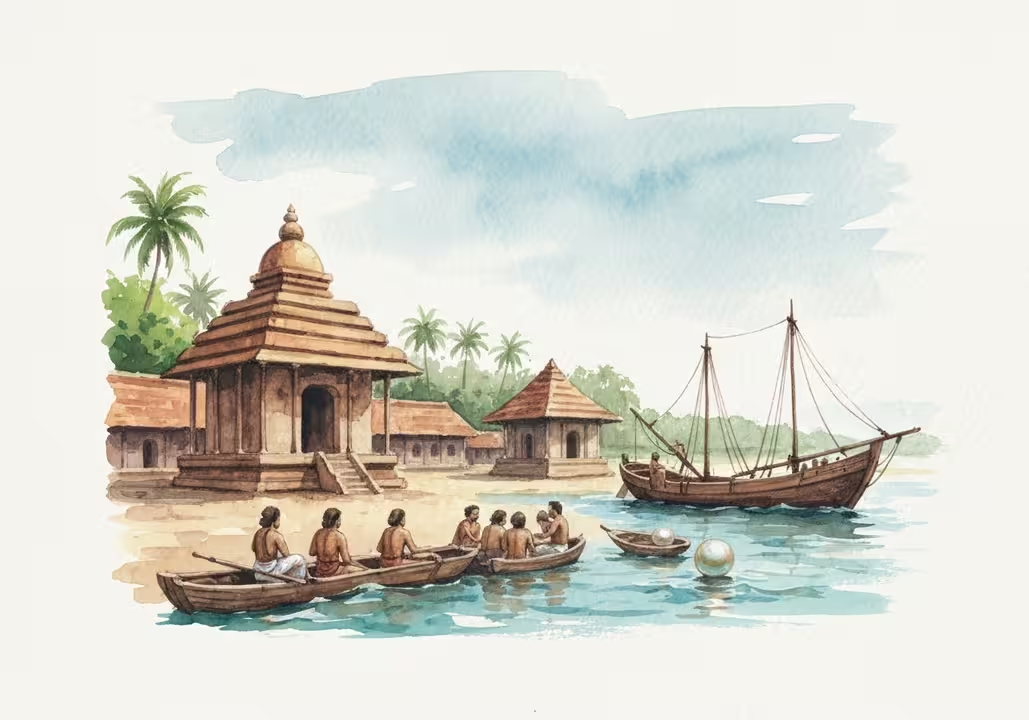
For more than three thousand years, the waters of the Gulf of Mannar shimmered with a promise more precious than gold. Beneath the waves, in beds stretching between the northwestern coast of Ceylon and southeastern India, pearl oysters grew in abundance, each potentially harboring a gem that could adorn a king or finance an empire. The pearl fisheries of Mannar were not merely an economic resource—they were a phenomenon that shaped dynasties, attracted colonial powers, and left an indelible mark on the maritime history of South Asia.
Ancient Treasures of the Deep
The story of Mannar’s pearls begins in the mists of antiquity, more than 3,500 years ago. Archaeological evidence, recently uncovered through systematic excavations of shell middens around the Gulf of Mannar, confirms that the pearl oyster Pinctada fucata was exploited from as early as the tenth century CE, with the industry’s high impact lasting through the nineteenth century. Yet historical records suggest the tradition stretches back much further into prehistory.
By the third century BCE, the fame of these pearls had reached distant shores. Megasthenes, the Greek ambassador to the court of Chandra Gupta, made a bold assertion that would echo through history: Ceylon’s pearls were not only larger and of better quality than those from India, but they surpassed even the renowned gems of the Persian Gulf. The Roman philosopher Pliny the Elder, writing in the first century CE, described the Mannar fishery as the world’s most productive, and with good reason—pearls from this region became the most expensive animal product imported by the Roman Empire.
The anonymous author of the Periplus of the Erythraean Sea, a merchant’s guide from the first century CE, documented the robust Western market for these oriental gems. For the Romans, who prized pearls above all other jewels, the luminous spheres from Mannar represented the ultimate luxury, adorning emperors and wealthy patricians alike.
The Tamil kings recognized the extraordinary value of this maritime treasure. Over three thousand years ago, pearls became one of the principal sources of revenue for the Pandyan dynasty, whose magnificent port city of Korkai served as the center of the pearl trade. Here, in bustling markets overlooking the sea, merchants from across the known world gathered to bid on the season’s harvest. Beyond their market value, seed pearls became symbols of plutocratic excess, used by kings and elites for religious offerings and personal adornment.
When Marco Polo arrived in Ceylon in the thirteenth century on his return journey from China to Venice, he too was captivated by the pearl fishing he witnessed in the Gulf of Mannar. His detailed accounts describe the fisheries operating from the beginning of April until the middle of May, following patterns that had remained unchanged for centuries.
The Dangerous Art of Pearl Diving
The extraction of these treasures required extraordinary human courage and endurance. Pearl diving was a perilous profession, demanding skills passed down through generations. Divers—often women in ancient times—would prepare their bodies by coating themselves in oil or grease to retain heat in the cold depths. They plugged their ears with greased cotton to protect against the crushing pressure and equipped themselves with heavy stones weighing up to fifteen kilograms to speed their descent.
Using a technique known as freediving, divers would descend into the middle of the Gulf, plunging to depths of thirty meters or more on a single breath. The stone weight carried them down rapidly to the oyster beds, where they had precious seconds to gather as many oysters as possible in nets or large baskets before their lungs demanded they return to the surface. The entire dive might last five minutes—five minutes when a miscalculation could mean death.
The work was exhausting and dangerous. Divers faced the constant threat of drowning, decompression sickness, shark attacks, and the insidious effects of repeated pressure changes on their bodies. Yet the lure of profit—and often the necessity of survival—compelled generation after generation to take up this hazardous trade.
The Era of Colonial Exploitation
The pearl banks that had sustained local kingdoms for millennia soon attracted more predatory attention. From 1215 to 1619, the pearl fisheries on the Sri Lankan side of the Gulf came under the exclusive control of the Jaffna kingdom, save for a brief interruption from 1450 to 1467 when the Sinhalese king Sapumal Kumaraya of the Kotte kingdom subdued the region. This indigenous control would not last.
When Portuguese forces finally conquered the Jaffna kingdom in 1619, the entire pearl fishery on both the Sri Lankan and Indian sides of the Gulf fell under their exclusive jurisdiction. The Portuguese, who had initiated extensive pearl fisheries as early as 1560 CE, exploited the resources to their fullest extent. So intense was their extraction that archaeological evidence points to long-term abandonment of fishing grounds in Sri Lanka by the 1640s—a testament to the environmental devastation wrought by colonial greed.
Control passed to the Dutch in 1658 when the Jaffna fort fell to their forces. The Dutch East India Company brought a different approach to the fishery, attempting to balance exploitation with sustainability. They organized pearl oyster fishing in the Gulf of Mannar every three years, believing this interval gave sufficient time for oyster populations to regenerate and reach maturity. Yet even this seemingly rational approach proved inconsistent—between 1658 and 1690, out of thirty-three years, only ten pearl fisheries were organized, most concentrated in the 1660s.
The British, who assumed control in 1796, brought the most systematic and efficient exploitation to the fisheries. By the mid-nineteenth century, the British colonial state exercised monopoly control over the entire industry. They streamlined extraction methods, merged management of the Gulf of Mannar and Persian Gulf fisheries, and implemented rigorous marketing that increased global demand. The financial returns were staggering. From March 1828 to May 1837 alone, over £227,000 flowed into the Ceylon Treasury from pearl fisheries—a fortune in contemporary terms. In years when successful fisheries were held, pearl revenues outweighed all other colonial monopolies, including the famous cinnamon trade.
The scale of the operation during peak years was extraordinary. A fishery was convened seasonally over a four- to six-week period in the lull between monsoons, timed to coincide with oyster spawning periods and navigable seas. The temporary pearl fishing camps swelled to populations of fifteen thousand people, including divers, haulers, indentured workers, bazaar-keepers, colonial police, medical staff, and spectators. These seasonal cities materialized like mirages on the coast, bustling with commerce and danger, then vanished when the season ended.
The 1891 fishery yielded £96,370, the second-highest return of the nineteenth century. But the early twentieth century saw even more spectacular hauls—£71,050 in 1904, and a record-breaking £251,073 in 1905. These revenues represented not just numbers in colonial ledgers, but countless oysters ripped from the seabed, countless divers risking their lives, and an ecosystem pushed to its breaking point.
The Collapse of an Industry
The very efficiency that made the colonial pearl fisheries so profitable contained the seeds of their destruction. Overexploitation contributed to the decline of oyster populations throughout the Gulf of Mannar. The colonial powers’ relentless extraction created what historians now recognize as an unprecedented environmental disaster, with impacts that persist to this day.
Yet the final blow came not from overfishing alone, but from human innovation in an unexpected quarter. In the early twentieth century, Japanese researchers perfected the technique of culturing pearls—growing them artificially in farmed oysters. This breakthrough marked the beginning of the rapid decline of traditional natural pearl production. Why wait for nature’s uncertain bounty when science could produce pearls on demand?
The British colonial administration attempted to save the industry by applying modern scientific principles to fishery management. They mapped oyster beds, studied population dynamics, and tried to rationalize the fishery along capitalist lines. But the ocean refused to be tamed. The natural unpredictability of oyster populations, the complex interactions of the marine ecosystem, and the impact of various organisms like boring sponges and parasitic tapeworms on oyster health defied their models and management schemes.
The Ceylon pearl fishery was abandoned in 1925 after these industrialization efforts failed and floundered. The sea, it seemed, could not be made to conform to colonial spreadsheets and five-year plans. Small-scale, sporadic fishing continued for decades, but the great seasonal fisheries—those temporary cities, those massive hauls, those fortunes won and lost—were gone forever. The last pearl fishery in Sri Lanka stopped operating in 1983, signaling the end of an industry that had endured for more than three millennia.
Legacy of the Pearl Banks
Today, the pearl fisheries of the Gulf of Mannar exist only in historical records, archaeological sites, and fading memories. The shell middens that archaeologists now excavate tell stories of an industry that connected ancient Tamil kingdoms to Roman emperors, that survived the rise and fall of empires, and that ultimately could not withstand the combined pressures of colonial exploitation and technological change.
The legacy of Mannar’s pearls extends beyond economics. These fisheries shaped settlement patterns, trade networks, and political relationships across the Indian Ocean world for millennia. They brought diverse peoples together in seasonal labor and commerce, created specialized knowledge systems passed down through generations of divers, and generated wealth that funded temples, armies, and kingdoms.
But the story of the pearl fisheries also serves as a cautionary tale about resource exploitation and environmental limits. The oyster beds that once seemed inexhaustible proved vulnerable to human greed. The traditional practices that had sustained the fishery for thousands of years gave way to industrial extraction that destroyed what it sought to profit from. The Gulf of Mannar still exists, still harbors marine life, but the legendary pearl banks that made it famous are silent, depleted reminders of what happens when short-term gain overrides long-term sustainability.
The lustrous pearls that once adorned Roman senators, Tamil kings, and European nobility came at a cost measured not just in the dangerous labor of divers, but in the slow degradation of a marine ecosystem. In the end, the ocean kept the last and most valuable treasure for itself—not a perfect pearl, but a lesson about the limits of exploitation and the price of forgetting that some riches, once exhausted, can never be recovered.