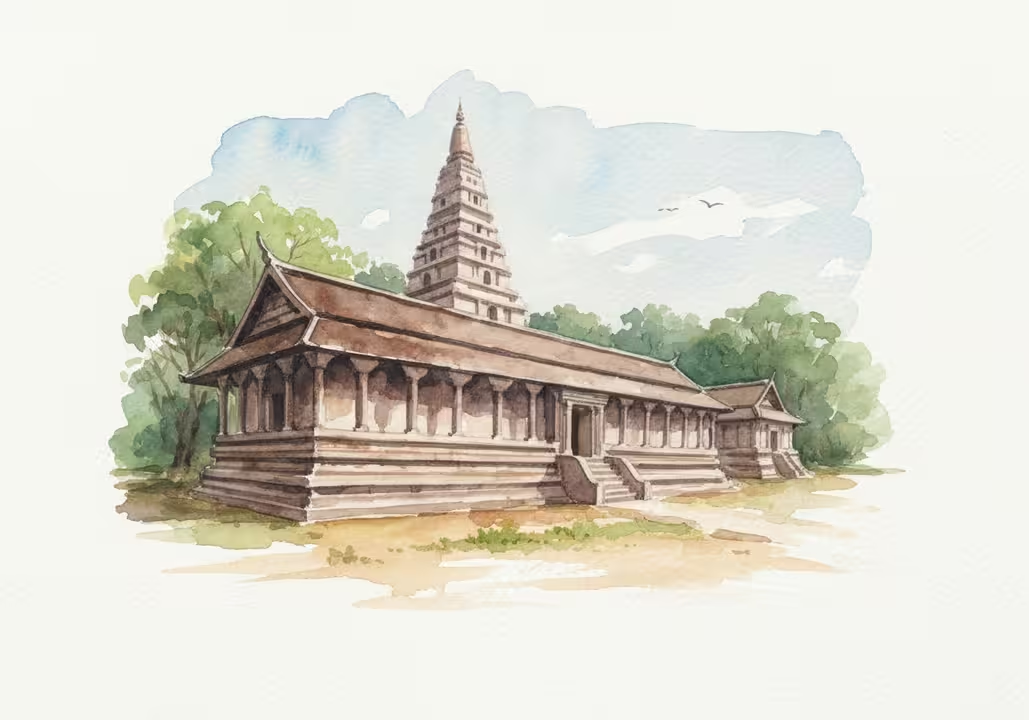
In the heart of the 12th century, when medieval kingdoms rose and fell across Asia, one extraordinary ruler transformed a fractured island nation into a unified empire of unprecedented prosperity. King Parakramabahu I, known to history as Parakramabahu the Great, didn’t merely rule Sri Lanka—he reimagined it, turning Polonnaruwa into a glittering capital whose monuments would endure for nearly a millennium.
The Making of a King
Born around 1123 AD in Punkhagama, the capital of Dakkhinadesa, Parakramabahu’s path to greatness was shaped by tragedy and opportunity. Following his father King Manabharana’s death, young Parakramabahu and his mother Ratnavali moved to Ruhuna to live with his uncle Sri Vallabha. The young prince’s education took him through the courts of his uncles and even the court of King Gajabahu II of Rajarata, experiences that would prove invaluable in understanding the complex political landscape of medieval Sri Lanka.
In 1140, when his childless uncle Kitti Sri Megha died, Parakramabahu ascended the throne of Dakkhinadesa. The kingdom he inherited was merely one piece of a divided island. Sri Lanka in the mid-12th century was fractured into three competing kingdoms—Rajarata in the north with its capital at Polonnaruwa, Dakkhinadesa in the southwest, and Ruhuna in the southeast. For a ruler of ambition and vision, this fragmentation was intolerable.
The Road to Unification
What followed was a masterclass in medieval statecraft. Over the next decade, Parakramabahu strengthened Dakkhinadesa’s infrastructure and military capabilities. When the time came to unite the island, he proved himself a brilliant military strategist. The civil war that ensued was intense and unforgiving. In one decisive battle, Parakramabahu’s general Mahinda so thoroughly defeated Gajabahu’s general Gokanna that the vanquished commander fled the battlefield, abandoning even his ceremonial umbrella—a powerful status symbol whose loss signified total defeat.
Around 1153, after approximately five years of incessant warfare that the king himself regarded as one of the most significant events of his reign, Parakramabahu finally became the unquestioned lord of the entire island. He was one of the last monarchs in Sri Lankan history to achieve complete unification—a feat that speaks to both his achievement and the challenges that would face his successors.
”Not Even a Drop of Water”
Perhaps nothing captures Parakramabahu’s vision better than his famous declaration: “Not even a drop of water that comes from the rain must flow into the ocean without being made useful to man.” This wasn’t mere rhetoric—it was a blueprint for transformation.
The centerpiece of his irrigation revolution was the Parakrama Samudra, or “Sea of Parakrama,” an engineering marvel that remains functional today, nearly 900 years after its construction. This massive reservoir was created by connecting five smaller tanks—Thopa, Dumbutulu, Erabadu, Bhu, and Kalahagala—through an ingenious system of canals. With a maximum capacity of 109,000 acre-feet and a catchment area of 2,800 square miles, the reservoir irrigated 18,000 acres of farmland through a network of three sluice gates.
The impact was transformative. Sri Lanka became known as “The Oriental Granary,” its agricultural abundance ensuring food security and generating wealth that would fund Parakramabahu’s other grand projects. The reservoir’s storage area exceeded 5,000 acres, and its sophisticated distribution system represented a revolutionary approach to water management that modern engineers still study with admiration.
The Spiritual Heart of an Empire
While Parakramabahu’s engineering achievements secured his kingdom’s material prosperity, his religious and cultural patronage shaped its soul. One of his first major projects was the restoration of Anuradhapura, the ancient capital that had been devastated by Chola invasions. He rebuilt the great monuments—Thuparamaya, Mihintale, and Ruwanweliseya—reconnecting his realm to its glorious past.
In Polonnaruwa itself, Parakramabahu oversaw the creation of monuments that would become symbols of Sri Lankan Buddhist art. The crown jewel was Gal Vihara, originally known as Uttararama or “Northern Monastery.” Here, master craftsmen carved four magnificent Buddha statues from a single granite rock face. The reclining Buddha, measuring 46 feet 4 inches in length, stands as one of the largest sculptures in Southeast Asia. The standing and seated Buddhas demonstrate such refined artistry and serene expression that the Gal Vihara has been celebrated for nearly 800 years as the pinnacle of medieval Sinhalese sculpture.
The Uttararama held special significance beyond its artistic achievement. Here, Parakramabahu convened a great congregation of monks to reform and purify the Buddhist sangha, later drawing up a comprehensive code of conduct for the clergy. This religious reformation paralleled his political unification, creating spiritual cohesion to match his administrative consolidation.
The king’s building campaign extended to numerous other monuments. He constructed the Kiri Vehera, with its 88-foot diameter dome, and the sprawling Alahana Parivena monastery. His seven-story Royal Palace, with walls three meters thick and stretching 31 by 13 meters, contained 50 rooms supported by 30 columns—a physical manifestation of royal power and architectural ambition.
An Empire’s Reach
Parakramabahu’s vision extended far beyond his island shores. Between 1165 and 1181, he launched a series of military expeditions against the Pagan Kingdom of Burma (known in Sri Lankan chronicles as Ramanna). The catalyst was a diplomatic insult: King Narathu of Burma had mistreated Sri Lankan envoys, prohibited elephant sales to foreign countries, and imprisoned and tortured the ambassadors while confiscating their possessions.
The retaliatory campaign marked the first overseas military expedition in Sri Lankan history. While Burmese chronicles don’t record the invasion in detail—suggesting the Culavamsa chronicle may have exaggerated its scope—contemporary Sri Lankan inscriptions confirm that the campaign occurred and achieved its objectives. The Devanagala inscription specifically mentions General Kitti Nagaragiri receiving land grants for his leadership in the Ramanna campaign.
Closer to home, Parakramabahu aided the Pandyan dynasty in their conflicts against the powerful Chola Empire in southern India, projecting Sri Lankan influence across the Palk Strait. His kingdom maintained extensive trade relations with China, the Khmer Empire of Angkor, and various Middle Eastern states, making Polonnaruwa a cosmopolitan hub of medieval Asian commerce.
The Price of Glory
Yet this golden age came at a cost. The five years of civil war that brought unification, followed by decades of foreign campaigns and monumental construction, placed enormous strains on the kingdom’s resources. Taxation reached levels that tested the patience of even prosperous subjects. By the end of Parakramabahu’s reign, high-value coinage had virtually disappeared from circulation—a troubling sign of economic stress beneath the surface splendor.
A Legacy in Stone and Memory
When Parakramabahu died in 1186 after 33 years of rule, he left behind a transformed island. The Culavamsa chronicle, compiled by the learned monk Dhammakitti, preserved his achievements for posterity with such devotion that the historian Wilhelm Geiger considered “the history of Parakkama as the real kernel, the main subject of the Culavamsa.”
The monuments endured even as the political unity crumbled. Polonnaruwa would soon be abandoned, its palaces and temples reclaimed by the jungle for centuries until 19th-century archaeological excavations brought this lost world back to light. In 1982, UNESCO recognized the Ancient City of Polonnaruwa as a World Heritage Site, acknowledging its unique testimony to the heights of medieval Sri Lankan civilization.
Parakramabahu’s influence on Sri Lankan kingship was so profound that seven subsequent monarchs adopted his name over the following four centuries. Three hundred years later, Parakramabahu VI would consciously model himself on his great predecessor, attempting to replicate his unification and cultural patronage from the new capital of Kotte.
Today, tourists from around the world walk among the ruins of Parakramabahu’s capital, marveling at the serene stone Buddhas of Gal Vihara and the still-functional irrigation systems that water the same fields they nourished 900 years ago. The Parakrama Samudra continues to shimmer in the tropical sun, its waters a liquid monument to a king who believed that not even a single drop of rain should be wasted.
In the annals of Sri Lankan history, many rulers commanded armies and built monuments. But only a handful possessed the vision to transform their entire civilization. King Parakramabahu I was such a ruler—a warrior-engineer-patron whose 33-year reign created a golden age whose luster time has dimmed but never extinguished. In stone and water, in chronicle and memory, Parakramabahu the Great remains what he was in life: the architect of glory, the master of medieval Sri Lanka’s greatest flowering.
Historical Sources: This narrative draws on information from the Culavamsa chronicle, UNESCO World Heritage documentation, archaeological research, and contemporary historical scholarship on medieval Sri Lankan history.