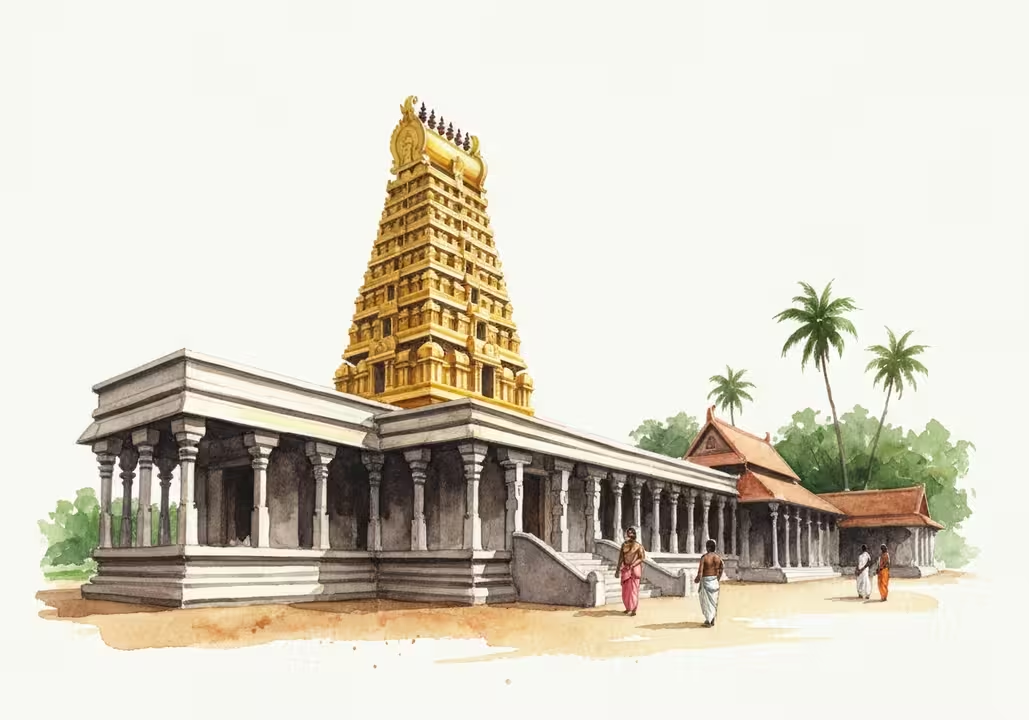
In the heart of Jaffna, where the scent of incense mingles with the sound of temple bells and the rhythmic beating of drums, stands the magnificent Nallur Kandaswamy Temple. With its towering gopuram reaching toward the heavens and its golden pillars gleaming in the tropical sun, this temple is more than an architectural marvel—it is a testament to faith’s endurance, a symbol of cultural resilience, and the spiritual heartbeat of Sri Lanka’s Tamil Hindu community.
The Ancient Roots
The story of the Nallur Kandaswamy Temple begins over a millennium ago, in 948 CE, when the first temple dedicated to Lord Murugan was established on land called “Kurukkal Valavu.” This original shrine laid the foundation for what would become one of the most significant Hindu temples in Sri Lanka, a place where devotion would transcend the ravages of time and the violence of colonial conquest.
By the 13th century, the temple had grown in prominence and grandeur. According to the Yalpana Vaipava Malai, an important Tamil historical chronicle, the temple was significantly developed around this time by Puvenaya Vaku, a minister to the powerful Jaffna King Kalinga Magha. This was an era when Nallur itself was flourishing as the capital of the Jaffna Kingdom, a prosperous Tamil realm that would endure from 1215 to 1619 CE. The temple stood not just as a place of worship, but as a symbol of royal patronage and the cultural sophistication of the northern kingdom.
The Sapumal Kumaraya Era: Destruction and Redemption
The mid-15th century brought dramatic upheaval to Nallur and its sacred temple. In 1450, Prince Sapumal Kumaraya—the adopted son of King Parakramabahu VI of the Kingdom of Kotte—led a military campaign northward to bring the Jaffna Kingdom under southern suzerainty. After successfully ousting the Tamil king Kanakasooriya Cinkaiariyan, Prince Sapumal established himself as ruler of Jaffna.
His early rule was marked by oppression and cultural erasure. The Nallur temple was destroyed, and the capital itself was renamed with the Sinhalese name “Srirangabodhi Bhuvanesubagu” in an attempt to suppress Tamil identity. Yet this dark chapter contains within it a remarkable story of transformation and remorse.
Prince Sapumal Kumaraya came to regret his destructive actions. Perhaps moved by the devotion of the local population, or perhaps experiencing a genuine spiritual awakening, he embarked on an ambitious reconstruction program. Beginning in 1457, he ordered the rebuilding of the very temple he had destroyed. This third incarnation of the Nallur Kandaswamy Temple would stand as a monument not just to Lord Murugan, but to the possibility of redemption and the recognition that sacred spaces transcend political boundaries.
When Prince Sapumal was called back to Kotte in 1467 to assume kingship following his father’s death, the Tamil kingdom quickly re-established itself. The temple he had rebuilt became once again a center of Tamil Hindu worship and cultural identity, more resilient than ever.
The Portuguese Devastation
The early 17th century brought a new and more thorough devastation to Nallur. The Portuguese, in their zealous pursuit of colonial dominance and Catholic conversion, viewed Hindu temples as obstacles to their ambitions. In 1624, the Portuguese commander Filipe de Oliveira conquered the Jaffna Kingdom and systematically set about erasing its cultural heritage.
The magnificent Nallur Kandaswamy Temple was demolished to its very foundations. The royal palace buildings and every structure that spoke of Nallur’s past glory were similarly destroyed. In a symbolic act of colonial supremacy, the Portuguese erected several churches over the temple ruins. Today, St. James’ Church in Nallur stands on what was once the original site of the Kandaswamy Temple—a geographical palimpsest where one faith’s sacred ground was literally built upon another’s.
For over a century, the Hindu community of Jaffna had no grand temple to call their own. Yet faith persisted in smaller shrines, in home altars, and in the collective memory of what had been lost.
The Dutch Era: A Temple Reborn
The arrival of Dutch colonial rule in the mid-17th century brought a somewhat more tolerant atmosphere. Though still under foreign domination, the Hindu community found opportunities to practice their faith more openly. It was in this context that a determined effort arose to rebuild the Nallur Kandaswamy Temple.
The man who would become the temple’s savior was Ragunatha Maapaana Mudaliyar, known also as “Don Juan,” who served as a Shroff (a financial officer) in the Dutch administration. In 1734, with the support of key community leaders like Krishna Suba Iyer and the broader Tamil community, Ragunatha Maapaana Mudaliyar began the ambitious project of constructing the fourth incarnation of the temple.
Given the long history of destruction, the builders took a pragmatic approach. Permission had been secured to build at the ancient site of Kurukkal Valavu, and the initial construction was deliberately modest—brick and stone walls with a simple cadjan (palm thatch) roof. At the heart of the sanctuary, they enshrined the vel, the sacred spear of Lord Murugan, with only two small halls for worship. The goal was not immediate grandeur but enduring survival.
Construction continued through 1749, when the temple was completed. Krishnaiyar, a learned Brahmin, became the first priest of this reborn temple. Ragunatha Maapaana Mudaliyar’s descendants would continue to serve as custodians of the temple for generations, ensuring its maintenance and gradual enhancement.
Growth and Splendor
The 19th century witnessed the temple’s transformation from a modest structure to the magnificent complex visible today. Particularly from the 1890s onward, extensive renovations restored and exceeded the temple’s former glory. The simple structure gave way to elaborate Dravidian architecture featuring ornately carved gopurams, intricately designed mandapams, and stunning sculptural work.
Today, the temple complex covers approximately six acres and features four gopurams facing the cardinal directions. The main eastern gopuram soars nine stories high, adorned with hundreds of sculptures depicting various deities and scenes from Hindu mythology. A golden kalasam (pot) crowns the summit, said to contain sacred water from the Ganges River. Inside, the mandapam boasts 48 golden pillars, each covered with intricate carvings. It is considered the largest gopuram in Sri Lanka, visible from great distances as a beacon of faith.
The Living Temple: Festival and Faith
The Nallur Kandaswamy Temple is far more than an architectural monument—it is a living, breathing center of devotion. Every year, the temple hosts a 25-day festival, typically held between July and August, that draws hundreds of thousands of devotees from across Sri Lanka and the Tamil diaspora worldwide.
The festival begins with the Kodiyetram, the ceremonial flag hoisting, and proceeds through daily rituals including Abhishekam (ritual bathing of the deity), fire offerings, and elaborate poojas. The air fills with the sounds of sacred chants, the rhythmic beating of drums, and the haunting melodies of the nadaswaram. On the 21st day comes the spectacular Ther Thiruvizha, the chariot festival, when the deity is paraded through the streets in a beautifully decorated chariot pulled by hundreds of devoted hands. The 23rd day features the Sapparam, with colossal palanquins that rank among the tallest mobile structures in the country.
Devotees demonstrate their faith through various forms of penance—rolling on the ground, carrying kavadi (decorated frameworks), and walking on fire. The festival culminates with the Theertham, the water-cutting ceremony, a symbolic ritual of bathing and purification that marks the conclusion of the sacred season.
A Symbol of Identity and Resilience
In the post-colonial era, the Nallur Kandaswamy Temple has transcended its role as merely a place of worship to become a powerful symbol of Tamil cultural identity and resilience. For a community that has endured centuries of colonial rule, cultural suppression, and more recent civil conflict, the temple stands as proof that faith and culture can survive attempts at erasure.
So important is this temple to the Tamil diaspora that numerous temples in Europe and North America have been named after Nallur Kandaswamy, serving as cultural anchors for communities far from their ancestral homeland. These overseas temples function not just as places of worship but as institutions preserving language, customs, and collective memory.
Conclusion: The Eternal Phoenix
The story of the Nallur Kandaswamy Temple is one of destruction and rebirth, of oppression and resistance, of loss and recovery. Three times destroyed—by conquest, by colonialism, by religious zealotry—the temple has risen again each time, more resolute in its purpose and more central to the identity of the community it serves.
As the temple bells ring out across Jaffna today, they carry echoes of a thousand years of devotion. They speak of kings and ministers, of colonial conquerors and community leaders, of ordinary devotees whose faith proved stronger than the forces arrayed against it. The Nallur Kandaswamy Temple stands as a sacred phoenix, its golden gopuram blazing in the tropical sun—a testament to the indomitable spirit of faith and the enduring power of cultural memory.
For those who walk through its gates, whether pilgrims seeking Lord Murugan’s blessings or visitors marveling at its architectural splendor, the temple offers a profound lesson: that what is sacred cannot be truly destroyed, only transformed, and that from the ashes of devastation can rise something more beautiful and meaningful than what came before.