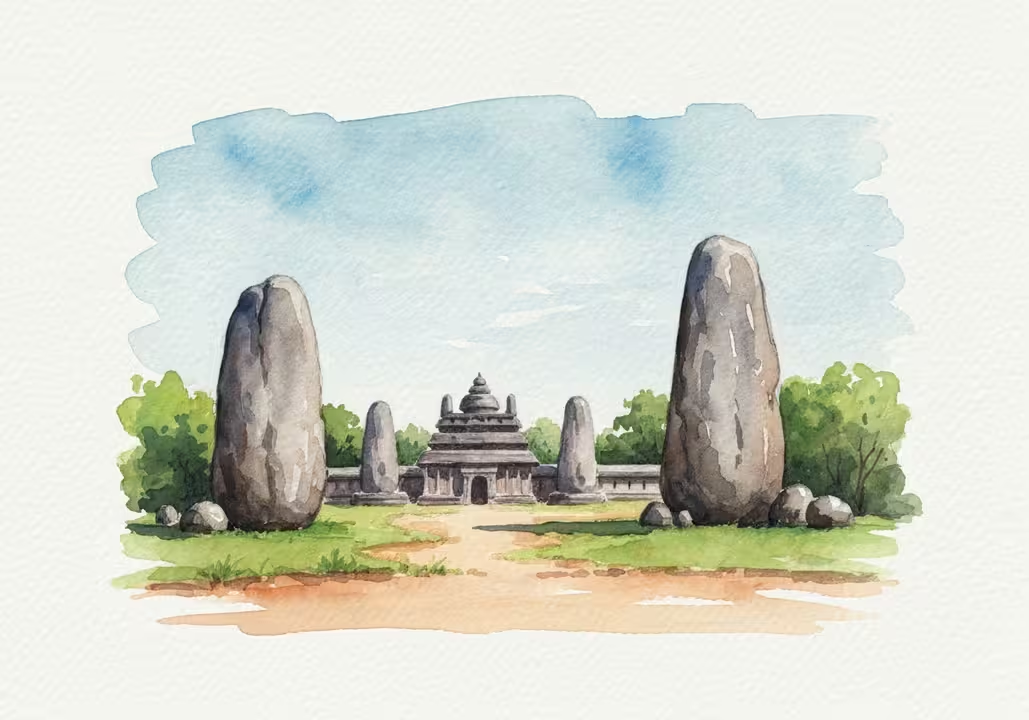
Encircled by seven massive granite sentinels rising from the earth like ancient guardians, Kurunegala emerged as Sri Lanka’s capital during one of the most tumultuous periods in the island’s medieval history. For nearly half a century, from 1293 to 1341, this naturally fortified city served as the seat of Sinhalese power, a strategic refuge where kings safeguarded the Sacred Tooth Relic and struggled to maintain sovereignty against the relentless pressures of South Indian invasions and internal instability.
The Kingdom of Kurunegala represents a crucial bridge in Sri Lankan history—a transitional period between the dramatic fortress capital of Yapahuwa and the more stable kingdom of Gampola. Though often overshadowed by its more famous predecessors and successors, Kurunegala’s reign witnessed significant cultural achievements, architectural developments, and the efforts of remarkable rulers to preserve Sinhalese Buddhist civilization during an age of perpetual crisis.
The Geography of Power
The choice of Kurunegala as a capital was no accident. The city’s location in the North Western Province offered something invaluable to 13th-century monarchs constantly threatened by invasion: natural defenses that required no army to maintain and no wall to breach.
Rising around the city like a protective embrace stood seven enormous rock outcrops, each with its own distinctive shape and character. The largest and most famous was Ethagala—the Elephant Rock—its massive granite face reaching 325 meters into the sky, its silhouette resembling a tusked elephant frozen in eternal vigilance. Indeed, the very name “Kurunegala” derives from this sentinel, combining “kurune” (tusker or elephant with protruding teeth) with “gala” (rock) in Sinhala.
Alongside Ethagala stood six companions: Ibbagala (Tortoise Rock), Andagala (Eel Rock), Kuruminiyagala (Ant Rock), Kumbalkatuwagala (Pot Rock), Gotagala (Conch Rock), and Yakdessagala (Demons’ Stone). Together, these geological formations created a natural amphitheater—a fortress built not by human hands but by ancient volcanic forces and millions of years of erosion.
For kings who had watched capital after capital fall to South Indian armies, this ring of stone offered something precious: defensibility. Enemy forces approaching from any direction would find their movements visible from the heights, their advance channeled through predictable approaches where defenders could concentrate their strength. The city that developed between Kuruminiyagala and Ibbagala, bounded by Ethagala, enjoyed protection that even the greatest military engineer of the age could not have improved.
The Prelude: Yapahuwa’s Fall
To understand why Kurunegala became capital, one must first understand the catastrophe that preceded it. In 1284, King Bhuvanekabahu I died while ruling from Yapahuwa, another rock fortress capital northeast of Kurunegala. Within days of his death, Pandyan forces from South India invaded, and despite Yapahuwa’s formidable defenses, the invaders achieved their objective: they seized the Sacred Tooth Relic of the Buddha and carried it triumphantly back to Tamil Nadu.
The loss of the Dalada was more than a military defeat—it struck at the very heart of Sinhalese kingship. For centuries, possession of the Tooth Relic had been the ultimate symbol of legitimate Buddhist sovereignty. Without it, no king could truly claim to rule with divine sanction. Yapahuwa, exposed as unable to protect the island’s most precious treasure, was abandoned as a capital.
King Parakramabahu III, who ascended the throne in 1287, refused to accept this cosmic humiliation. Through diplomatic negotiations with the Pandyan rulers—the details lost to history but the outcome preserved in chronicles—he accomplished what seemed impossible. In 1288, just four years after its capture, the Sacred Tooth Relic returned to Sri Lanka.
But Parakramabahu III did not restore the capital to Yapahuwa. He briefly placed the relic in Polonnaruwa, the ancient capital that Kalinga Magha had devastated decades earlier. By 1293, however, a new decision had been made: the capital would move to Kurunegala, where the protective ring of rocks promised greater security than Yapahuwa had provided.
The Rulers of Kurunegala
Buwanekabahu II: The Founder (1293-1302)
After Parakramabahu III’s death in 1293, King Buwanekabahu II formally established Kurunegala as the kingdom’s capital. Little is recorded about this monarch’s nine-year reign, but his fundamental achievement was consolidating the kingdom in its new location and beginning the construction of the royal infrastructure that would house subsequent rulers and the sacred relic.
The old city of Kurunegala Kingdom spread between Kuruminigala and Ibbagala, bounded by Athugala (as Ethagala was also known). Here, Buwanekabahu II and his successors would build a palace complex, a Temple of the Tooth, administrative buildings, and all the apparatus of medieval kingship.
Parakramabahu IV: The Scholar-King (1302-1326)
The reign of Parakramabahu IV, lasting nearly a quarter-century, marked the zenith of Kurunegala’s importance. This remarkable monarch earned himself an additional name that speaks volumes about his character and achievements: Panditha Parakramabahu—“Parakramabahu the Scholar.”
In an age dominated by military concerns, Parakramabahu IV distinguished himself as a patron of Buddhism, education, and literature. While the specific literary works produced during his reign are less documented than those from the earlier Dambadeniya period, his reputation as a learned king suggests he maintained the tradition of royal scholarship that had characterized the finest Sinhalese monarchs.
Most significantly, Parakramabahu IV successfully safeguarded the Sacred Tooth Relic throughout his long reign—no small achievement in an era when South Indian powers repeatedly cast covetous eyes toward Sri Lanka’s treasures. He also commissioned the construction of a magnificent Dalada Maligawa (Temple of the Tooth) in Kurunegala, a three-story structure that became the spiritual heart of the kingdom.
Archaeological evidence reveals that Parakramabahu IV’s reign witnessed active economic and cultural life. The kingdom maintained copper coinage bearing royal insignia, indicating organized monetary economy. Trade connections extended across the Indian Ocean, as evidenced by archaeological finds of imported goods.
Under his stewardship, Kurunegala achieved a degree of stability and prosperity that had seemed impossible in the decades following Polonnaruwa’s collapse. For a generation, the kingdom enjoyed relative peace—a rare commodity in 13th-century Sri Lanka.
Buwanekabahu III: The Last King (1326-1335)
When Parakramabahu IV died in 1326, his son Buwanekabahu III—also known as Wanni Buwanekabahu—inherited the throne. He would prove to be the last monarch to rule Sri Lanka from Kurunegala.
The reasons for Kurunegala’s eventual abandonment as capital remain somewhat unclear in the historical record. No dramatic conquest or catastrophic defeat is recorded. Instead, a gradual sense seems to have emerged that the kingdom required a new center—perhaps one further inland, deeper in the protective mountains, more removed from the coastal invasion routes that South Indian armies repeatedly used.
Buwanekabahu III’s nine-year reign appears to have been relatively uneventful, which in the context of 14th-century Sri Lankan history qualified as an achievement in itself. When he died in 1335, however, the capital question reopened.
The Transition to Gampola (1335-1341)
After Buwanekabahu III’s death, King Vijayabahu V ruled from 1335 to 1341, but significantly, he moved between various locations including Dambadeniya and Yapahuwa, never fully settling in Kurunegala. The capital had effectively entered a period of instability.
When Vijayabahu V’s son, Buwanekabahu IV, ascended the throne in 1341, he made the decisive break. With the support of General Senalankadhikara, the powerful military commander who would become a kingmaker in Sinhalese politics, Buwanekabahu IV moved the capital to Gampola, deeper in the central highlands.
Kurunegala’s brief reign as capital had ended. The city that had sheltered four kings and protected the Sacred Tooth Relic for nearly half a century entered a new chapter as a provincial center rather than the seat of sovereignty.
Architecture and Monuments
While time and the elements have taken their toll, archaeological remains at Kurunegala offer tantalizing glimpses of the medieval capital’s grandeur.
The Dalada Maligawa, believed to have been constructed during Parakramabahu IV’s reign, was a three-story structure—a significant architectural achievement for its time. The temple that housed the Buddha’s Tooth Relic would have been the most sacred space in the kingdom, accessible only to the king, selected monks, and the highest nobility during special ceremonies.
The royal palace complex, spread across the area between the protective rocks, featured stone entrances, elaborate steps carved from granite, rock pillars that supported wooden superstructures, and substantial walls built from stone and clay. Archaeological excavations have uncovered these foundations, revealing the scale and sophistication of the medieval construction.
The ruins demonstrate that Kurunegala’s architects and builders possessed considerable skill, creating structures that were both functional and aesthetically refined. Stone carving techniques developed during the earlier Polonnaruwa and Dambadeniya periods continued to evolve at Kurunegala, though the city’s monuments never achieved the artistic fame of Yapahuwa’s ornamental staircase.
Today, the most visible monument to Kurunegala’s historical importance is not from the medieval period itself but from much later. Atop Ethagala, the Elephant Rock that gave the city its name, stands the Athugala Viharaya temple and an enormous seated Buddha statue 27 meters high, constructed in 2003. This modern addition has become a landmark visible from across the region, a contemporary continuation of the site’s sacred character.
From the summit of Ethagala, visitors can survey the entire city spread below and understand immediately why medieval kings chose this location. The panoramic view encompasses the entire valley, with the other six rock outcrops visible like protective sentinels, creating a natural fortress that required no human enhancement.
Political and Cultural Significance
The Kingdom of Kurunegala represents a crucial phase in the broader pattern of capital migration that defined post-Polonnaruwa Sri Lankan history. Following the devastating invasion of Kalinga Magha in 1215 and the subsequent collapse of Polonnaruwa as a viable capital, Sinhalese kings embarked on what would become a centuries-long journey southward and westward, constantly seeking locations that offered better defense against South Indian military power.
The sequence of capitals—Dambadeniya, Yapahuwa, Kurunegala, Gampola, Kotte, and eventually Kandy—traces a path of strategic retreat into increasingly defensible terrain. Each move represented both a response to immediate threats and an adaptation to changing political realities.
Kurunegala’s significance lies partly in its success: unlike Yapahuwa, which lost the Tooth Relic after barely a decade, Kurunegala protected the sacred object for nearly half a century. This achievement provided crucial continuity to Sinhalese kingship during a period when continuity seemed almost impossible to maintain.
The kingdom also demonstrates the resilience of Sinhalese Buddhist civilization. Despite constant external pressures, internal instability, and the enormous challenges of moving capitals repeatedly, the core institutions of Buddhist monarchy persisted. Kings continued to patronize the Sangha, maintain the sacred relic, commission religious works, and perform the rituals that legitimized their rule. The civilization bent but did not break.
Legacy and Memory
Today, Kurunegala thrives as a major city in modern Sri Lanka, the capital of the North Western Province and an important commercial and transportation hub. The medieval capital lies buried beneath portions of the modern city, with archaeological sites scattered among contemporary developments.
Unlike the more remote rock fortresses of Yapahuwa and Sigiriya, which have been preserved as archaeological parks largely frozen in time, Kurunegala’s accessibility and strategic location have meant continuous habitation and development. This ongoing vitality is itself a form of legacy—the city that medieval kings chose for its strategic importance remains strategically important in the 21st century.
The seven rock outcrops continue to dominate the city’s skyline and identity. Ethagala, crowned now with its modern Buddha statue, has become a pilgrimage site and tourist attraction. Visitors climb the steep steps to the summit—not the original medieval access routes, but modern constructions following similar paths—to pay respects at the temple and marvel at the views that once allowed kings to survey their domains.
Stone inscriptions from the Kurunegala period, discovered at various sites across the island, provide valuable windows into the administrative, religious, and economic life of the kingdom. These epigraphic records—carved in stone and therefore surviving when palm-leaf manuscripts crumbled to dust—allow modern scholars to reconstruct aspects of medieval governance, land grants to temples, and the religious endowments that sustained Buddhist institutions.
The archaeological remains of the palace complex and Temple of the Tooth, though fragmentary, continue to attract scholarly attention. Each excavation potentially reveals new insights into the material culture of the period—the ceramics used, the architectural techniques employed, the layout of royal and religious spaces.
Kurunegala in Historical Perspective
The Kingdom of Kurunegala lasted barely half a century—a brief moment in Sri Lanka’s multi-millennial history. Yet this short period illuminates crucial dynamics that shaped medieval Sinhalese civilization.
It demonstrates the importance of geography in political survival. The seven rock outcrops provided security that allowed kings to focus on governance and cultural patronage rather than constantly defending against invasion. Natural defenses bought time and stability.
It reveals the centrality of the Sacred Tooth Relic to political legitimacy. Kurunegala’s primary purpose was to protect the Dalada, and its success in this mission for nearly fifty years validated the choice of location and strengthened the kings who ruled there.
It shows the persistence of Buddhist cultural institutions despite political upheaval. Even as capitals shifted, the Sangha continued, literature was produced, temples were built, and the rituals of Buddhist kingship endured.
And it illustrates the adaptive capacity of Sinhalese civilization. Rather than clinging to the ruins of Polonnaruwa or attempting to recapture the glory of Anuradhapura, medieval kings pragmatically moved their capitals to wherever offered the best combination of security and viability. Kurunegala represented one solution among many, successful for its time but ultimately superseded by other choices.
The rock fortress capitals—Yapahuwa, Kurunegala, and to a lesser extent Sigiriya centuries earlier—represented a particular moment in Sri Lankan architectural and political evolution. They were defensive responses to an age of invasions, elevated sanctuaries where kings could guard their most precious treasures while literally looking down upon potential threats.
When the capital moved to Gampola in 1341, it signaled a shift in strategic thinking. The central highlands, with their mountain barriers and distance from invasion routes, offered a different kind of security—not the dramatic defenses of isolated rocks but the protective depth of difficult terrain and loyal populations.
Kurunegala had served its purpose. It had provided sanctuary during turbulent decades, sheltered the Sacred Tooth Relic, given four kings a secure base from which to rule, and preserved the continuity of Sinhalese Buddhist monarchy. In doing so, this ring of ancient rocks earned its place in Sri Lankan history—not as a dramatic capital like Polonnaruwa or an artistic masterpiece like Sigiriya, but as a practical solution to existential challenges, a fortress that kept the flame of civilization burning during the storm.
The seven sentinels of stone remain, silent witnesses to the kings who sought their protection and the kingdom that flourished briefly in their embrace. They stand today much as they stood seven centuries ago—timeless, patient, enduring—reminding us that while kingdoms rise and fall, the land itself persists, recording in stone the passage of power and the resilience of civilization.