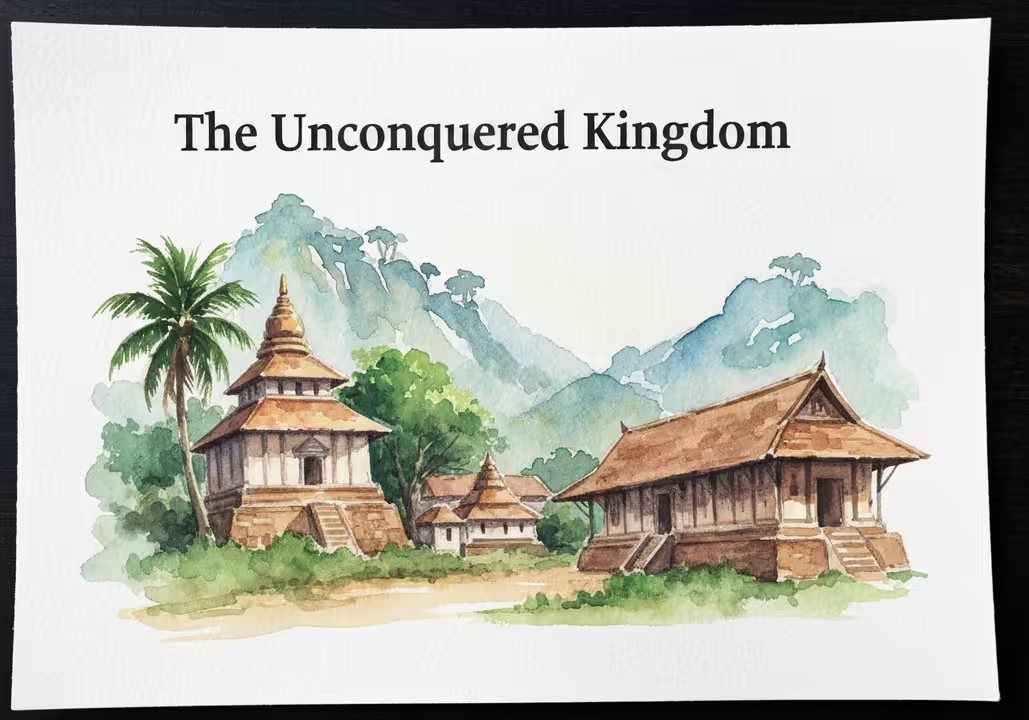
The Last Bastion of Independence
While coastal Sri Lanka fell to European conquistadors in the 16th century, the mountainous Kingdom of Kandy remained defiant. From the 1590s until 1815, this highland fortress kingdom successfully resisted Portuguese, Dutch, and British colonial forces through a remarkable combination of guerrilla warfare, strategic geography, and diplomatic cunning. This is the story of one of history’s longest and most successful indigenous resistances against European colonialism.
The Geography of Resistance
The Kingdom of Kandy’s survival depended heavily on its geography. Located in Sri Lanka’s mountainous and thickly forested interior, the kingdom was naturally defended by rugged terrain. Mountain passes leading to the capital provided numerous opportunities for ambushes, and routes to the city were kept secret—revealing them could result in death. This geographical advantage would prove decisive in repelling three successive colonial powers.
The Portuguese Era: Lessons in Defeat (1590s-1658)
The Campaign of Danture (1594): A Turning Point
The Portuguese learned the hard way that conquering Kandy would not be easy. On July 5, 1594, Governor Pedro Lopes de Sousa led a massive invasion force of approximately 20,000 troops—including 1,000 Portuguese soldiers and 15,400 Lascarins (Catholic Sri Lankan militiamen)—into Kandyan territory. They entered the capital without resistance, finding the Royal Palace abandoned and partially burned. King Vimaladharmasuriya I had retreated to Wellassa with his followers, implementing what would become the kingdom’s signature strategy: tactical withdrawal.
For three months, the Portuguese occupiers were systematically weakened by guerrilla warfare and mass desertions. King Vimaladharmasuriya, his forces now swelled to between 10,000 and 20,000 men (many of them defecting Lascarins), prepared his trap. He ordered trees felled to block the narrow, winding Danture tract near Balana. As the exhausted Portuguese army attempted their retreat, the Kandyans surrounded them.
On October 9, 1594, the demoralized Portuguese forces surrendered. For the first time in Sri Lankan history, a Portuguese army had been completely annihilated. This stunning victory established the Kingdom of Kandy as a major military power and set the template for its future resistance.
The Battle of Randeniwela (1630): Total Annihilation
The Portuguese hadn’t learned their lesson. In 1630, Portuguese Governor Constantinu De Sá de Noronha led another invasion force into Kandyan territory. On August 25, 1630, near Wellawaya in the Uva region, they faced King Senarath’s sons, Prince Maha Astana (later King Rajasinha II) and Prince Vijayapala.
The battle proved catastrophic for the Portuguese. Their Lascarin contingent defected en masse to the Kandyan side. Then came torrential rain that rendered Portuguese gunpowder and arquebus matches useless. Throughout the night, the Kandyans unleashed a relentless barrage of arrows and bullets. On the third day of the Portuguese retreat, the invaders were surrounded in a paddy field and destroyed. The battle is commemorated today by an obelisk monument on the Ella-Wellawaya Road.
The Dutch Betrayal (1638-1795)
Alliance of Convenience
In 1638, recognizing that the Portuguese remained a threat, King Rajasinha II made a calculated decision: he would ally with the newly formed Dutch East India Company. On May 23, 1638, Rajasinha II signed a treaty with Admiral Westerwolt, granting the Dutch a monopoly on most of Sri Lanka’s valuable cinnamon trade in exchange for military assistance against the Portuguese.
The alliance bore fruit. On March 28, 1638, Rajasinha II led the Kandyans to a major victory over the Portuguese at Gannoruwa—the last great military victory of the kingdom. With Dutch naval support, the combined forces gradually expelled the Portuguese from Sri Lanka’s coastal regions.
From Allies to Enemies
The relationship soured dramatically in May 1656. When the Portuguese surrendered Colombo to the Dutch, the victors shut the gates against their Kandyan allies. Dutch requests for territorial cession met with evasion and broken promises. It became clear that the Dutch intended not to liberate Sri Lanka, but to replace the Portuguese as colonial masters.
Rajasinha II’s response was ruthless and effective. He destroyed the agricultural lands around Colombo, removed the population, and withdrew to his mountain kingdom. This scorched-earth policy made the occupied territories economically worthless to the Dutch. Though Rajasinha could not reconquer the coastal lowlands, he ensured the Dutch paid dearly for their possession. This began what would become a century of intermittent warfare between Kandy and the Dutch colonial administration.
King Rajasinha II ruled for 52 years, from 1635 until his death in 1687 at age 79. As the ruler of the sole remaining Sinhalese state, he became the focal point of resistance against foreign rule—a role he courageously maintained throughout his life.
The British Challenge (1796-1818)
The First Kandyan War (1803): Hubris and Massacre
When Britain seized Dutch colonial possessions during the Napoleonic Wars, they inherited the conflict with Kandy. In January 1803, declaring war on the kingdom, the British launched a two-pronged invasion. Major-General Hay MacDowall led 1,900 troops from Colombo, while Colonel Barbut advanced from Trincomalee. The total British force numbered 3,387 soldiers.
Initial success bred overconfidence. The British found Senkadagala (Kandy) deserted in February 1803. They established a garrison, crowned a puppet king named Muttusami, and prepared to pacify the kingdom. But their intelligence had been fatally flawed—the extent of King Sri Wickrama Rajasinha’s unpopularity had been greatly exaggerated.
Kandyan resistance proved fierce. Supply lines were cut. Disease ravaged the garrison. On June 24, 1803, Kandyan forces attacked the weakened British garrison. Major Davie surrendered, believing it his only option. The officers were disarmed, separated from their men, and massacred. Colonel Barbut was captured and executed.
The retreating British columns fared no better. One was defeated at the flooding Mahaveli River, with only four survivors. Of the 3,387 troops who entered Kandy, 1,091 died between January and June 1803. Most devastating of all: only one man from the main garrison, Corporal George Barnsley of the 19th Infantry, survived to tell the tale of the massacre.
The Kandyan Convention (1815): Betrayal from Within
What military force could not achieve, political intrigue accomplished. King Sri Vikrama Rajasinha, who had successfully repelled the British in 1803, faced growing discontent among his nobles. His chief minister, Pilimatalauwa, had long harbored ambitions of establishing his own dynasty. When his plot was discovered and he was executed, other nobles feared for their own positions.
Ehelepola, another high-ranking noble, fled to British-controlled territory and persuaded the British that military intervention was justified. British agent Sir John D’Oyly worked secretly to turn Kandyan nobles against their king. On February 10, 1815, British forces advanced to Kandy without resistance, supported by the very chiefs sworn to defend it.
On March 2, 1815, at the Magul Maduwa (Royal Audience Hall) of the Royal Palace of Kandy, the Kandyan Convention was signed. The kingdom that had resisted European powers for over 225 years was ceded to the British Crown. King Sri Vikrama Rajasinha was declared deposed, his hereditary claims abolished. He was exiled to Vellore Fort in southern India, where he died on January 30, 1832, at age 52. The Kandyan Convention marked the end of 2,357 years of Sinhalese independence.
The Final Rebellion: Uva-Wellassa (1817-1818)
The Kandyan nobles soon learned they had merely exchanged one master for another. In 1817, rebellion erupted in the Wellassa region, rapidly spreading to Uva and Walapane. The British Governor Robert Brownrigg sent Keppetipola Disawe, a Kandyan chief, with 500 men to suppress the uprising.
Instead, Keppetipola performed an act of extraordinary defiance. Upon meeting the rebels, he joined them as their leader. In a gesture of honorable warfare, he returned his arms and ammunition to the British governor, stating he would not destroy them with their own weapons. By February 1818, Keppetipola led a rebel force of 5,000-6,000 warriors in a siege of Fort MacDonald.
The British response was unprecedented in its brutality. They implemented a scorched-earth policy: killing cattle and livestock, destroying homes and salt stocks, and burning rice paddies. More than 10,000 Sinhalese were killed in the suppression. Reinforcements from Madras under Brigadier Shuldham tilted the balance decisively.
Keppetipola and other rebel leaders were captured, tried for high treason, and sentenced to death. Keppetipola’s exceptional courage at his execution became legendary. In 1818, the British issued a proclamation that effectively ended the erstwhile organization of the Kandyan kingdom. The last armed resistance against colonial rule had been crushed.
Legacy: The Art of Resistance
The Kingdom of Kandy’s 225-year resistance offers profound lessons in asymmetric warfare. The Kandyans mastered several key strategies:
Guerrilla Warfare: Rather than meeting European armies in open battle, Kandyan forces employed hit-and-run tactics, ambushes, and strategic withdrawals.
Geographic Advantage: The mountainous terrain neutralized European advantages in firepower and disciplined formations. Secret routes and mountain passes became deadly traps for invaders.
Scorched-Earth Policy: When unable to hold territory, the Kandyans destroyed its economic value, making occupation costly and unrewarding for colonial powers.
Diplomatic Maneuvering: Playing colonial powers against each other—allying with the Dutch against the Portuguese, seeking British support against the Dutch—bought crucial time and resources.
Popular Support: Until the final years, Kandyan kings commanded the loyalty of their people, enabling sustained resistance despite military setbacks.
The kingdom’s ultimate fall came not through military conquest but through internal betrayal—a cautionary tale about the importance of political unity in resistance movements. Yet the memory of Kandy’s defiance remained a powerful symbol during Sri Lanka’s independence movement in the 20th century, reminding future generations that colonial rule was neither inevitable nor invincible.
Sources
This narrative is based on historical accounts from multiple sources including academic research, British colonial records, and Sri Lankan historical documentation. Key battles such as the Campaign of Danture (1594), Battle of Randeniwela (1630), and the First Kandyan War (1803) are well-documented in military histories. The Kandyan Convention of 1815 is preserved in the Sri Lanka National Archives. The figure of 10,000+ casualties during the Uva Rebellion comes from historical estimates of the British scorched-earth campaign. Names, dates, and military details have been verified across multiple historical sources to ensure accuracy.