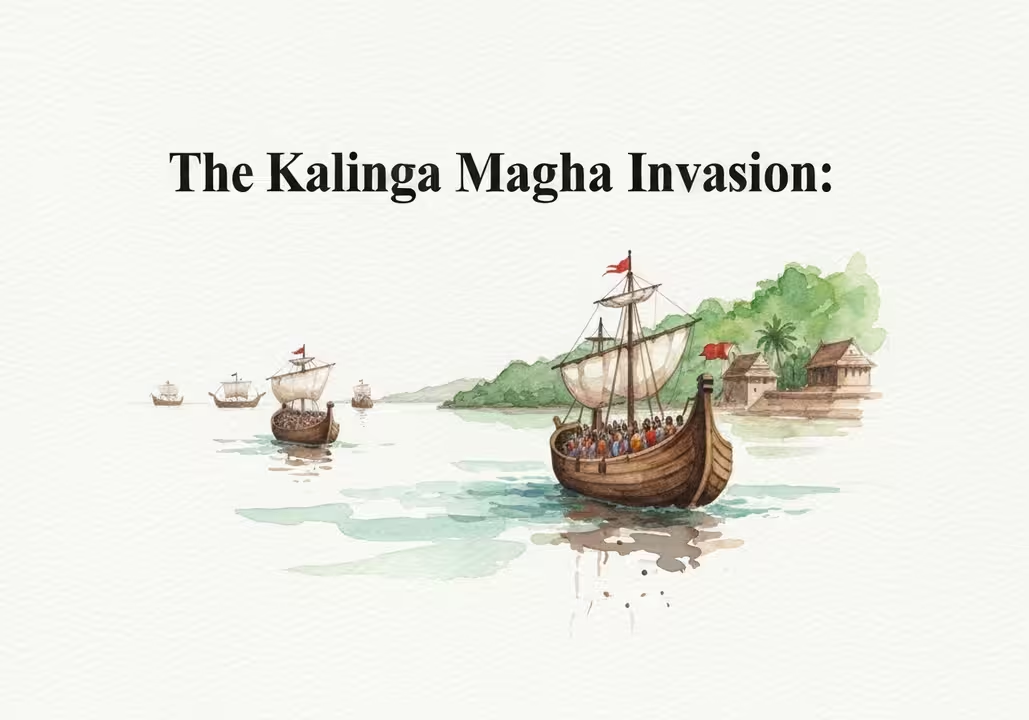
In the year 1215 AD, as ships bearing thousands of armed warriors appeared on the northern horizon of Sri Lanka, few could have imagined that the island stood on the precipice of one of its most devastating transformations. The man who commanded this formidable fleet was Kalinga Magha, an invader from the Kingdom of Kalinga in eastern India (modern-day Odisha and northeastern Andhra Pradesh), and his arrival would mark the beginning of what the ancient Culavamsa chronicle would describe as a veritable reign of terror.
The Invasion Begins
Kalinga Magha landed at Karainagar with an imposing force of 24,000 soldiers drawn from Kerala and Tamil territories. This was no mere raiding party; it was a full-scale invasion force designed for conquest. The invader first established his foothold by camping his troops at Karainagar and Vallipuram, systematically bringing the Jaffna principality under his control. With the northern peninsula secured as his base, Kalinga Magha set his sights on the ultimate prize: Polonnaruwa, the magnificent capital of the Sinhalese kingdom and seat of power in the traditional heartland of Rajarata.
The reigning monarch, Parakrama Pandyan II, stood little chance against such overwhelming military force. Kalinga Magha’s army marched southward, and in a decisive confrontation, defeated and executed the king. Having seized the throne through force of arms, Kalinga Magha was crowned king by his own soldiers, an act that represented a bold disregard for the island’s traditional authority and established customs.
A Reign of Terror
What followed was not merely a change of rulers, but a systematic campaign of destruction that would leave permanent scars on Sri Lankan civilization. The Culavamsa, the ancient chronicle that meticulously recorded the island’s history, provides Kalinga Magha with an unusually detailed and damning introduction—something the normally laconic text very rarely does. The chronicle describes his army as ruthless, engaged in the thorough destruction of the Buddhist religion that had flourished in Sri Lanka for over a millennium.
The scale of devastation was staggering. Kalinga Magha’s forces ransacked and destroyed the great temples of both Anuradhapura and Polonnaruwa, the twin jewels of Sinhalese Buddhist civilization. Ancient stupas, some standing for centuries as monuments to faith and architectural achievement, were systematically pillaged and demolished. The sacred Ruwanwelisaya stupa, one of Buddhism’s most revered monuments, fell victim to his Tamil and Kerala armies. The Mahavamsa chronicles note that the invaders devastated massive temples such as Rathnavali, and countless sacred bodily relics of the Buddha disappeared, lost to history.
But the destruction went far beyond religious sites. The Culavamsa particularly notes the brutality inflicted upon the population: theft on a massive scale, wanton destruction of property, kidnapping, torture—including the flogging of children—mutilation, amputation, and the enslavement of Rajarata’s nobility. Even the island’s sophisticated irrigation systems, the hydraulic engineering marvels that had sustained Rajarata’s agricultural prosperity for centuries, were destroyed in the chaos.
As word of these atrocities spread, panic gripped the Sinhalese population. In what would become one of the largest migrations in the island’s history, people fled southward and westward, seeking refuge in the mountainous interior away from Kalinga Magha’s reach. Buddhist monks, recognizing the existential threat to their faith, took heroic action to protect Sri Lanka’s most sacred treasures. The chief priests of Polonnaruwa managed to spirit away two of the island’s holiest relics—the Buddha’s sacred Tooth Relic and his alms bowl—carrying them to safety in more secure regions, ensuring that these symbols of Buddhist heritage would survive the catastrophe.
The Resistance and Reconquest
For twenty-one years, from 1215 to 1236, Kalinga Magha ruled from Polonnaruwa, his reign marked by continuous oppression and the suppression of traditional Sinhalese authority and Buddhist practice. Yet resistance was gathering in the south. In the 1220s, amid the chaos of foreign occupation, Vijayabahu III established a new capital at Dambadeniya, approximately 70 miles southwest of Polonnaruwa. This represented a strategic retreat to more defensible terrain, and marked the beginning of the Sinhalese kingdom’s reconstitution in the southern regions of the island.
When Parakramabahu II ascended to the throne of Dambadeniya in 1236, he inherited not just a kingdom, but a mission to reclaim the occupied lands and restore Sinhalese sovereignty. The new king proved equal to the challenge. Parakramabahu II launched a determined military campaign against Kalinga Magha, and with assistance from the Pandyan kingdom of South India—ironically, seeking help from Indian allies to expel an Indian invader—he succeeded in driving Kalinga Magha’s forces out of Polonnaruwa.
The year 1236 marked the turning point. Kalinga Magha was expelled from the ancient capital and forced to retreat northward to Jaffna, where he would rule until his death in 1255. Though he had lost Polonnaruwa, he had fundamentally altered the political geography of the island. Parakramabahu II would consolidate his victory over the following years, with sources indicating that by 1244 he had completely pushed Kalinga Magha’s influence out of the Polonnaruwa region.
The Permanent Transformation
The consequences of Kalinga Magha’s invasion extended far beyond the immediate destruction and loss of life. His impact on Sri Lankan civilization was so profound that it permanently transformed the island’s political, demographic, and cultural landscape.
Most significantly, Kalinga Magha was the last ruler to have his seat in Rajarata, the traditional northern heartland that had been the center of Sinhalese power for over a thousand years. The destruction was so comprehensive, the trauma so deep, that never again would a major Sinhalese kingdom establish its capital in the ancient lands of the north. All successor kingdoms would exist primarily in the south of the island, marking a permanent geographic shift in the island’s political center of gravity.
The population displacement that began during Kalinga Magha’s reign continued and accelerated after his expulsion. As people followed their kings southward and established new lives in new territories, the once-flourishing Rajarata was gradually abandoned. Without the dense population needed to maintain the intricate irrigation systems, these engineering marvels fell into disrepair. The interconnected network of water tanks and channels that had sustained agriculture for centuries dried up. Villages were depopulated, and the jungle reclaimed land that had been cultivated for generations.
By the time later generations looked back, Rajarata had become a landscape of ruins—overgrown temples, dried-up tank beds, and the ghostly remnants of a civilization that had once thrived there. The economic and social consequences were severe. The shift of population and political power meant the gradual decline of the old heartland and the rise of new centers of power in the south and southwest, fundamentally altering the island’s demographic and economic patterns.
The question of Kalinga Magha’s relationship to the later Jaffna Kingdom (1215-1619) remains a subject of historical debate. A late theory identifies him as the founder of the Tamil Jaffna Kingdom, and his withdrawal to Jaffna and rule there until 1255 certainly contributed to Tamil settlement patterns in the north. However, many scholars note that the Culavamsa makes a clear distinction between Kalinga Magha and the Aryacakravarti dynasty, which was established later when a Pandyan minister was installed as king in 1262 following the death of another invader, Chandrabhanu. What is clear is that following Kalinga Magha’s invasion and the subsequent political developments, Tamil settlements became predominant in the northern regions, creating a pattern that would have lasting implications for the island’s ethnic and cultural geography.
Legacy of Devastation
The Mahavamsa account concludes that the Kalinga Magha invasion led Sri Lanka to destruction in every aspect of the kingdom—cultural, economic, and social—to such a condition that complete recovery was not possible. This assessment, while perhaps reflecting the chronicler’s perspective on the loss of Buddhist preeminence in the north, was not without foundation. The invasion truly marked the end of an era.
The great civilization of Rajarata, which had produced magnificent monuments like the Ruwanwelisaya and Jetavanaramaya stupas, sophisticated irrigation works that demonstrated advanced hydraulic engineering, and centers of Buddhist learning that had attracted scholars from across Asia, would never again rise in its ancient homeland. The political unity that had characterized the island during its golden ages gave way to a more fragmented political landscape, with multiple kingdoms and regional powers competing for dominance.
Yet amid this devastation, there was also resilience. The sacred relics survived. The Buddhist faith survived. The Sinhalese kingdoms, though displaced, survived and eventually flourished again in new locations. The story of Kalinga Magha’s invasion is thus not just one of destruction, but also of survival, adaptation, and transformation.
The Kalinga Magha invasion of 1215 stands as one of the pivotal moments in Sri Lankan history—a watershed event that ended the long era of northern dominance and ushered in a new period of southern kingdoms. It demonstrated both the vulnerability of even the most established civilizations to external military force, and the remarkable capacity of a people to preserve their cultural and religious identity even in the face of systematic attempts at destruction. The ruins that still stand in the north, overgrown and weathered, remain silent testimony to this traumatic chapter in the island’s long and complex history.