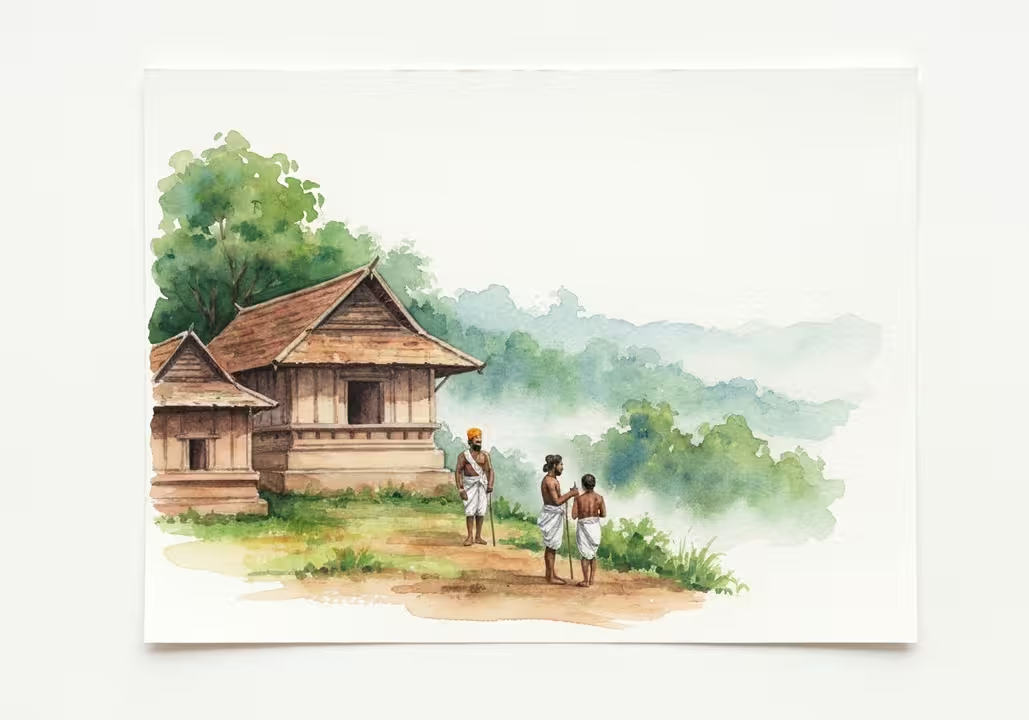
On the morning of October 12, 1817, in the mist-covered highlands of Uva-Wellassa, the ancient rice bowl of the Kandyan Kingdom, the flames of rebellion ignited against British colonial rule. What began as scattered acts of resistance would grow into the Great Rebellion of 1817-1818, a desperate struggle for freedom that would test the courage of an entire nation and result in devastation so complete that its scars remain visible to this day.
Seeds of Discontent: The Broken Promises of 1815
The story of the 1818 rebellion begins three years earlier, on March 2, 1815, when Kandyan chiefs gathered in the Magul Maduwa (Royal Audience Hall) of the Royal Palace of Kandy to sign the Kandyan Convention with British Governor Sir Robert Brownrigg. This treaty, which deposed the last king of Kandy, Sri Vikrama Rajasinha, and ceded the kingdom to the British Crown, contained promises that would prove hollow.
Article 5 of the Convention explicitly stated that “the religion of Buddhoo, professed by the chiefs and inhabitants of these provinces is declared inviolable and its rites and ministers and places of worship are to be maintained and protected.” The Convention also promised that civil and criminal justice would be administered according to the established customs of the country, and that the traditional privileges of the Kandyan chiefs would be maintained.
The Kandyan chiefs and Buddhist monks had agreed to British rule based on these solemn guarantees. But within two years, the British colonial administration began systematically violating these promises. Traditional privileges enjoyed by the Kandyan aristocracy were stripped away. British officials of all ranks showed open disrespect to high-ranking Kandyan chiefs and Buddhist priests. Most controversially, Governor Brownrigg, on the recommendation of his advisor John D’Oyly, appointed Haji Marikkar Travala, a Moorman of Wellassa, as Madige Muhandiram in September 1817—a post traditionally held by families of Kandyan chiefs.
The Sinhalese population, unaccustomed to being ruled by a distant king who lived on another continent, grew increasingly restless. The British administrative system, imposed over customary powers, created deep resentment. On November 21, 1818, the British would unilaterally modify the Convention by dropping the word “inviolable” from the clauses protecting Buddhism—a final betrayal that came even as the rebellion was being crushed.
The Uprising Begins
The rebellion exploded across five Kandyan districts in October 1817. Led initially by disgruntled Kandyan nobles, the uprising quickly gained popular support. The rebels proclaimed a pretender to the throne—Wilbawe, also known as Duraisamy, who claimed to be the son of Kalu Nayakkar, a relation of the former king. Though his actual connection to royal lineage was disputed, Wilbawe served as a rallying symbol for those who sought to restore Kandyan sovereignty.
The leadership included some of the most prominent nobles of the land: Pilimathalawe (the Second Adikar), Madugalla Disawe, Kohu Kumbure Rate Rala, Dimbulana Disawe, Kivulegedara Mohottala, Butewe Rate Rala, members of the Galagoda family, Galagedara Mohottala, Meegahapitiya Rate Rala, Dambawinna Disawe, and Kurundukumbure Mohottala.
By October 1817, the uprising was spreading rapidly through Matale, Uva, and Wellassa. Governor Brownrigg, stationed in Kandy, recognized the gravity of the situation and began organizing military operations to suppress the rebellion.
The Defection of Keppetipola
The turning point came on October 26, 1817, when Governor Brownrigg dispatched what he believed to be an overwhelming force to crush the rebellion: 500 British soldiers accompanied by 2,000 Sinhalese, Malay, and Indian troops, all under the command of Monarawila Keppetipola Disawe, a trusted Kandyan noble who had served both under the last king and the British administration.
But Keppetipola, traveling through the countryside and witnessing the depth of popular anger against British rule, made a fateful decision. At Alupotha in Uva, instead of attacking the rebels, he joined them, bringing with him the soldiers under his command. His defection electrified the rebellion and provided it with experienced military leadership.
Under Keppetipola’s command, the rebellion achieved remarkable successes. By January 1818, the rebels controlled an estimated 65 percent of the former Kandyan Kingdom, including Matale, the southern parts of Thamankaduwa and Nuwarakalaviya, Mahiyanganaya, Monaragala, Wellassa, southern Kandy regions, Athugalpura, Walapane, and Badulla. The fighters captured Matale and even threatened Kandy itself.
For months, the rebellion maintained momentum. Villages rose up, traditional systems of governance were restored in rebel-held areas, and the dream of throwing off British rule seemed, briefly, achievable.
The Brutal Suppression
But the British Empire, having just emerged victorious from the Napoleonic Wars, was not willing to relinquish control of Ceylon. Governor Brownrigg ordered a campaign of suppression that would become one of the darkest chapters in Sri Lankan colonial history.
The British adopted a deliberate scorched earth policy designed not merely to defeat the rebellion but to break the spirit of the Kandyan people forever. In the once-fertile regions of Uva and Wellassa, British forces systematically destroyed the ancient irrigation systems that had made these areas the rice bowl of the kingdom. Paddy fields were burned, fruit trees were cut down, cattle and livestock were slaughtered, homes were razed to the ground, and even stocks of salt—essential for preserving food—were destroyed.
The human cost was catastrophic. The British massacred the male population of Uva above the age of 18 years. English writers estimated 10,000 fighters killed, though some modern historians suggest the total casualties, including civilians, may have ranged from 40,000 to 100,000—a staggering figure in a country whose entire population was under three million.
Herbert White, a British Government Agent in Badulla who surveyed the region after the rebellion, wrote in his official minutes: “It is a pity that there is no evidence left behind to show the exact situation in Uva in terms of population or agriculture development after the rebellion.” The deliberate destruction of records suggests the British themselves understood the enormity of what had been done.
The Fall of the Leaders
By late 1818, weakened by illness and facing overwhelming British military force, the rebellion began to collapse. Keppetipola, struck down by jungle fever, was unable to maintain the offensive. On October 28, 1818, he and Pilimathalawe were captured by Captain O’Neil of the British army, assisted by Native Lieutenant Cader-Boyet of the Ceylon Rifle Regiment.
The captured leaders were brought to trial and found guilty of high treason. A Gazette Notification issued by Governor Brownrigg condemned all those who had fought against British rule as “traitors” and ordered the confiscation of their properties. Some rebels were executed, others were exiled to Mauritius.
On November 18, 1818, at Bogambara, Keppetipola Disawe and Madugalla Disawe were led to their execution. Keppetipola, facing death with extraordinary courage, made a final request to his executioner: to behead him with a single stroke of the sword. He tied his hair over his head to keep it from falling on his neck, and bent to receive the blade while uttering verses praising the supreme qualities of the Buddha.
The executioner failed. It took two strokes to kill Keppetipola. His courage at the moment of death, however, ensured his immortality in Sri Lankan memory.
Kivulegedara Mohottala was beheaded at Bogambara on December 18, 1818. Pilimathalawe, who was elderly and ailing at the time of his capture, was exiled to Mauritius, where he died far from his homeland.
In a final indignity, the British took Keppetipola’s skull to Edinburgh as a trophy. It would not be returned to Sri Lanka until 1954, when it was finally entombed at the Keppetipola memorial.
The Aftermath: A Land Laid Waste
The aftermath of the rebellion was a humanitarian catastrophe. The Uva-Wellassa region, once the breadbasket of the Kandyan Kingdom, was reduced to famine and starvation. The systematic destruction of irrigation systems meant that agriculture could not recover. The region became impoverished and, as some historians note, “was to remain so to this day due to the depredations of the British forces.”
The British used the rebellion as justification for even harsher colonial policies. The Crown Lands Ordinance of 1840 authorized mass land confiscations from the Kandyan peasantry, reducing them to penury. In 1853, the British government officially dissociated itself from Buddhism, abandoning even the pretense of honoring the Kandyan Convention.
Legacy and Recognition
For more than a century, the official colonial narrative branded Keppetipola and his fellow rebels as traitors. But in the hearts of the Sri Lankan people, they were heroes who had fought for freedom against overwhelming odds.
That popular memory was finally given official recognition in 2017, when the Government of Sri Lanka formally revoked the 1818 Gazette Notification issued by Governor Brownrigg. Nineteen leaders of the Great Rebellion, including Keppetipola Disawe, Pilimathalawe, Madugalla, and Kivulegedara Mohottala, were officially declared National Heroes rather than traitors.
Today, the Great Rebellion of 1817-1818 stands as a testament to the courage of those who resisted colonial rule and the terrible price paid in the struggle for freedom. The story of Keppetipola Disawe—the trusted official who chose honor over loyalty to an unjust regime, who led his people in their darkest hour, and who faced death with unwavering dignity—continues to inspire generations of Sri Lankans.
In Uva-Wellassa, where the irrigation systems destroyed in 1818 have never been fully restored, the memory of the Great Rebellion remains vivid. The rebellion may have been crushed, but the spirit it embodied—the refusal to accept foreign domination, the willingness to sacrifice everything for freedom—proved indomitable. That spirit would rise again in 1848, and again in later generations, until Ceylon finally achieved independence in 1948.
The Great Rebellion of 1818 was not merely a failed uprising. It was a defining moment in Sri Lankan history, a demonstration that even in the face of overwhelming military power, the human desire for freedom and dignity cannot be permanently suppressed. The scorched earth of Uva-Wellassa bears witness to both the brutality of colonial rule and the courage of those who dared to resist it.