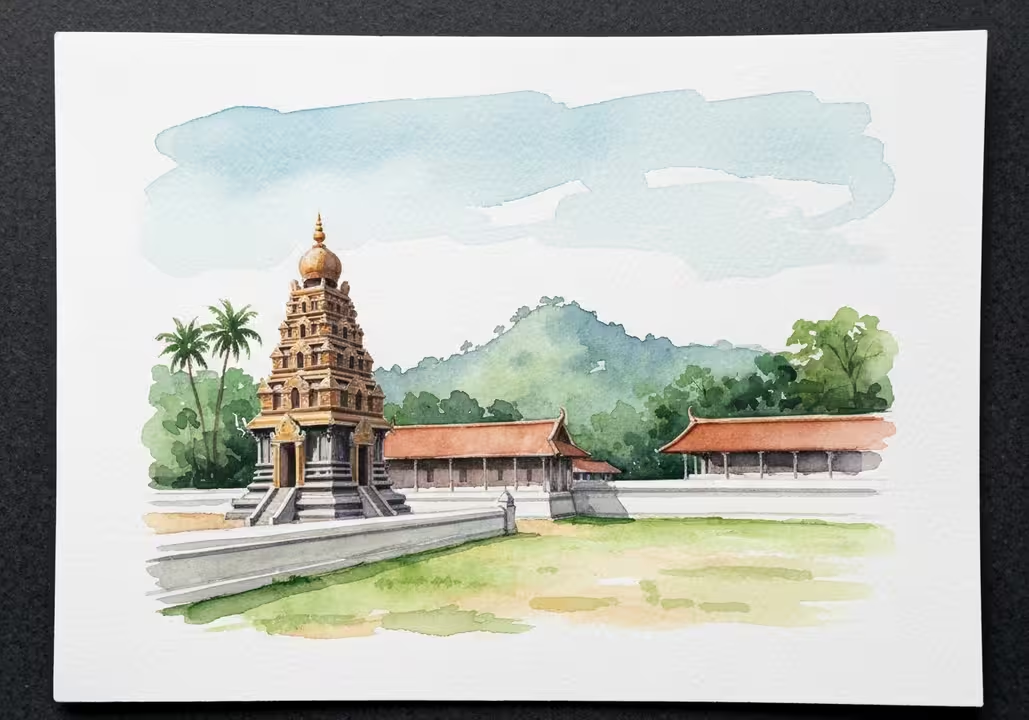
In the mid-14th century, as the island of Sri Lanka navigated through decades of shifting capitals and external threats, a new kingdom emerged in the verdant hills near what is now Kandy. The Kingdom of Gampola, established in 1341, would serve as the island’s capital for seven decades—a crucial bridge between the fragmenting medieval kingdoms and the powerful Kingdom of Kotte that would follow. Though often overshadowed by its predecessor Dambadeniya and successor Kotte, Gampola’s reign produced some of the most spectacular religious architecture in Sri Lankan history and maintained Sinhalese sovereignty during a period of unprecedented external pressure.
The Strategic Relocation
The establishment of Gampola as a capital city reflects the ongoing strategic calculus of medieval Sinhalese kings. For over a century, the island’s political center had been migrating southward and westward, away from the ancient heartlands of Anuradhapura and Polonnaruwa that had fallen to invasions. After Dambadeniya and Yapahuwa, the capital had briefly settled in Kurunegala. But by 1341, King Buwanekabahu IV recognized that a new location was needed.
Buwanekabahu IV, son of King Vijayabahu V of Kurunegala, ascended to power with the crucial support of General Senalankadhikara, a powerful military commander whose backing proved essential in the factional politics of the era. The king chose Gampola—originally known as Gangasiripura—as his new capital, drawn by its position in the protective embrace of Sri Lanka’s central highlands, yet still accessible to the western coastal regions that had become economically vital.
The site offered natural advantages. Nestled in a valley surrounded by hills, Gampola provided defensive depth against the invasions from the Jaffna Kingdom to the north while remaining connected to maritime trade routes. The location also placed the capital closer to the sacred city of Kandy, which was beginning to emerge as a religious and cultural center.
Buwanekabahu IV’s reign, though lasting only four years until his death in 1345, set the foundations for what would become a distinctive period in Sri Lankan history. His most lasting contribution would not be military conquests or administrative reforms, but the patronage of religious architecture that would define Gampola’s legacy for centuries to come.
A Dynasty of Brothers and Sons
The succession pattern in Gampola reveals the complex family politics that characterized medieval Sinhalese kingdoms. After Buwanekabahu IV’s death in 1345, power passed not to his son but to his brother, who ascended the throne as Parakramabahu V.
Parakramabahu V had previously ruled from Dedigama, a separate power center, before moving to Gampola to assume the throne. His fourteen-year reign (1345-1359) represented a period of relative stability, though the kingdom faced constant pressure from the powerful Jaffna Kingdom to the north, which had been growing increasingly aggressive throughout the 14th century.
The succession became contentious again in 1359 when Parakramabahu V was deposed by his nephew, Buwanekabahu IV’s son, who claimed the throne as Vikramabahu III. The circumstances of this overthrow remain murky in the chronicles, but tradition holds that Parakramabahu V was sent into exile in Malaya, a common fate for deposed monarchs who were too prestigious to execute but too dangerous to keep nearby.
Vikramabahu III and the Sacred Tooth
The reign of Vikramabahu III (1359-1374) marked the zenith of Gampola’s importance as a spiritual center. Understanding that legitimacy in Sri Lankan kingship derived as much from religious authority as military power, Vikramabahu III orchestrated a momentous event: the formal transfer of the Sacred Tooth Relic of the Buddha to Gampola.
The Dalada—the Buddha’s tooth relic—represented the ultimate symbol of rightful sovereignty in Buddhist Sri Lanka. Its possession by a king signified divine approval and legitimate rule. Throughout the turbulent centuries since Polonnaruwa’s fall, the relic had been moved repeatedly to protect it from invaders and to sanctify new capitals.
Vikramabahu III constructed a magnificent shrine at Niyamgampaya in Gampola to house the sacred relic. The transfer ceremony was conducted with elaborate rituals, and the king instituted a grand festival—a precursor to the famous Esala Perahera—to honor the relic’s presence in his capital. This religious celebration drew pilgrims from across the island, reinforcing Gampola’s position as not merely a political capital but a sacred center of Buddhist devotion.
The king’s reign also saw continued patronage of religious institutions. Buddhist monasteries flourished under royal protection, and the Sangha (monastic community) enjoyed the stability needed to maintain their scholarly and spiritual practices.
The Shadow of Jaffna
While Gampola’s kings focused on religious legitimacy and cultural development, they could not ignore the growing threat from the north. The Jaffna Kingdom, established by the Arya Chakravarti dynasty in the 13th century, had steadily expanded its power and influence. By the mid-14th century, Jaffna had become the dominant force in northern Sri Lanka, controlling not only the peninsula but extending its reach southward into territories that had traditionally belonged to Sinhalese kingdoms.
In 1353, during the reign of Parakramabahu V, the Jaffna king Gunapushanan (also known as Segarajasekeran IV) launched a major invasion southward. His forces swept through the northern regions of the Gampola Kingdom, capturing the Four Korales and other territories. The invasion extended Jaffna’s effective control down the northwestern coast as far as Puttalam, representing a significant loss of territory and revenue for Gampola.
When Vikramabahu III ascended the throne in 1359, he initially fled before Jaffna’s military might. The chronicles record this as a low point for Gampola’s prestige. However, the kingdom’s survival depended on more than just the king’s personal valor. The military and administrative apparatus, led by capable nobles, continued to function even when the monarch wavered.
Eventually, Vikramabahu III was forced into a humiliating accommodation: he agreed to become a tributary to Jaffna, paying regular tribute in exchange for peace. This subordinate status reflected the military realities of the era. The Jaffna Kingdom possessed superior military resources and could draw upon South Indian allies when needed, while Gampola’s armies, though capable of defending the central highlands, could not match Jaffna’s forces in open battle.
The Alagakkonara Resistance
While the king submitted to Jaffna’s overlordship, not all of his subjects accepted this arrangement. A nobleman named Alagakkonara, serving as chief minister, emerged as the leader of resistance against Jaffna’s expansion. Even after Vikramabahu III abandoned the field, Alagakkonara remained behind, determined to check Jaffna’s ambitions.
The Alagakkonara family, of South Indian origin, had risen to prominence in Sinhalese service and had become thoroughly integrated into the kingdom’s elite. They possessed both military capability and strategic vision. Alagakkonara began raising armies, building fortifications, and establishing a network of defensive strongpoints to contain Jaffna’s further expansion.
Most significantly, Alagakkonara established a fortified position at Sri Jayawardhanapura, known commonly as Kotte, located near the western coast. This fortress would prove to be far more than a military outpost—it was the seed of the next great Sinhalese kingdom. The walls of Kotte, designed by Alagakkonara, would eventually surround one of the most powerful capitals in Sri Lankan history.
The resistance organized by Alagakkonara prevented Jaffna from completely dominating the island. While Gampola paid tribute, the kingdom maintained its independence and internal autonomy. The Jaffna Kingdom found itself overstretched, facing simultaneous challenges from the resurgent Vijayanagar Empire in South India and the fortified resistance in Sri Lanka’s interior and western regions.
The Golden Age of Temple Architecture
Despite—or perhaps because of—the military and political uncertainties of the era, the Gampola period witnessed an extraordinary flowering of religious architecture. Kings and nobles, seeking to accumulate spiritual merit and demonstrate their devotion, commissioned a series of magnificent temples that blended Sinhalese traditions with architectural influences from South India.
The most spectacular of these monuments, built in the 1340s, constitute what is now known as the “Three Temple Loop”—Lankatilaka, Gadaladeniya, and Embekke—structures that represent the artistic pinnacle of the Gampola era.
Lankatilaka Viharaya, commissioned by King Buwanekabahu IV himself, stands as perhaps the most magnificent architectural achievement of the period. Completed in 1344, the temple was designed by an Indian architect named Sthapati Rayar, who created a unique synthesis of architectural styles. The building exhibits Sinhalese elements merged with Dravidian influences from South India and even echoes of Khmer architecture from Southeast Asia—a testament to the cosmopolitan cultural exchanges facilitated by maritime trade.
Built upon an uneven stone surface using brick and granite, Lankatilaka is cruciform in plan—an unusual shape for a Buddhist temple that suggests influences from diverse religious architectures. The temple rises in tiers, creating an impression of soaring verticality. Inside, the shrine room contains a massive standing Buddha image, and the walls preserve fragments of ancient murals depicting religious scenes. The very name “Lankatilaka” means “Jewel of Lanka,” and the temple certainly justifies this appellation.
Gadaladeniya Raja Maha Viharaya, also completed in 1344 during Buwanekabahu IV’s reign, represents another architectural triumph. Unlike Lankatilaka’s brick and granite construction, Gadaladeniya was built entirely of stone—a technical achievement requiring enormous skill given the temple’s position atop a rocky outcrop. The stone carvings at Gadaladeniya are particularly noteworthy, displaying intricate decorative patterns and religious motifs executed with precision and artistry.
The interior shrine room contains remarkable murals that have survived over 650 years, their colors still visible though faded by time. These paintings provide invaluable insights into the religious iconography, artistic conventions, and cultural aesthetics of 14th-century Sri Lanka. The temple’s architectural style again shows the characteristic Gampola blend of Sinhalese and Dravidian elements, reflecting the cultural exchanges between the island and the Indian subcontinent.
Embekke Devalaya, built during Vikramabahu III’s reign (1357-1374), serves a different purpose—it is a devale (shrine) dedicated to the deity Kataragama rather than a Buddhist temple. This reflects the religious pluralism of medieval Sri Lanka, where Buddhism coexisted with Hindu worship, particularly devotion to guardian deities believed to protect both the kingdom and the Buddhist religion itself.
Embekke’s fame rests primarily on its extraordinary wooden carvings. The devale’s pillars feature intricate designs carved into the wood with breathtaking skill. The motifs include dancers frozen in graceful poses, wrestlers engaged in combat, mythical creatures like swans and dragons, and elaborate floral patterns. Each pillar tells its own story, displaying variations on themes of nature, mythology, and human activity.
These wooden carvings have been recognized by UNESCO as among the finest examples of wood sculpture in the world. The fact that they have survived for over six centuries in Sri Lanka’s humid tropical climate speaks both to the quality of the wood selected and the preservation efforts of successive generations who recognized their value.
The Long Reign of Buwanekabahu V
After Vikramabahu III’s death in 1374, his nephew ascended the throne as Buwanekabahu V. His reign would prove to be remarkably long by the standards of the turbulent medieval period—lasting twenty-nine years until 1408. This extended period of relative stability allowed for continued cultural and economic development, even as political challenges mounted.
During Buwanekabahu V’s reign, the power of the Alagakkonara family continued to grow. The fortress at Kotte, initially established as a defensive position against Jaffna, evolved into an increasingly important urban center. Nobles began constructing residences there, merchants established themselves to take advantage of proximity to the coast, and the settlement’s population grew steadily.
The king seems to have recognized that Gampola’s position in the interior, while offering security, limited access to the maritime trade that was becoming increasingly crucial to the kingdom’s economy. The western coast, with its ports, connected Sri Lanka to the vast Indian Ocean trading networks that linked East Africa, Arabia, India, and Southeast Asia. Chinese ships were regular visitors, bringing porcelain and silk in exchange for spices, gems, and other Sri Lankan products.
The Chinese Connection and the Transition
The early 15th century brought a new element into Sri Lankan politics: direct Chinese involvement. The Ming Dynasty, under the Emperor Yongle, had launched ambitious naval expeditions into the Indian Ocean under the command of Admiral Zheng He (known in Sri Lankan sources as Cheng Ho). These massive fleets, comprising dozens of ships and thousands of sailors, visited ports throughout the Indian Ocean world to establish Chinese prestige and tributary relationships.
Zheng He’s fleet visited Sri Lanka multiple times between 1405 and 1433. These visits had profound effects on Sri Lankan politics. The Ming court expected tributary relationships—formal acknowledgment of Chinese superiority in exchange for trade privileges and imperial recognition. The diplomatic complexities this created for Sri Lankan kings were considerable.
During this period, the Alagakkonara family effectively controlled Kotte, which had become the kingdom’s most important city despite Gampola remaining the nominal capital. The relationship between Gampola and Kotte grew increasingly complex. Some chronicles suggest that the Alagakkonara rulers were essentially autonomous, governing Kotte and the western regions while acknowledging Buwanekabahu V’s nominal overlordship.
When Buwanekabahu V died in 1408, the succession became contentious. Vira Alakesvara, also known as Vijayabahu VI, of the Alagakkonara family, claimed the throne. This marked the effective transfer of power from Gampola to Kotte, though the transition was not smooth.
In 1411, Zheng He returned to Sri Lanka. The Chinese admiral, displeased by the political situation—the specific reasons remain debated by historians—took the extraordinary step of arresting Vijayabahu VI and carrying him off to China to face the Ming Emperor. This dramatic intervention effectively ended the Gampola Kingdom’s existence as an independent power.
After 1411, Kotte emerged as the undisputed capital of the Sinhalese kingdom, marking the beginning of a new era. Gampola faded as a political center, though it retained religious and cultural significance.
Legacy in Stone and Wood
Today, Gampola itself is a bustling town in the Kandy District, its royal past visible primarily in the magnificent temples that survived the centuries. The three great temples—Lankatilaka, Gadaladeniya, and Embekke—remain active religious sites, maintained by Buddhist monks and Hindu priests, continuing their sacred functions after more than 650 years.
These architectural monuments represent the Gampola Kingdom’s most enduring contribution to Sri Lankan civilization. They demonstrate the sophisticated artistic culture that flourished during this period, the technical capabilities of 14th-century craftsmen, and the cosmopolitan nature of the kingdom, which absorbed and synthesized influences from South India, Southeast Asia, and the broader Indian Ocean world.
The wooden carvings at Embekke, in particular, provide an invaluable window into the aesthetic sensibilities and artistic techniques of the medieval period. The motifs carved into the pillars—dancers, wrestlers, animals, and mythological creatures—reflect both religious symbolism and the daily life of the era. These carvings influenced subsequent generations of Sri Lankan woodworkers and remain studied by artisans and scholars today.
The Gampola period also preserved and transmitted literary and religious texts. Monasteries patronized by the kings served as centers of learning where monks copied manuscripts, studied Buddhist philosophy, and maintained the intellectual traditions of Sinhalese Buddhism. Though fewer literary works survive from Gampola compared to the preceding Dambadeniya period, the kingdom played a crucial role in maintaining these cultural traditions during a time of political fragmentation.
A Bridge Between Eras
The Kingdom of Gampola occupies a unique position in Sri Lankan history. It was not a kingdom of dramatic military conquests or revolutionary political innovations. Its kings often found themselves in subordinate positions, paying tribute to Jaffna or negotiating carefully with Chinese admirals. The capital shifted during its existence, and power gradually migrated from the king to powerful noble families like the Alagakkonaras.
Yet Gampola endured for seven decades—longer than many more celebrated kingdoms—and during that time maintained the continuity of Sinhalese Buddhist civilization. The kingdom served as a bridge between the fragmenting medieval kingdoms and the more unified and powerful Kingdom of Kotte that would follow. It demonstrated that political power in 14th-century Sri Lanka required more than military might; it depended on religious legitimacy, cultural patronage, strategic alliances, and the ability to navigate between competing regional powers.
The temples built during this period stand as testimony to what the kingdom valued most: religious devotion, artistic excellence, and the creation of sacred spaces that would endure long after palaces crumbled and kings were forgotten. In this, the Gampola Kingdom succeeded magnificently. Seven centuries later, pilgrims still climb to Lankatilaka, worship at Gadaladeniya, and marvel at Embekke’s wooden pillars—not because they remember the political intrigues of 14th-century kings, but because the beauty and sanctity created during that era continue to inspire devotion and wonder.
Gampola reminds us that kingdoms should be measured not only by their military victories or territorial extent, but by what they create and preserve for future generations—and by that measure, this transitional kingdom’s legacy shines as brightly as any in Sri Lankan history.