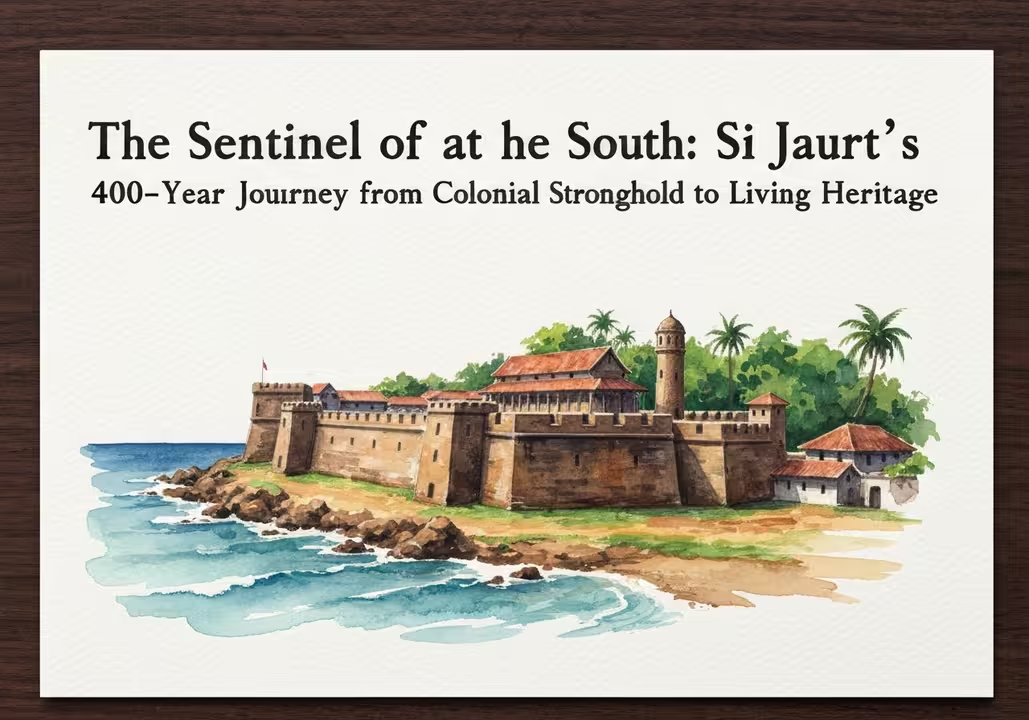
On the southwestern coast of Sri Lanka, where the Indian Ocean crashes against ancient ramparts of coral and granite, stands one of the most remarkable testaments to colonial architecture in Asia. Galle Fort, a 130-acre fortified city, tells a story that spans four centuries, three empires, and countless lives—a story of conquest and trade, architectural ambition and cultural fusion, devastation and renewal.
The Portuguese Foundation: A Hasty Beginning
The story of Galle Fort begins not with grand ambition, but with desperation. In 1588, Portuguese forces, under attack by King Raja Singha I of Sitawaka, retreated to the coastal settlement of Galle. With enemy forces pressing, they hastily constructed a simple fort named Santa Cruz de Gale from earth and wooden palisades. This rudimentary fortification featured a rampart and three bastions protecting the northern landside approach. The Portuguese, confident in the natural defenses of the peninsula, left the seaward side largely unfortified—a decision that would prove shortsighted.
For over half a century, this modest earthwork fort served as a Portuguese outpost in their lucrative cinnamon trade network. But it was merely a prelude to the architectural transformation that would follow.
The Dutch Masterpiece: Engineering Colonial Power
On March 13, 1640, everything changed. Combined Dutch forces under Commander Coster overpowered the Portuguese garrison and seized control of Galle. What happened next would create one of the finest examples of military architecture in the entire South and Southeast Asian region.
Beginning in 1649, the Dutch East India Company embarked on an ambitious fortification project that would span decades. Unlike their Portuguese predecessors, the Dutch approached Galle with meticulous planning and substantial resources. They envisioned not merely a military outpost, but a fully functioning fortified city that would serve as the jewel of their Ceylon operations.
The year 1663 marked the completion of most fortification walls—massive structures built from coral, granite, and limestone that would encircle the entire 52-hectare peninsula. These ramparts, measuring approximately two kilometers in circumference, rose up to 10 meters high and several meters thick, creating an imposing barrier against both sea and land attacks. The sea wall, an engineering feat of particular complexity, wasn’t completed until 1729, representing decades of continuous construction and refinement.
Fourteen Bastions: The Architecture of Defense
The crown jewels of Dutch military engineering were the fourteen strategically positioned bastions that punctuated the fort’s walls. Each bastion had its own character and purpose, many retaining their Dutch names to this day: Sun, Moon, and Star—the three imposing landside bastions that defended at two levels with both short-range and long-range cannons; Zwart, the oldest bastion standing guard along the eastern wall; and others including Akersloot, Aurora, Point Utrecht, Triton, Neptune, Clippenburg, Flagrock, Aeolus, Fishmark, and Commandment.
These bastions reflected sophisticated European fortification knowledge adapted to unfamiliar South Asian conditions. They weren’t merely defensive structures but carefully engineered platforms for artillery, surveillance, and force projection. The triangular projections created overlapping fields of fire, ensuring no attacker could approach the walls without exposure to multiple cannon positions.
A City Within Walls: Dutch Urban Planning Meets Tropical Reality
What truly distinguished Galle Fort from other colonial installations was its character as a complete urban ensemble. The Dutch imposed their traditional street grid pattern—a systematic parcelling of blocks designed to create orderly clusters of buildings within the limited fortified area. But this wasn’t simply European urbanism transplanted to the tropics; it represented something more remarkable.
The streets that emerged showcased a unique architectural fusion. Rows of houses presented their narrow gabled ends to the street in classic Dutch fashion, but adapted to tropical conditions with high overhanging roofs supported on slender columns. These verandas, shaded and open to cooling breezes, created distinctive streetscapes that were neither purely European nor traditionally South Asian, but something entirely new—a colonial vernacular born of climate, materials, and cultural encounter.
The inscription on the Old Gate, completed in 1669, proudly displayed the VOC monogram of the Vereenigde Oostindische Compagnie (United East India Company), announcing Dutch dominion over this strategic port. Behind those gates, the fort contained administrative buildings, warehouses filled with cinnamon and other spices, business houses conducting trade across the Indian Ocean, residential quarters for Dutch officials and local inhabitants, and churches serving the spiritual needs of the colony.
The Groote Kerk: Faith in Stone
In 1755, the Dutch constructed what would become one of Galle Fort’s most enduring landmarks—the Dutch Reformed Church, known as Groote Kerk. Built at the highest point inside the fort, 12 meters above sea level, the church embodied Dutch Reformed theology in architectural form. Its design followed a Greek cross plan with Doric features similar to Colombo’s Wolvendaal Church. The building was austere yet dignified, eschewing Catholic ornamentation for Protestant simplicity, yet commanding attention through its proportions and prominent position.
This church wasn’t merely a place of worship; it was a statement of cultural and religious authority, a permanent marker of Dutch Reformed presence on the Indian Ocean’s shores.
British Modifications: A New Empire’s Stamp
On February 23, 1796—just one week after capturing Colombo—British forces took control of Galle Fort. The age of Dutch dominion had ended, but the physical legacy would endure. The British, pragmatic colonizers, didn’t rebuild; instead, they modified and adapted the Dutch infrastructure to their own needs.
British alterations to Galle Fort reflected different priorities. They closed the defensive moat, built additional houses for their administration, and erected new landmarks that would add to the fort’s architectural layers. In 1871, they constructed All Saints Anglican Church in Victorian Gothic Revival style, its basilica plan and pointed arches contrasting sharply with Dutch Reformed austerity. In 1882, a clock tower rose to commemorate Queen Victoria’s Golden Jubilee, another British monument amid Dutch foundations. Most prominently, in 1939, they built the iconic 59-foot Galle Lighthouse atop the Utrecht Bastion, its white tower becoming the fort’s most recognizable landmark.
Yet despite these additions, Galle’s importance to the British diminished significantly. After developing Colombo as their colonial capital and main port in the mid-nineteenth century, Galle became a secondary concern—a historic backwater rather than a vital hub. This decline, though economically painful, would paradoxically help preserve the fort’s Dutch character for future generations.
Recognition and Rebirth: UNESCO World Heritage Status
For decades after Sri Lanka gained independence in 1948, Galle Fort existed in a kind of suspended animation—inhabited, functional, but underappreciated. That changed dramatically in 1988 when UNESCO designated the Old Town of Galle and its Fortifications as a World Heritage Site.
The UNESCO inscription, made under criterion iv, recognized Galle Fort’s “unique exposition of an urban ensemble which illustrates the interaction of European architecture and South Asian traditions from the 16th to the 19th centuries.” It was officially acknowledged as the best example of a fortified city built by Europeans in South and Southeast Asia—a place where European architectural styles and planning principles had genuinely fused with South Asian traditions rather than simply imposing themselves upon local culture.
This recognition transformed how both Sri Lankans and international visitors perceived the fort. It was no longer merely an old colonial relic but a treasure of global significance, worthy of preservation and celebration.
The 2004 Tsunami: Disaster and Restoration
On December 26, 2004, the Indian Ocean tsunami tested Galle Fort’s centuries-old defenses in ways its Dutch and Portuguese builders could never have imagined. The massive walls that had been built to repel human invaders stood against nature’s fury, providing some protection to the old town even as surrounding areas suffered catastrophic damage. Many buildings within the fort were damaged, though the fortifications themselves proved remarkably resilient.
The tsunami’s aftermath sparked significant restoration efforts. The Sri Lankan government’s Ministry of Cultural Affairs launched an ambitious project for renovation and reconstruction, carefully paying attention to original architectural styles to retain the fort’s historical character. The Galle Heritage Foundation coordinated restoration work, with financial support notably coming from the Netherlands—a gesture connecting the fort’s Dutch past with its contemporary preservation.
A Living Heritage: Modern Transformation and Challenges
Today, Galle Fort exists as what heritage specialists call a “living heritage site”—not a museum frozen in time, but a dynamic urban neighborhood where history and modernity coexist. Approximately 400 residential properties house a community that has inhabited these streets for generations, while the fort has also become a magnet for tourism, culture, and commerce.
This transformation has brought both vitality and tension. Colonial-era warehouses have become boutique hotels and art galleries. Dutch administrative buildings now house museums, including the National Maritime Archaeology Museum in a seventeenth-century warehouse built around 1669 to store spices and ship equipment. The Historical Mansion Museum displays one of Sri Lanka’s largest collections of historical artifacts. Cafes and shops line Church Street and Pedlar Street, catering to the steady stream of visitors drawn by UNESCO recognition.
The success of heritage tourism has sparked concerns about gentrification and the preservation of community character. Debates about sustainable tourism, responsible development, and the rights of long-term residents continue as the fort navigates the challenge of honoring its past while building its future. Post-pandemic tourism initiatives have increasingly emphasized community involvement, support for local businesses, and ensuring that tourism development enhances rather than overwhelms the fort’s cultural and historical essence.
An Enduring Legacy
Walking along Galle Fort’s ramparts at sunset, with the lighthouse standing sentinel and the ocean stretching endlessly southward, one encounters 400 years of human ambition, conflict, creativity, and adaptation compressed into 130 acres. The Portuguese who built the first desperate earthworks, the Dutch engineers who spent decades creating massive stone fortifications, the British administrators who added their own architectural flourishes, and the Sri Lankan families who have made these ancient streets their home—all have left their marks on this remarkable place.
Galle Fort stands as proof that colonial history, however complicated and contested, has created architectural heritage worthy of preservation. It demonstrates how military architecture can evolve into civic space, how defensive walls can become promenades, and how structures built for war and commerce can become foundations for community and culture.
The fort’s greatest achievement may be its demonstration that heritage sites need not be static monuments but can be living, breathing urban spaces where history informs the present and the future. As the waves continue their eternal assault on ramparts built centuries ago by Dutch engineers, Galle Fort remains what it has always been: resilient, adaptive, and utterly unique—the sentinel of the south, standing watch over Sri Lanka’s coastal heritage.