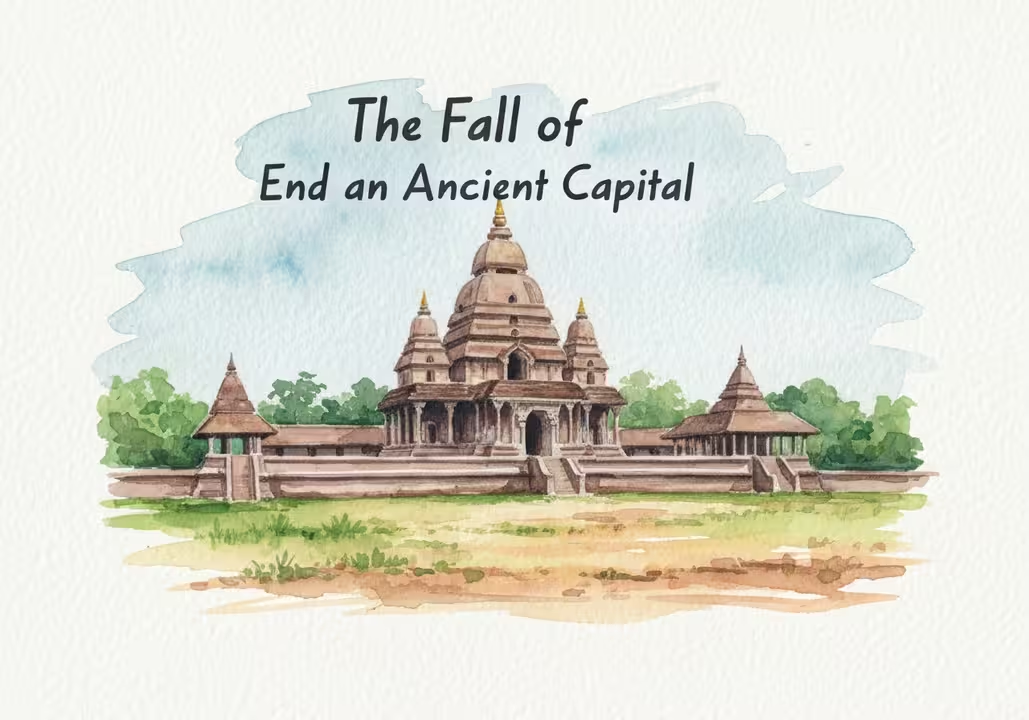
For over fourteen centuries, the sacred city of Anuradhapura stood as the beating heart of Sinhalese Buddhist civilization. From its founding in the 5th century BCE until the fateful year of 1017 CE, this magnificent capital witnessed the rise and fall of dynasties, the construction of architectural marvels that rivaled any in the ancient world, and the flowering of a sophisticated hydraulic civilization that transformed the northern dry zone into a prosperous kingdom. Yet even the mightiest empires are not eternal, and Anuradhapura’s fall would mark not just the end of a capital, but the conclusion of an entire epoch in Sri Lankan history.
The Glory That Was Anuradhapura
To understand the magnitude of Anuradhapura’s fall, one must first appreciate the heights from which it descended. For approximately 1,500 years, Anuradhapura served as Sri Lanka’s capital, making it one of the longest-continuously inhabited cities in human history. This was no mere administrative center, but the cradle of Sinhalese civilization and Theravada Buddhism on the island.
The city’s achievements in hydraulic engineering alone secured its place among the great civilizations of the ancient world. Situated in the northern dry zone where rainfall was seasonal and uncertain, Anuradhapura’s kings developed a remarkably sophisticated irrigation system that became the kingdom’s greatest material achievement. Kings like Vasabha constructed 11 tanks and 12 canals, while Mahasena built 16 reservoirs and extensive waterways. The crowning jewel was the Jayaganga canal, stretching 54 miles with a gradient of just six inches per mile—a feat of engineering precision that demonstrated the builders’ expert knowledge and sophisticated measuring techniques.
These irrigation works were not simply impressive; they were essential to the kingdom’s prosperity. The reservoirs and canals transformed the arid landscape into fertile agricultural land capable of supporting a large population and funding the construction of monuments that would define the city’s skyline for centuries.
Among these monuments, the Buddhist stupas stood paramount. The Jetavanaramaya, built by King Mahasena, soared to 122 meters, making it one of the tallest structures in the ancient world—a testament to both engineering prowess and religious devotion. The Ruwanwelisaya, commissioned by King Dutugemunu, became one of the most sacred sites in Theravada Buddhism. These massive domed structures, along with elaborate monasteries like the Abhayagiri and the multi-storied Lovamahapaya, transformed Anuradhapura into a pilgrimage destination that attracted Buddhist monks and devotees from across Asia.
At the heart of the city’s spiritual identity stood the Jaya Sri Maha Bodhi, a sapling from the original Bodhi tree under which the Buddha attained enlightenment, brought to Sri Lanka in the 3rd century BCE. This living connection to Buddhism’s founding moment made Anuradhapura not just a political capital, but a sacred center of the Buddhist world.
Seeds of Decline
Yet by the late 10th century CE, cracks had begun to appear in the foundation of this ancient civilization. The kingdom that had withstood invasions and internal conflicts for over a millennium now faced a perfect storm of challenges that would prove insurmountable.
The Anuradhapura kingdom had engaged in a perpetual power struggle with South Indian dynasties—the Pallavas, Pandyas, and Cholas—for centuries. These conflicts had escalated during the late Anuradhapura period (5th to 10th centuries CE), creating an era characterized by chronic instability. Internal revolts compounded the external threats, weakening the kingdom’s administrative capacity and military readiness.
The reign of Mahinda V (982-1017 CE), who would become Anuradhapura’s last king, began under inauspicious circumstances. The Mahavamsa chronicles describe a severe economic crisis gripping the kingdom at the end of the 10th century. The royal treasury, drained by constant warfare and lavish construction projects of previous rulers, could no longer meet its obligations. Most critically, Mahinda V found himself unable to pay his mercenary troops—a fatal weakness in a kingdom that had come to rely heavily on hired Tamil soldiers to supplement its military forces.
When payment failed to materialize, the Tamil mercenaries did what unpaid soldiers throughout history have done: they revolted. The king who could not control his own army found his authority evaporating. Turbulent local chiefs and intractable rebels, whose allegiance had always been opportunistic at best, saw the weakness at the center and acted accordingly. The carefully maintained hierarchy of power that had sustained the Anuradhapura kingdom for centuries began to unravel.
The Chola Storm
Across the Palk Strait, a keen observer watched these developments with great interest. Rajaraja I, emperor of the Chola dynasty, had built his South Indian kingdom into one of the most formidable military powers in medieval Asia. The chaos in Sri Lanka presented an opportunity too tempting to ignore.
In 993 CE, Rajaraja I launched a massive invasion of the Anuradhapura kingdom. His timing was impeccable. With Mahinda V distracted by the revolt of his mercenary troops and facing rebellions across his realm, organized resistance proved impossible. The Sinhalese king, unable to mount an effective defense of his capital, fled southward to Rohana, the southeastern province that had served as a refuge for Sinhalese resistance throughout history.
The Chola forces swept through the northern plains with devastating efficiency. The Culavamsa, the Great Chronicle that continues the history begun in the Mahavamsa, records in stark terms what followed: Anuradhapura was “utterly destroyed in every way by the Chola army.” The city that had stood for over thirteen centuries, that had survived countless invasions and internal upheavals, now lay in ruins.
Taking advantage of the complete collapse of Sinhalese authority in the north, Rajaraja I made a strategic decision that would alter Sri Lankan history. Rather than attempt to rebuild the devastated ancient capital, he moved his administrative center to Polonnaruwa, approximately 100 kilometers to the southeast. This settlement offered distinct military advantages—it was more defensible and closer to the eastern ports that connected the occupied territories to the Chola homeland. The Cholas renamed their new capital “Mummudi-sola-mandalam” after their emperor, a name that proclaimed their dominance over the conquered lands.
The Final Blow
The invasion of 993 CE, devastating as it was, proved to be only the beginning of Anuradhapura’s ordeal. In 1014 CE, Rajaraja I’s son, Rajendra Chola I, launched another massive campaign against the island. This time, Chola forces pushed beyond the northern territories to conquer most of Sri Lanka. The scattered resistance that Mahinda V had managed to organize from his refuge in Rohana proved ineffective against the Chola military machine.
By 1017 CE—in the 36th year of Mahinda V’s reign, as the Mahavamsa carefully notes—the conquest was complete. Rajendra Chola I’s forces hunted down the fugitive king and captured him along with his family. The last king of Anuradhapura was taken in chains across the strait to South India, a prisoner in a foreign land. The conquered territories were formally incorporated as a province of the vast Chola Empire. Mahinda V would never see his homeland again; he died in captivity in India in 1029 CE, twelve years after his kingdom’s final fall.
The symbolic and practical significance of the king’s capture cannot be overstated. In the worldview of ancient and medieval Sri Lanka, the king was not merely a political leader but the dharmmaraja—the righteous ruler whose virtue sustained the cosmic order and ensured the prosperity of the land and people. His capture and deportation represented not just military defeat, but a rupture in the fundamental order of Sinhalese Buddhist civilization.
Aftermath and Migration
The Chola occupation that followed would last approximately three-quarters of a century, from 993 to 1070 CE. For the Sinhalese people, these decades represented far more than foreign political control. Temples were neglected or desecrated, monasteries stood abandoned, and the ancient traditions that had defined the island’s Buddhist character for over a millennium seemed destined for extinction. The sophisticated irrigation systems, which had required constant maintenance and centralized coordination, fell into disrepair as the social order that sustained them collapsed.
Yet resistance never entirely ceased. From the southern reaches of the island, Sinhalese princes continued to organize opposition to Chola rule. Finally, in 1070 CE, Prince Vijayabahu I, after seventeen years of guerrilla warfare, succeeded in expelling the Chola forces and reclaiming the island. When he emerged victorious, he faced a momentous decision: should he attempt to restore Anuradhapura to its former glory, or acknowledge the new reality?
Vijayabahu I chose pragmatism over sentiment. Though he had himself crowned at Anuradhapura in deference to tradition, he established his permanent capital at Polonnaruwa. The strategic advantages that had appealed to the Cholas—defensibility and access to trade routes—made equal sense for a reunited kingdom that still faced potential threats from South India. Moreover, the extensive destruction that Anuradhapura had suffered during decades of warfare made its restoration a daunting, perhaps impossible, task.
Thus, in a profound irony, the Chola invaders who had sought to destroy Sinhalese civilization inadvertently determined the location of its next flourishing. Polonnaruwa would go on to witness a golden age under kings like Parakramabahu I and Nissanka Malla, but it would never again be Anuradhapura. The ancient capital, which had nurtured Sri Lankan civilization for over 1,400 years, passed into history.
The End of an Era
The fall of Anuradhapura marked more than the abandonment of a city; it represented the end of Sri Lanka’s ancient period and the conclusion of the island’s hydraulic civilization in the northern dry zone. Never again would the Rajarata basin—the “King’s Country” that had been the heartland of power for fifteen centuries—serve as the center of Sinhalese authority.
The reasons for Anuradhapura’s fall were complex and interconnected. The immediate cause was military: the Chola invasions of 993 and 1017 CE. But these invasions succeeded because of deeper structural weaknesses. The economic crisis that prevented Mahinda V from paying his troops reflected long-term fiscal problems. The revolt of the mercenaries and local chiefs revealed the erosion of central authority. The inability to mount effective resistance demonstrated how internal divisions had sapped the kingdom’s strength.
In a broader sense, Anuradhapura fell victim to the same challenges that have toppled empires throughout history: overextension, administrative decay, economic strain, and the rise of more powerful neighbors. The sophisticated irrigation systems that had been the kingdom’s greatest achievement also represented a vulnerability. These massive public works required constant maintenance, centralized coordination, and social stability to function. When warfare and chaos disrupted this delicate balance, the entire system could rapidly collapse.
Legacy of the Sacred City
Though Anuradhapura’s political power ended in 1017 CE, its spiritual significance never diminished. Even as successive capitals rose and fell—Polonnaruwa, Dambadeniya, Yapahuwa, Kurunegala, Gampola, Kotte, and finally Kandy—Anuradhapura remained the sacred city, the birthplace of Sinhalese Buddhist civilization.
The ruins that remained—the towering stupas, the ancient monasteries, the Bodhi tree still growing in its sacred enclosure—became pilgrimage sites that drew devotees across the centuries. Kings from later capitals sent missions to restore the monuments and maintain the sacred sites, acknowledging Anuradhapura’s special place in the island’s spiritual geography.
In 1982, UNESCO recognized Anuradhapura as a World Heritage Site, acknowledging its significance not just to Sri Lanka but to world civilization. Today, the ancient city stands as both an active religious center and an archaeological treasure, its monuments attracting pilgrims seeking spiritual merit and tourists marveling at the achievements of a civilization that flourished over a millennium ago.
The irrigation works, though long abandoned, remain visible across the landscape. Modern archaeologists and engineers continue to study these ancient systems, gaining insights into the sophisticated knowledge that created them. Some of the reservoirs have been restored and once again serve local agriculture, creating a tangible link between past and present.
Lessons of History
The fall of Anuradhapura carries lessons that resonate across time. It reminds us that even civilizations that seem eternal can fall, that internal weakness makes external threats far more dangerous, and that the failure to address economic and social problems can have catastrophic consequences.
Yet Anuradhapura’s story is not ultimately one of failure, but of extraordinary achievement. For over 1,400 years, this city served as the heart of a sophisticated civilization. It developed engineering solutions that allowed prosperity in an challenging environment. It created monuments of lasting beauty and spiritual significance. It nurtured a Buddhist culture that spread across Asia and continues to shape lives today.
The civilization that built Anuradhapura proved resilient enough to survive the city’s fall. Though the capital moved, the culture persisted. The values, traditions, and religious practices that had been nurtured in Anuradhapura’s monasteries and palaces continued in Polonnaruwa and beyond, adapting to new circumstances while maintaining essential continuities.
As the tropical sun sets over the ancient dagobas of Anuradhapura, casting long shadows across ruins that have stood for over two millennia, the city continues to tell its story—of human ambition and achievement, of civilization’s heights and vulnerabilities, and of a sacred city whose spiritual significance has outlasted its political power. The fall of Anuradhapura was an ending, certainly, but it was also a transformation, a reminder that while kingdoms may fall, the cultural and spiritual legacies they create can endure across the centuries.