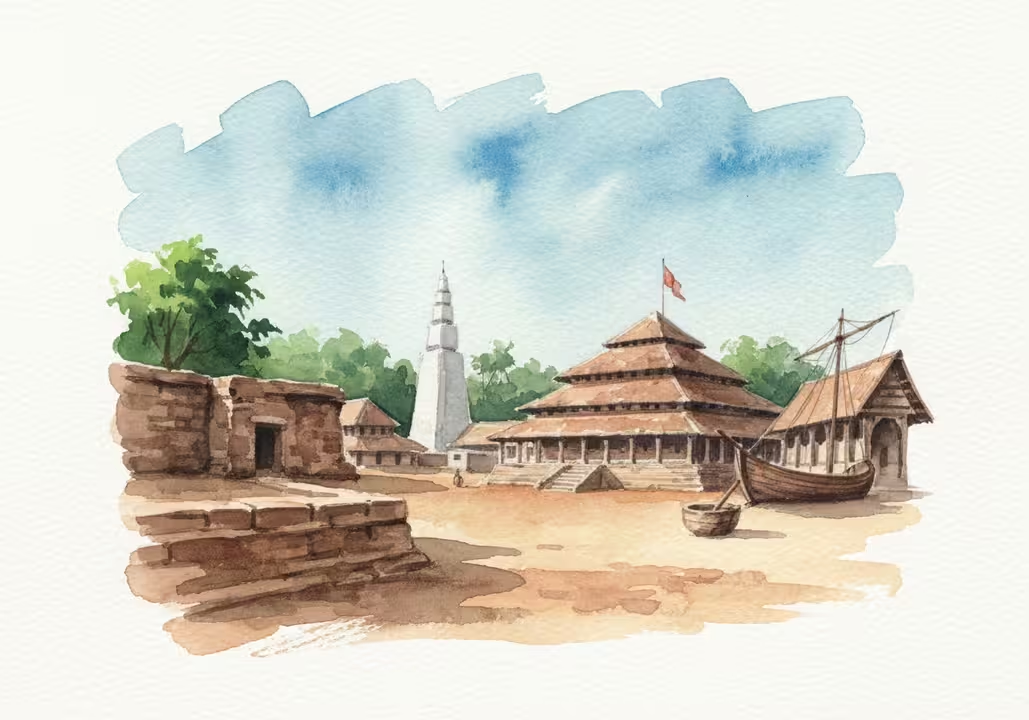
For nearly two thousand years, the island known to ancient Greeks as Taprobane and to Arabs as Serendib served as one of the most crucial maritime hubs in the Indian Ocean. Sri Lanka’s strategic location at the crossroads of sea routes connecting the Mediterranean, Persia, India, China, and the Spice Islands of Indonesia transformed its natural harbors into bustling centers of international commerce. Archaeological evidence reveals a sophisticated network of ports that facilitated trade in precious gems, fragrant spices, and exotic goods between East and West, making ancient Sri Lanka an essential node in the legendary Maritime Silk Road.
The Great Ports of Ancient Lanka
Mantai: The Premier Emporium
At the mouth of the Malvatu River on Sri Lanka’s northwestern coast lay Mantai, known in ancient times as Mahatittha. For nearly two millennia, from the 5th century BCE to the 13th century CE, this port served as one of the Indian Ocean’s most important trading centers. The 6th century CE Greek merchant Cosmas Indicopleustes described Mantai as “the most important emporium in the Indian Ocean during his lifetime”—high praise from a seasoned trader who had traveled extensively across the maritime world.
Mantai’s strategic importance derived from its direct river access to Anuradhapura, the ancient capital located upstream on the banks of the same Malvatu River. This connection enabled goods from across the Indian Ocean to flow directly into the heart of the kingdom, while Sri Lankan exports could easily reach international markets. The town appeared on Claudius Ptolemy’s map of Sri Lanka in the 2nd century CE, testifying to its recognition across the classical world.
Archaeological excavations in the 1980s uncovered remarkable evidence of Mantai’s global connections. Among the discoveries were processed wheat grains dated to 100-200 CE and grape seeds dated to 650-800 CE—exotic agricultural products that could only have arrived through trade with Arabia or the Roman world. Contemporary Chinese records noted that Persia-bound vessels from China stopped at the “flourishing port of Mantota” to trade in gems, spices, and ivory. The port’s cosmopolitan nature is evident from artifacts originating from multiple countries, recovered during excavations before civil conflict disrupted archaeological work in 1983.
Godavaya: The Ancient Harbor
On the southern coast, the port of Godavaya served as another vital link in ancient Sri Lanka’s maritime network. An inscription from the reign of King Gajabahu I (114-136 CE) found at the site records that customs duties collected at this port were dedicated to the Godapavata Vihara, demonstrating both the port’s economic significance and the integration of trade revenue into religious patronage.
German archaeologists excavating at Godavaya in the 1990s discovered a sophisticated harbor complex featuring a jetty constructed from stone pillars reaching up to 3.5 meters in height. The site also revealed customs houses, clay seals for marking official documents and goods, Roman coins, and pottery from various origins—evidence of a well-organized port equipped to handle international commerce.
The most spectacular discovery at Godavaya came in 2003, when local fishermen stumbled upon a shipwreck lying 33 meters below the ocean’s surface. Advanced radiocarbon dating confirmed the vessel dated to approximately the 2nd century BCE, making it the oldest known shipwreck in the entire Asia-Pacific region. The ship, likely an Indian or South Asian trading vessel, carried a cargo of raw materials including hundreds of glass ingots, iron and copper ingots, grinding stones, and ceramic bowls. This 2,100-year-old wreck provides tangible evidence of the regular commercial voyages that connected Sri Lanka to India and beyond during the ancient period.
Full-scale excavation of the Godavaya shipwreck began in 2012-2013 with a multinational team of maritime archaeologists from the United States, France, Sri Lanka, and Turkey. Nearly 200 artifacts have been recovered and preserved, with advanced 3D modeling techniques creating a comprehensive digital record of the site. These treasures now contribute to our understanding of ancient maritime technology, trade networks, and economic exchange.
Jambukola: Gateway to North India
The northern port of Jambukola (modern Kankesanturai) held special significance as the primary gateway between Sri Lanka and North India, particularly Bengal (known as Tamralpiti in ancient texts). Historical records indicate that envoys of King Devanampiyatissa departed from Jambukola when they set sail for the court of Emperor Ashoka of India—a diplomatic mission that would lead to the introduction of Buddhism to Sri Lanka in the 3rd century BCE.
A dedicated highway connected Jambukola directly to Anuradhapura, ensuring rapid movement of goods and travelers between the capital and this vital northern port. This infrastructure investment underscores the port’s strategic and economic importance to the ancient kingdom.
Gokanna: The Eastern Port
After the 7th century CE, the principal arena for East-West exchange trade shifted from the Arabian Sea to the Bay of Bengal. This maritime reorientation brought increased importance to Gokanna (modern Trincomalee) on Sri Lanka’s eastern coast. Blessed with one of the finest natural deep-water harbors in South Asia, Trincomalee became increasingly significant for trade with Southeast Asia and China.
Galle: The Southern Jewel
The natural harbor of Galle on the southern coast gained prominence by at least the mid-14th century. The remarkable Galle Trilingual Inscription, erected in 1411 and discovered in the city in 1911, stands as testament to the port’s international character. Written in Chinese, Tamil, and Persian, the inscription commemorates the visit of Chinese Admiral Zheng He’s treasure fleet and describes donations made to the famous Tenavarai Nayanar temple.
This multilingual monument reveals the diverse merchant communities that frequented Galle—Chinese, Muslim, South Indian Hindu, and Jain traders all conducted business at this cosmopolitan port. Arabic tombstones found at Galle, along with Sufi inscriptions discovered in Colombo, provide evidence that Islam was practiced on the island as early as the 10th century CE, brought by Arab merchants who dominated much of the Indian Ocean trade.
The Treasures of Lanka: Export Goods
Ancient Sri Lanka’s prosperity derived from its rich natural resources, which commanded high prices in markets from Rome to China. The island earned the Sanskrit name “Ratnadveepa”—Isle of Gems—from the abundance of precious stones found in its central highlands.
Gems and Pearls
Sri Lankan gems ranked among the most prized commodities in the ancient world. Sapphires, amethysts, cat’s eyes, garnets, and numerous other precious and semi-precious stones were extracted from the island’s gem-bearing gravels and exported across the known world. Dark red garnets from Sri Lanka have been found in archaeological sites as far away as Staffordshire, England, dating to around 600 CE. Muslim writers particularly noted the valuable gemstones available from the island, listing sapphires, amethysts, and cat’s eyes among the treasures.
Pearls from the Gulf of Mannar fisheries gained fame from as early as the time of Kautilya (4th century BCE). These lustrous gems from the sea provided a major source of foreign exchange and were particularly valued in Roman markets. Ancient texts describe how pearls were harvested through dangerous diving expeditions in the waters between Sri Lanka and southern India.
Cinnamon and Spices
Ancient Greek and Indian texts from the 3rd century BCE to the 3rd century CE describe Lanka as the “Spice Island,” famous for cinnamon, pepper, cardamom, and cloves. True cinnamon (Cinnamomum verum) was endemic to Sri Lanka and commanded astronomical prices in European and Middle Eastern markets, where it was valued for both culinary and medicinal purposes.
Arab merchants were among the first to recognize the commercial value of Ceylon spices, transporting them to the Middle East and beyond. Arabian vessels carrying Eastern spices to European markets necessarily stopped at Sri Lankan ports, positioned halfway along their sea routes, to take on fresh water and provisions. Chinese explorers, including Admiral Zheng He, visited Sri Lanka specifically to acquire spices for medicinal and culinary uses.
The value placed on these aromatic substances in the ancient world cannot be overstated. Spices served as preservatives, flavorings, medicines, and status symbols. Control of the spice trade brought immense wealth to those who commanded it.
Additional Exports
Beyond gems, pearls, and spices, Sri Lankan merchants exported a diverse array of valuable goods: elephants prized for warfare and ceremonial purposes, ivory for luxury crafts, tortoise shell for ornamental work, valuable timber, fine textiles including muslin cloth, rice, ginger, honey, beryl, gold, silver, and chanks (conch shells used in Hindu religious ceremonies).
The Trading Partners: A Global Network
The Roman Connection
From approximately the 1st century BCE to the 3rd century CE, Sri Lanka maintained vigorous trade relations with the Greco-Roman world. Ancient texts knew the island as Taprobane, and Roman nobility prized Lankan exports of spices, perfumes, silks, ivory, and pearls.
The scale of this trade is demonstrated by extraordinary coin finds. Over 200,000 Roman copper coins have been discovered in Sri Lankan archaeological sites, with major hoards found at Baragama (30,000 coins), Hungama (20,000 coins), and in money boxes from Ridiyagama and Tissamaharama. Most of these coins date from the 3rd and 4th centuries CE. Remarkably, Roman brass coins were even imitated locally for trade and circulation, demonstrating their integration into the island’s economy.
Roman coins have been found at Mantai, Anuradhapura, Sigiriya, and around the Godavaya port area. Along with coins, Roman-style artifacts and inscriptions found throughout the island attest to cultural exchanges and economic links during this period. The sophisticated harbor facilities at these ports—complete with stone jetties, customs houses, and administrative buildings—were equipped to handle the logistics of long-distance maritime trade with the Mediterranean world.
Chinese Maritime Links
Trade connections between Sri Lanka and China stretch back to ancient times. The Chinese Buddhist monk Faxian, visiting Anuradhapura in 413 CE during the reign of King Mahanama, was moved to discover silks from his native China and witnessed a Chinese merchant offer a silk fan to a Buddha image in the great city.
These connections intensified during the Ming Dynasty’s treasure voyages led by Admiral Zheng He between 1405 and 1433. Zheng He commanded the third voyage (1409-1411) with 48 large ships and 30,000 troops. His 1411 visit to Sri Lanka resulted in the erection of the Galle Trilingual Inscription, a remarkable monument to intercultural exchange.
The visit was not entirely peaceful—Zheng He’s expedition became involved in a land battle in Sri Lanka, easily defeating a rebel Buddhist leader in 1411. This military intervention helped the Sinhalese King Parakramabahu consolidate his rule over the island. Despite this conflict, the Ming treasure voyages represented the height of Chinese maritime exploration and demonstrated Sri Lanka’s importance in the wider Asian maritime network.
Arab and Persian Merchants
Arab and Persian merchants played crucial roles in Sri Lanka’s maritime trade throughout the ancient and medieval periods. Muslim traders established communities on the island, as evidenced by Arabic tombstones and Sufi inscriptions dating from the 10th century CE onward. These communities facilitated trade between Sri Lanka and the broader Islamic world, from the Arabian Peninsula to Persia and beyond.
The presence of Persian text on the Galle Trilingual Inscription, alongside Chinese and Tamil, demonstrates the multilingual, multicultural nature of medieval Sri Lankan ports. Arab dhows, with their distinctive triangular sails, were a common sight in Lankan harbors, carrying spices westward and bringing back Middle Eastern goods.
Indian Ocean Networks
Sri Lanka maintained particularly close connections with ports throughout the Indian subcontinent. Trade routes linked Lankan ports to the southern, western, and northeastern regions of India. South Indian merchants, both Hindu and Jain, were regular visitors to ports like Galle and Mantai. The Tamil text on the Galle Trilingual Inscription reflects the significant presence of Tamil-speaking merchants from southern India.
Beyond India, Sri Lankan vessels and those calling at Lankan ports connected the island to Southeast Asian kingdoms and, through them, to China and the Spice Islands of Indonesia. This placed Sri Lanka at the heart of a vast maritime network encompassing the entire Indian Ocean world.
The Infrastructure of Trade
The success of Sri Lanka’s maritime trade required sophisticated infrastructure and organization. Port facilities included stone jetties capable of handling oceangoing vessels, warehouses for storing goods, customs houses where duties were assessed and collected, and administrative buildings where port officials managed the complex logistics of international commerce.
Clay seals found at excavation sites were used to mark official documents and authenticate traded goods, demonstrating bureaucratic systems for managing trade. The dedication of customs revenues to religious institutions, as recorded in the Gajabahu inscription at Godavaya, shows how trade wealth supported broader social and cultural institutions.
The road network connecting ports to inland cities was equally important. The highway linking Jambukola to Anuradhapura, and Mantai’s river access to the capital, ensured that imported goods could reach consumers while exports flowed efficiently to waiting ships. This integration of maritime and terrestrial infrastructure supported the complex logistics of long-distance trade.
Legacy and Significance
The ancient seaports of Sri Lanka were more than economic facilities—they were cosmopolitan spaces where cultures, religions, and ideas mixed and mingled. Chinese Buddhists, Arab Muslims, Hindu and Jain merchants from India, Roman traders, and Persian seafarers all converged on Lankan shores, creating a truly international environment.
Archaeological evidence continues to reveal the extent and sophistication of ancient Sri Lanka’s maritime trade. The Godavaya shipwreck, Roman coin hoards, foreign pottery fragments, imported wheat and grapes, and multilingual inscriptions all contribute to a picture of an island deeply integrated into global exchange networks. From the 6th century BCE through the medieval period, Sri Lankan ports served as crucial nodes in the Maritime Silk Road, facilitating the flow of goods, people, and ideas across the Indian Ocean world.
The wealth generated by this maritime trade supported the great kingdoms of ancient Sri Lanka, funded magnificent Buddhist monasteries and Hindu temples, and sustained a sophisticated civilization that commanded respect across the ancient world. When foreign visitors wrote of Taprobane or Serendib, they described not merely an exotic island, but a prosperous maritime power whose merchants and sailors helped weave together the civilizations of three continents.
Today, the ruins of ancient jetties, the treasure troves of foreign coins, the sunken ships resting on the ocean floor, and the multilingual inscriptions carved in stone all testify to Sri Lanka’s remarkable maritime heritage—a legacy that lasted for two millennia and connected the island to the furthest reaches of the ancient world.