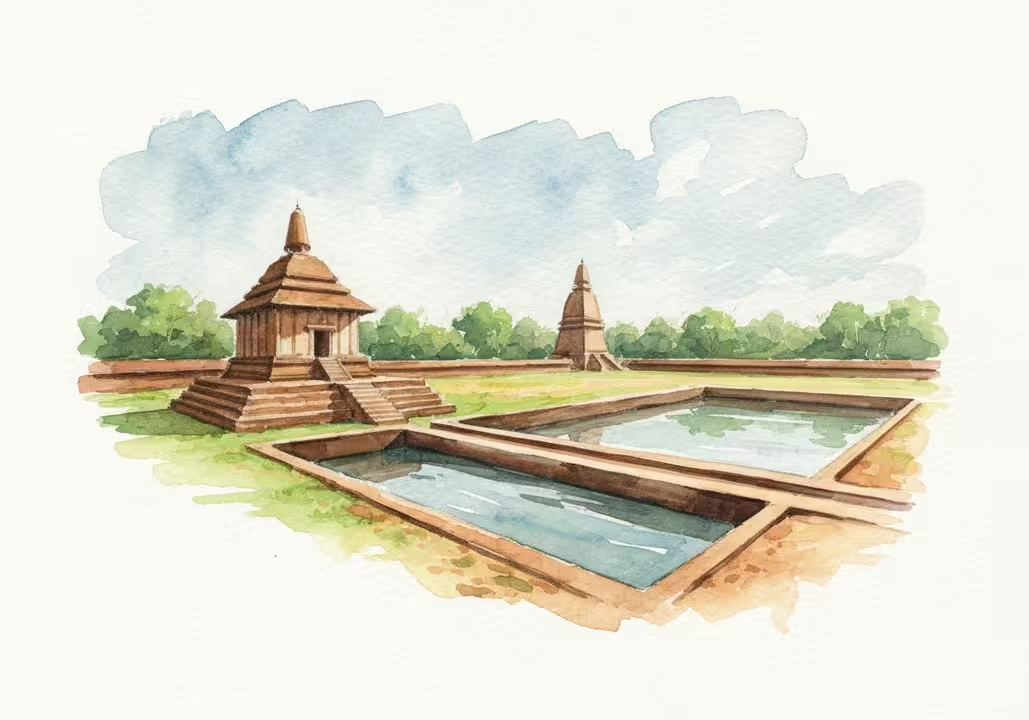
In the parched dry zone of northern Sri Lanka, where monsoon rains are scarce and unpredictable, ancient engineers achieved what seemed impossible: they created a hydraulic civilization so advanced that it would not be matched by Europe for over two millennia. The irrigation systems of Anuradhapura stand as one of humanity’s greatest engineering achievements, a testament to ingenuity, precision, and the transformative power of water management.
The Birth of a Hydraulic Kingdom
The story begins in 437-367 BC, when King Pandukabhaya, the founder of the Anuradhapura Kingdom, commissioned the construction of Abhaya Wewa (also known as Basawakkulama). This wasn’t just any reservoir—it was the first identified artificial water storage system in Sri Lanka’s recorded history. With an impressive embankment stretching 5,910 feet long and rising 22 feet high, holding 1,580 acre-feet of water across 1,235 acres, Abhaya Wewa marked the dawn of Sri Lanka’s hydraulic civilization.
But this was merely the beginning. By the time King Devanampiya Tissa ascended to the throne in the 3rd century BC, the vision had expanded. He ordered the construction of Tissa Wewa, an even more ambitious project featuring an embankment 11,000 feet in length and 25 feet in height. The embankment’s base measured an astounding 160 feet wide, demonstrating engineering principles that modern dam builders would recognize and respect. This 550-acre reservoir would become integral to supplying water to the sprawling capital city and its vast monastic complexes.
The Anuradhapura Kingdom, which flourished from 377 BC to 1017 AD, would ultimately see the construction of approximately 15,000 tanks between 300 and 1300 CE. This wasn’t just infrastructure—it was the foundation of an entire civilization.
The Engineering Marvel: Biso Kotuwa
Perhaps no innovation better exemplifies the genius of ancient Sinhalese engineers than the Biso Kotuwa, or valve tower. Invented in the 3rd century BC, this ingenious device solved a problem that would perplex engineers for millennia: how to safely release water from massive reservoirs without the destructive force of high pressure overwhelming the sluice gates.
The Biso Kotuwa—literally “queen-enclosure,” later termed “bisi-kotuwa” meaning “the enclosure where the water level lowers”—was a masterpiece of hydraulic engineering. Water from the reservoir entered a large rectangular vertical tower chamber built from massive granite blocks, precisely dressed and sealed to fit together without mortar. Inside this chamber, the water’s tremendous pressure and energy were dissipated through careful design. The somewhat tamed water then flowed through two or more stone conduits, with outlet dimensions carefully enlarged along the path to further reduce velocity and energy.
What makes this invention truly remarkable is its timing. While ancient Sinhalese engineers were incorporating the principles of both hydraulic surge chambers and valve towers into a single integrated structure over 2,100 years ago, European engineers wouldn’t develop similar technology until the mid-18th century—more than two millennia later. British colonial engineer Henry Parker, who worked in Ceylon between 1870 and 1901, was astounded to discover that the valve-pit of 19th-century Europe had been invented by the ancient Sinhalese long before his time.
Archaeological excavations at Urusita Wewa near Embilipitiya and the Maduru Oya Reservoir have unearthed beautifully preserved Biso Kotuwas. When modern engineers calculated the specifications needed for the Maduru Oya sluice, they found their calculations matched exactly with those of the ancient designers—a testament to the precision and sophistication of ancient hydraulic knowledge.
The Great Tank Builders
The annals of Anuradhapura are filled with kings who distinguished themselves as master builders of irrigation works, but three names stand above all others: Vasabha, Mahasena, and Dhatusena.
King Vasabha, who ruled in the early centuries of the common era, established the tradition of royal patronage for irrigation, constructing 11 tanks and 12 canals during his reign. But it was King Mahasena (274-301 AD) who truly earned the title “Father of Tank Construction.” During his 27-year reign, Mahasena oversaw the construction of 16 major tanks and numerous canals. His crowning achievement was Minneriya Tank, a colossal reservoir covering 4,670 acres—a body of water so vast that it resembled an inland sea. The Mahavamsa, Sri Lanka’s ancient chronicle, specifically commemorates Mahasena’s contributions to the nation’s water infrastructure.
Yet even Mahasena’s accomplishments were surpassed by King Dhatusena (455-473 AD), whose irrigation projects remain legendary. Dhatusena built 18 massive irrigation tanks and an equal number of smaller tanks, but his greatest achievement was Kalawewa and its associated canal system. Kalawewa itself was a vast reservoir, but what made it truly extraordinary was what came next.
The Impossible Canal: Jaya Ganga
From Kalawewa, King Dhatusena commissioned the construction of a canal that would carry water 87 kilometers (54 miles) to replenish Tissa Wewa in Anuradhapura. Named Jaya Ganga (or Yoda Ela, meaning “giant canal”), this waterway represented an engineering achievement that staggers the imagination even today.
The canal’s most astonishing feature was its gradient: a mere 6 to 10 centimeters per kilometer—in some sections, just 6 inches per mile. To put this in perspective, that’s a slope of 1:10,000. Even with modern laser-guided surveying equipment, maintaining such precision over 87 kilometers of varied terrain would be extraordinarily challenging. How did 5th-century engineers, working without any of today’s technology, calculate and maintain such exacting specifications?
The mystery deepens when one considers the canal’s sophisticated design. The Jaya Ganga follows a carefully calculated meandering route along topographical contours, collecting water from 66 mini-catchments while simultaneously feeding 120 smaller reservoirs along its path. It features only one major bund to manage water pressure—a deliberate design choice. Ancient engineers understood that two bunds would increase pressure dangerously, while a single bund allowed water to spread on the upper side, releasing pressure naturally and preventing damage.
The engineering methods used to calculate the exact elevation differences between Kalawewa and Tissa Wewa, and to maintain the canal’s precise gradient, were lost with the eventual decline of the civilization. Modern engineers examining the Jaya Ganga can only marvel at the achievement and acknowledge that these ancient builders possessed hydraulic knowledge that rivaled or exceeded their own.
The Tank Cascade System: Engineering Meets Ecology
While individual reservoirs and canals impressed with their scale, the true genius of the ancient Sinhalese hydraulic system lay in its integration. The Tank Cascade System, known locally as “Ellanga Gammana” or the Cascaded Tank-Village System, represented a holistic approach to water management that modern engineers are only beginning to fully appreciate.
This system consisted of a connected series of tanks organized within micro-catchments across the dry zone landscape. Water flowed from higher elevation tanks to lower ones in a carefully orchestrated cascade, storing, conveying, and utilizing water from ephemeral rivulets with maximum efficiency. The system didn’t just move water—it created a sustainable ecosystem that supported agriculture, wildlife, and human settlements for over 1,500 years.
The sophistication of this system evolved over nearly two millennia. By integrating reservoirs of various sizes—from massive royal tanks to village tanks to small paddy field tanks—ancient engineers created a resilient network that could withstand droughts, efficiently distribute water resources, and support intensive agriculture in an otherwise inhospitable climate.
Transforming Society and Culture
The impact of these irrigation systems extended far beyond agriculture, though their agricultural effects were revolutionary. Reliable irrigation transformed the dry zone into Sri Lanka’s fertile heartland. Paddy cultivation flourished, producing food surpluses that could support large populations, sustain armies, and fund the construction of massive religious monuments like the great stupas and monasteries of Anuradhapura.
The ability to grow multiple crops per year created unprecedented food security and economic prosperity. This agricultural surplus became the backbone of Anuradhapura’s power and influence, enabling the flourishing of arts, culture, and religion that made the kingdom famous throughout the ancient world.
But the tanks were more than utilitarian structures. In ancient Sri Lankan society, water held immense cultural and religious significance. Tanks were often seen as sacred, integrated into the religious and cultural landscape. The construction and maintenance of vast irrigation systems required extraordinary levels of social organization and community cooperation, fostering collective responsibility that bound communities together.
Archaeological research, including comprehensive studies by Durham University between 2004 and 2009, has revealed that Anuradhapura developed a unique urban form: “low-density, dispersed agrarian urbanism.” Rather than a densely packed city separated from agricultural lands, Anuradhapura integrated urban, religious, and agricultural spaces into a sprawling network covering more than 10 hectares, all sustained by the hydraulic infrastructure.
Legacy and Modern Recognition
The ancient irrigation systems of Anuradhapura didn’t merely fade into history—many continue to function today, still providing water for agriculture over two millennia after their construction. This enduring utility speaks to both the quality of ancient engineering and the sustainability of the tank cascade approach.
In 1982, UNESCO designated Anuradhapura as a World Heritage Site, recognizing both its cultural significance and its hydraulic achievements. But perhaps the most significant modern recognition came in 2017, when the United Nations Food and Agriculture Organization (FAO) designated the Cascaded Tank-Village System as a Globally Important Agricultural Heritage System (GIAHS).
This GIAHS designation acknowledged what modern engineers and ecologists increasingly recognize: the ancient tank cascade system represents a sustainable, resilient approach to water management that offers valuable lessons for addressing contemporary challenges. The system demonstrates beneficial characteristics including extensive coverage, unique technology, sustainability, resilience to natural disasters, and support for high biodiversity.
Modern Sri Lanka maintains and uses thousands of these ancient tanks, and researchers worldwide study the system’s principles for application in other water-scarce regions. The famous saying attributed to King Parakramabahu I—“Let not even a drop of rain water go to the sea without benefiting man”—encapsulates a philosophy of water stewardship that remains remarkably relevant in an era of climate change and water scarcity.
Conclusion: Water as Civilization
The ancient irrigation systems of Anuradhapura represent more than impressive engineering—they embody a civilization’s response to environmental challenge through ingenuity, long-term planning, and social cooperation. From King Pandukabhaya’s first reservoir in the 4th century BC to the vast networks completed under Dhatusena in the 5th century AD, these systems sustained a sophisticated civilization for over 1,500 years.
The Biso Kotuwa’s hydraulic principles, the Jaya Ganga’s impossible precision, the integrated tank cascades—each innovation reflected deep understanding of hydrology, geology, and social organization. Ancient engineers who could calculate gradients to within centimeters over dozens of kilometers, who invented valve towers millennia before Europe, who created sustainable agricultural ecosystems that still function today—these builders deserve recognition alongside history’s greatest engineers.
As climate change and water scarcity challenge modern societies, the wisdom embedded in Anuradhapura’s ancient irrigation systems takes on new relevance. The masters of water who transformed a dry landscape into a thriving hydraulic civilization offer lessons in sustainability, resilience, and the power of long-term thinking—lessons we would do well to remember.