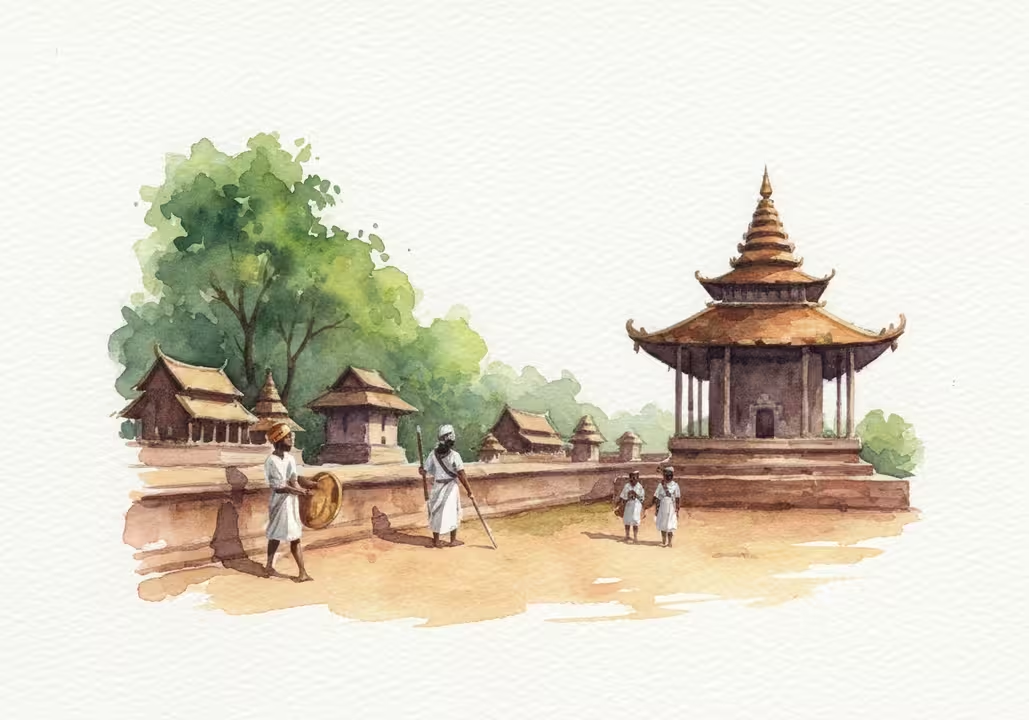
In the ancient world, there existed an island so rich in precious stones that it earned the Sanskrit name Ratna-Dweepa—the Island of Gems. This was Sri Lanka, a land where the earth itself seemed to bleed treasure, where river gravels concealed sapphires fit for emperors, and where miners discovered rubies that would adorn the crowns of distant kings. For over three thousand years, this small island in the Indian Ocean has been synonymous with gemstone wealth, its reputation echoing through the chronicles of Chinese monks, Greek astronomers, Arab travelers, and European explorers.
The Geological Foundation of a Treasure Island
The story of Sri Lanka’s gems begins not in human history, but in the deep time of geological epochs. Over ninety percent of the island’s landmass consists of high-grade metamorphic rock, some dating back an astounding 2.4 billion years to the Precambrian age. When Sri Lanka occupied a critical position within the ancient supercontinent of Gondwana, intense tectonic forces subjected its rocks to tremendous pressure and heat. Between 539 and 608 million years ago, during a period of peak metamorphism, the conditions were perfect for the formation of corundum—the mineral that would become sapphires and rubies—along with countless other precious stones.
The Highland Complex, extending from northeast to southwest across the island, contains the greatest concentration of these gem deposits. Here, gneisses, schists, and granulites formed under extreme conditions created the perfect matrix for gemstones. Over millions of years, erosion released these treasures from their ancient host rocks, carrying them downstream where they settled in alluvial deposits—the gem-bearing river gravels that miners would call illam.
Today, Sri Lanka boasts an extraordinary diversity: 40 out of the 85 known gemstone varieties in the world are found on this island, making it one of the top five gem-producing nations. But it is not merely the quantity that has made Sri Lanka legendary—it is the quality. The island produces the finest and largest blue sapphires in the world, their cornflower blue hue unmatched by stones from any other source.
Ancient Names, Ancient Fame
Long before modern geologists understood the island’s metamorphic heritage, ancient peoples knew Sri Lanka as a land of incomparable wealth. The Sinhalese themselves called it Ratna-Dweepa, a name that appears in the great chronicle of Ceylon, the Mahavamsa. This ancient text, recording events from 543 BC, mentions a gem-encrusted throne owned by a Naga king—evidence that the island’s gem wealth was already legendary in the sixth century before the Common Era.
The ancient Greeks knew the island as Taprobana, a name first reported by the geographer Megasthenes around 290 BC. In his descriptions, Megasthenes wrote of a land producing gold and gems, divided by rivers and teeming with elephants. By the second century AD, the renowned astronomer Claudius Ptolemy was documenting the island’s exports of beryl, sapphire, and gold in his geographical treatises.
To Persian and Middle Eastern traders who crossed the Indian Ocean during the fourth and fifth centuries AD, the island was known as Serendib—a name that would eventually give English the word “serendipity,” meaning a fortunate discovery made by accident. How fitting, given that the island’s greatest treasures lay hidden beneath rice paddies and riverbeds, waiting to be accidentally discovered by farmers and deliberately sought by miners.
Royal Monopolies and Sacred Stones
The gem trade of ancient Sri Lanka was no free market enterprise. Between 500 and 1500 AD, during the reigns of the ancient and medieval Sinhala kings, the mining, possession, and commerce of precious stones fell under strict royal control. The monarch held monopoly over these subterranean treasures, recognizing that the gems washing down from the highlands represented not merely wealth, but power and prestige on the international stage.
During the Anuradhapura period (3rd century BC to 10th century AD), the gem trade flourished under royal patronage. Ratnapura—literally the “City of Gems”—became the epicenter of this industry, the first locality where sapphire mining was systematically conducted. The tradition continued through the Polonnaruwa period (10th to 13th century AD), with successive dynasties maintaining tight control over the gem fields.
The royal courts themselves glittered with local stones. Buddhist temples received donations of precious gems, which were set into reliquaries and stupas. The sacred and the commercial intertwined, as gems that adorned religious monuments also served as demonstrations of royal piety and economic might.
The Gem Roads: From Ratnapura to Rome
While kings controlled the mining, it was the merchants who carried Sri Lanka’s gems to the world. Between 400 and 800 AD, Middle Eastern traders established a sophisticated network. Arab and Persian merchants settled along the coast, their caravans traveling inland to buy rough stones directly from miners. These precious cargoes were then transported back to the port cities of Colombo and Galle, where Arab ships waited to carry them across the Indian Ocean.
The gems of Sri Lanka traveled the ancient world’s most famous trade routes. The Silk Road, that great artery of commerce connecting East and West, carried Ceylon sapphires alongside Chinese silk and Indian spices. Sri Lankan gems reached the markets of Rome, where wealthy patricians sought the island’s renowned stones. They traveled to China, where emperors prized them. They adorned the courts of Persia and decorated the palaces of Arabia.
According to Pliny the Elder’s Natural History, formal contact between Sri Lanka and Rome was established during the reign of Emperor Claudius (AD 41-54). Ancient Roman authors documented Sri Lankan trade goods: pearls, gems, transparent stones, muslins, tortoise shells, rice, honey, ginger, cinnamon, beryl, and elephants. Among these valuable exports, gems held a special place.
Some scholars have even suggested that Sri Lanka might be connected to the Biblical land of Tarshish or Ophir, from whence King Solomon’s ships brought “gold, and silver, and elephants’ teeth, and apes, and peacocks” once every three years, as recorded in 1 Kings 10:22. The items mentioned—all abundantly found in ancient Sri Lanka—have led historians to speculate about trade connections dating back to the 10th century BC. Linguistic evidence supports this theory: the classical Tamil word for peacock, thogkai, appears to have been assimilated into Hebrew as thukkiyyim.
The Witnesses: Travelers and Their Tales
Throughout the centuries, travelers from distant lands documented their amazement at Sri Lanka’s gem wealth. In 412 AD, the Chinese Buddhist monk Fa-hsien visited the island and recorded that “there is a district of about 10 square [li] which produces the mani jewel.” His account brought knowledge of Sri Lankan gems to the Far East.
The most famous medieval witness was Marco Polo, who visited the island in 1292 or 1293 during his epic journey through Asia. The Venetian explorer wrote with evident awe of the abundance and quality of the gems he encountered. In his travels, he documented ruby, sapphire, topaz, amethyst, and garnet, declaring that the island possessed “the best sapphires, topazes, amethysts, and other gems in the world.” He even wrote of seeing a “flawless ruby the size of a man’s arm”—whether this was literal truth or traveler’s exaggeration, it speaks to the island’s reputation.
In the 14th century, the great Arab explorer Ibn Battuta added his testimony to the growing literature on Sri Lankan gems. His writings described the variety and quality of precious stones he witnessed during his time on the island, helping to spread the island’s fame throughout the Islamic world.
The Ancient Art of Gem Mining
The methods by which these treasures were extracted from the earth remained remarkably consistent for millennia. Unlike the hard-rock mining of diamonds in Africa or emeralds in Colombia, Sri Lankan gem mining focused on alluvial deposits—the secondary concentrations of gemstones in river gravels and ancient flood plains. This approach was both practical and sustainable, working with the island’s unique geology rather than against it.
Teams of miners would identify promising locations, often guided by generations of accumulated knowledge about where the gem-bearing gravels—the illam—were most concentrated. They would then hand-dig pits, sometimes as shallow as five feet, sometimes as deep as fifty feet, depending on the depth of the illam layer. As they dug, groundwater would seep into the pit from below, requiring constant pumping to keep the workspace dry.
Once the pit reached the gem gravel layer, miners would dig horizontal tunnels in several directions, minimizing surface disturbance while maximizing access to the illam. This network of tunnels created an underground honeycomb beneath rice paddies and farmland, allowing agricultural activity to continue above while gem mining proceeded below.
The actual extraction of gems from the gravel required skill and patience. Miners used conical-shaped baskets for sluicing, swirling the mixture of clay, gravel, sand, and water until the heavier stones—the jathi—settled to the bottom. In this sediment, experienced eyes could spot the glint of sapphire blue, the red flash of ruby, or the subtle gleam of other precious stones.
These traditional methods, largely unchanged from ancient times, proved remarkably effective and environmentally sound. Modern gem mining in Sri Lanka still employs these basic techniques, a testament to the wisdom of ancient miners who developed sustainable practices that would serve the island for thousands of years.
Jewels of Legend
From Sri Lanka’s gem gravels have come some of the world’s most famous and valuable gemstones. Perhaps the most celebrated is the Star of India, a 563.35-carat greyish-blue star sapphire discovered in Sri Lanka approximately 300 years ago. What makes this stone extraordinary is not merely its size—making it the world’s largest gem-quality blue star sapphire—but the fact that it displays asterism (the star effect created by needle-like rutile inclusions) on both its top and bottom surfaces.
The stone’s journey from a Sri Lankan river bed to its current home in the American Museum of Natural History in New York is itself a tale of empires and collectors. In the late 19th century, the renowned mineralogist George Kunz acquired it for financier J.P. Morgan’s collection, which was displayed at the Paris Exposition of 1900 before being donated to the museum. In 1964, the Star of India was famously stolen in a dramatic heist, only to be recovered and returned to public display.
Interestingly, the stone is called the Star of India rather than the Star of Ceylon, likely because at the time of its discovery, Sri Lanka was administered by the British East India Company from Madras, and the gem was announced as property of that India-based organization.
Other legendary stones from Sri Lanka include the Rosser Reeves star ruby, one of the world’s largest and finest star rubies, and the Star of Bombay, a 182-carat violet-blue star sapphire that was given to actress Mary Pickford by her husband Douglas Fairbanks in the 1920s. Each of these stones carried with it not just monetary value, but the accumulated prestige of Sri Lanka’s three-thousand-year reputation as the Island of Gems.
The Legacy of Ratna-Dweepa
The ancient gem trade of Sri Lanka was more than a commercial enterprise—it was a cultural phenomenon that connected the island to the wider world. Through gems, Sri Lanka participated in the great economic networks of antiquity, from the markets of Imperial Rome to the courts of Chinese emperors. The island’s precious stones adorned Buddhist temples and Hindu shrines, Christian reliquaries and Islamic treasuries.
The trade brought wealth, yes, but also cultural exchange. Arab merchants who came for gems brought new technologies and ideas. Chinese monks who marveled at the island’s jewels also studied its Buddhism. Roman traders who sought sapphires also learned of cinnamon and other spices. Each gem that left the island carried with it a piece of Sri Lankan expertise, a fragment of its geological heritage, and evidence of its miners’ skill.
Today, Sri Lanka’s gem industry continues this ancient tradition, still relying largely on the traditional mining methods developed millennia ago. Modern gemologists have confirmed what ancient traders knew intuitively: that the island’s unique geological history creates stones of exceptional quality and variety. The name Ratna-Dweepa, coined thousands of years ago, remains as accurate today as it was when ancient kings first claimed monopoly over the treasures hidden in their island’s earth.
The ancient gem trade of Sri Lanka reminds us that economic globalization is not a modern invention. Three thousand years ago, the precious stones of a small island were already traveling the length and breadth of the known world, valued equally by Buddhist monks and Roman senators, Arab merchants and Chinese emperors. In the glitter of a Sri Lankan sapphire, ancient peoples saw not just beauty, but connection—to distant lands, to underground mysteries, and to the deep time of the earth itself.