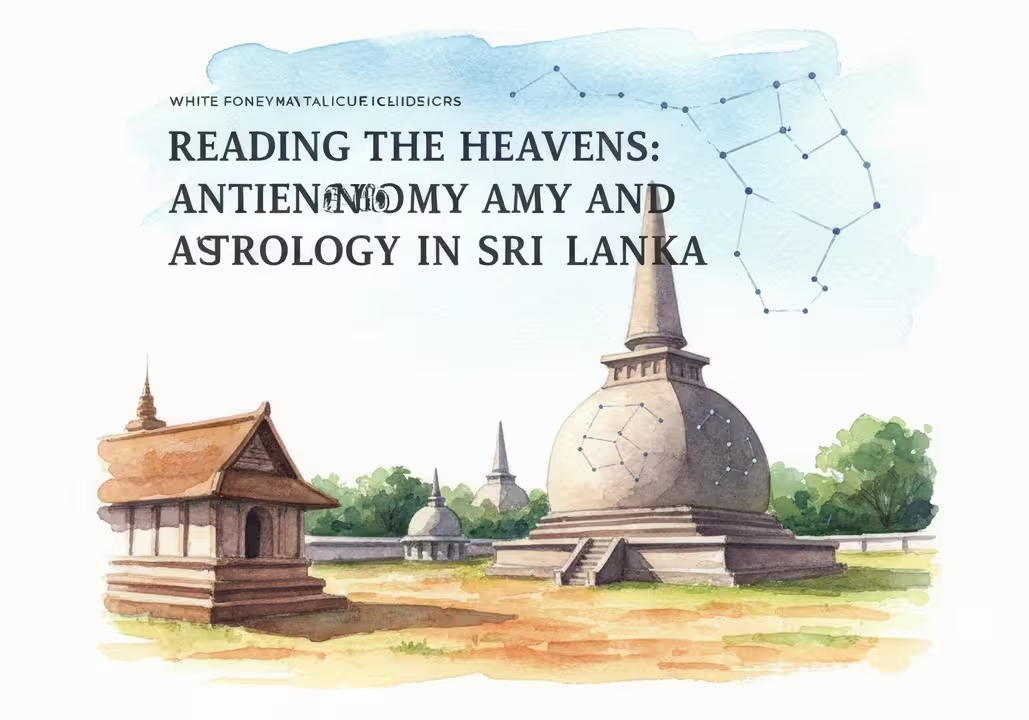
Long before modern telescopes and digital calendars, the people of ancient Sri Lanka looked to the heavens for guidance. The stars, sun, and moon were not merely distant points of light, but essential tools for organizing society, planning agriculture, conducting religious observances, and making critical decisions. From the alignment of massive stupas with distant constellations to the precise calculation of auspicious moments, astronomy and astrology formed an integral part of Sri Lankan civilization for over two millennia.
The Foundations of Celestial Knowledge
The practice of astrology in Sri Lanka can be traced back to at least the third century BCE, before the formal establishment of Buddhism in the island. According to historical records, religious leaders and Brahmins—who served as state priests and teachers—performed astrological functions for the rulers of ancient Lanka. This celestial knowledge, known in Sri Lanka as “Jyothishya” (meaning “Science of the light”), was based on the fundamental belief that astronomical bodies influenced human destinies and earthly events.
The ancient city of Anuradhapura itself bears testament to this astronomical heritage. According to the Mahavamsa, Sri Lanka’s great historical chronicle, the city was founded under the auspicious asterism called “Anura”—the Anuradha nakshatra. This constellation, consisting of the stars Beta, Delta, and Pi Scorpionis, was carefully observed in the night sky where it appeared in a straight line above the bright red star Antares. The very name of the ancient capital reflected the importance of celestial timing in major undertakings.
Perhaps the most intriguing early text is the Ravana Samhita, attributed to the legendary King Ravana of ancient Lanka. This treatise on astrology and palmistry demonstrates advanced knowledge of planetary positions, predictive techniques, and celestial mechanics. According to tradition, Ravana possessed such profound astronomical expertise that he could manipulate planetary alignments. When his son Meghnath was born, Ravana allegedly attempted to position all planets except Rahu and Ketu in the eleventh house of gains and profits—a feat requiring extraordinary understanding of celestial movements.
A King’s Commitment to the Stars
The importance of astrology in ancient Sri Lankan society is perhaps best illustrated by the actions of King Dutugemunu (161-137 BCE), one of the island’s most celebrated monarchs. Recognizing astrology as essential to his subjects’ wellbeing, Dutugemunu established an unprecedented administrative system: he provided “a doctor, an astrologer, and a priest for each group of 16 villages throughout the kingdom.”
This remarkable decree placed astrologers alongside doctors and priests as essential public servants. It ensured that even in remote villages, people had access to someone who could read the heavens and determine auspicious times for planting crops, conducting ceremonies, beginning journeys, or undertaking important ventures. The knowledge was thus democratized, not confined to the royal court or wealthy elite.
Schools teaching astrology, known as Jyothishaya Gurukula, became centers of learning where this celestial knowledge was preserved and transmitted. The facts concerning this science were meticulously recorded on ola leaves—dried palm fronds that served as the ancient equivalent of books—ensuring that astronomical wisdom passed from generation to generation.
The Celestial Calendar: Nakshatras and Rashis
At the heart of Sri Lankan astronomical practice was a sophisticated lunisolar calendar system, adapted from ancient Indian models but refined through local observation and practice. This calendar had to serve two masters: the moon’s monthly cycles and the sun’s yearly journey through the heavens.
The system recognized 27 nakshatras, or lunar mansions, each representing a 13-degree and 20-minute division of the zodiac. The moon takes approximately one day to traverse each nakshatra, completing its journey through all 27 in about one lunar month. These nakshatras were: Ashwini, Bharani, Krittika, Rohini, Mrigashira, Ardra, Punarvasu, Pushya, Ashlesha, Magha, Purva Phalguni, Uttara Phalguni, Hasta, Chitra, Swati, Vishakha, Anuradha, Jyeshtha, Mula, Purva Ashadha, Uttara Ashadha, Shravana, Dhanishta, Shatabhisha, Purva Bhadrapada, Uttara Bhadrapada, and Revati.
Each nakshatra had its own symbol, ruling planet, and associated deity, influencing its energetic qualities and determining its suitability for various activities. Astrologers would consult these nakshatras when determining auspicious times, or “nakath,” for everything from royal coronations to common weddings.
Alongside the lunar nakshatras, the Sri Lankan system used the twelve rashis, or zodiac constellations—the same signs familiar today as Aries, Taurus, Gemini, and so forth. In Sinhala, a rashi indicates the position of the moon at the moment of an individual’s birth, believed to influence their fundamental character and life path.
Instruments of Time: Sundials and Water Clocks
The ancient Sri Lankans were not content merely to observe the heavens; they built sophisticated instruments to measure time’s passage with remarkable precision. Archaeological excavations at Anuradhapura have uncovered sundials and water clocks dating from the Anuradhapura period (377 BCE–1017 CE), providing tangible evidence of advanced timekeeping technology.
Both horizontal and vertical sundials were employed, each with specific applications. These devices used the sun’s shadow to mark the hours, enabling monks to maintain regular schedules for meditation and prayer, farmers to time their irrigation, and officials to coordinate daily activities. The theoretical and practical mechanisms of these sundials demonstrate a sophisticated understanding of solar movement and geometry.
Water clocks, or clepsydras, complemented sundials by providing time measurement during cloudy days and throughout the night. These devices measured time by the regulated flow of water from one container to another, allowing for consistent time intervals regardless of weather or solar position.
Written in the Stars: The Stupas of Anuradhapura
Perhaps the most spectacular evidence of ancient Sri Lankan astronomical knowledge lies not in texts or instruments, but in stone—specifically, in the precise positioning of the three great stupas of Anuradhapura. The Mirisavetiya, Ruvanweliya, and Jetavanaramaya stupas, built between 161 BCE and 331 CE, were not randomly placed. Instead, they form a triangular pattern that perfectly mirrors three stars in the constellation of Orion.
This celestial alignment—with the three stupas corresponding to the stars Bellatrix, Rigel, and either Al Nitak or Mintaka—creates what researchers call a “heaven-earth duplication.” The three stupas’ triangular ground layout correlates precisely with the triangle formed by three stars on Orion’s wing, mapping the heavens onto the earth below.
This phenomenon is not unique to Sri Lanka. Similar astronomical alignments characterize ancient sacred architecture worldwide, from the Egyptian pyramids at Giza (also aligned with Orion’s belt) to the temples of Angkor Wat in Cambodia. Yet the precision and intentionality of the Anuradhapura stupas’ alignment reveals the sophisticated astronomical knowledge possessed by ancient Sri Lankan architects and priests.
What purpose did these alignments serve? Beyond demonstrating technical prowess, they likely held profound religious and philosophical significance. In ancient Egyptian tradition, Orion was associated with Osiris, the god of rebirth and the afterlife. For Buddhist builders, aligning massive monuments with eternal stars may have symbolized the timeless nature of the dharma, connecting earthly practice with cosmic order.
Seasons of Cultivation: Astronomy and Agriculture
For most ancient Sri Lankans, astronomical knowledge served an eminently practical purpose: it helped them know when to plant and harvest crops. The island’s agricultural calendar revolved around two main seasons, each tied to monsoon patterns that brought life-giving rains.
The Maha season, whose name means “bigger” in Sinhala, extended from September to March, coinciding with the northeast monsoon. This was the primary cultivation period, when the heavens opened and rains nourished the land. Rice paddies would transform into emerald seas as farmers worked their fields under skies watched by astrologers who had declared the planting time auspicious.
The Yala season, meaning “lesser,” ran from May to August during the southwest monsoon. Though shorter with more intense rainfall bursts, the Yala season allowed for a second annual harvest, particularly in areas with good irrigation systems—another technological achievement of ancient Sri Lanka.
While these seasons were defined primarily by monsoon patterns and calendar dates, astronomical observations played a crucial role in predicting their arrival and duration. The position of certain stars and constellations on the horizon, the angle of the sun, and the phases of the moon all provided clues about when the rains would come and when farmers should prepare their fields.
The Sacred Cycle: Poya Days and Lunar Observance
Perhaps nowhere was astronomy more intimately connected to daily life than in the observance of Poya days—the full moon days that served as Buddhism’s primary religious holidays in Sri Lanka. The term “poya” derives from the Pali and Sanskrit word “uposatha,” meaning “fast day,” and occurs every time the moon reaches its fullest phase.
In the Buddhist calendar, the full moon represents the culmination of the waxing process, treated as the most auspicious of the four lunar phases. Every full moon day, practicing Buddhist Sri Lankans would visit temples for religious observances, making Poya days sacred time set aside from ordinary labor and worldly concerns.
The astronomical precision required to determine Poya days was considerable. A lunar month lasts approximately 29.5 days, meaning there are 13 or 14 Poya days per year. While modern astronomers can calculate lunar phases with extreme accuracy, ancient astrologers used traditional calculation methods based on careful observation and mathematical formulas passed down through generations. Occasionally, small discrepancies between these traditional calculations and actual astronomical events would occur, but the system remained remarkably accurate.
Each Poya day had its own name and commemorated specific events in the Buddha’s life. King Dutugemunu’s decision to provide astrologers to every 16 villages ensured that even in remote areas, people knew when the full moon would arrive and could prepare for proper observance.
The New Year and the Nonagathe: Precision in Transition
No astronomical event in the Sri Lankan calendar required more precise calculation than Avurudu—the Sinhala and Tamil New Year. Unlike the Gregorian calendar, which begins at the arbitrary moment of midnight on January 1st, the traditional Sri Lankan New Year begins at a time determined by the sun’s movement through the zodiac.
Specifically, Avurudu marks the transition when the sun moves from Meena Rashiya (the house of Pisces) to Mesha Rashiya (the house of Aries). This solar transition represents the completion of Earth’s cycle around the sun and the beginning of a new year. Astrologers would calculate the exact moment of this transition, which varied slightly from year to year.
What makes Avurudu particularly fascinating from an astronomical perspective is the “Nonagathe”—the neutral period between the old year and the new. This transitional span typically lasts about 12 hours and 48 minutes, beginning when the sun as a disk starts to cross the astrological boundary between Pisces and Aries, and ending when the crossing is complete. The halfway point marks the dawn of the new year.
During the Nonagathe, traditional practice dictated that people should cease all work and worldly activities. It was a liminal time, neither old nor new, when the normal order was suspended. People would clean their homes, settle debts, and prepare for the new year’s arrival, but they would not eat, cook, or work until the auspicious moment arrived.
This moment—and indeed all moments during the New Year celebrations—were governed by “nakath,” auspicious times calculated by astrologers with astronomical precision. Everything from lighting the hearth to cooking the first meal to beginning new work happened at these precisely determined moments, when the alignment of celestial bodies was most favorable.
The Legacy of the Stars
The astronomical and astrological traditions of ancient Sri Lanka were not merely superstition or primitive science. They represented a sophisticated understanding of celestial mechanics, a practical system for organizing agricultural and religious life, and a philosophical framework for understanding humanity’s place in the cosmos.
From the foundation of Anuradhapura under an auspicious nakshatra to the precise calculation of Poya days and New Year transitions, from the architectural achievement of stupas aligned with distant stars to the provision of astrologers for every 16 villages, these practices wove together observation, calculation, religion, and daily life into a coherent whole.
Modern Sri Lanka continues many of these traditions. Poya days remain national holidays. Avurudu is celebrated with attention to nakath times. Astrologers are consulted before major decisions. The ancient knowledge recorded on ola leaves has been transferred to digital formats, but its essence remains.
When we look at the ruins of Anuradhapura today, we see more than ancient stones. We see a civilization that looked to the stars for guidance, that built monuments aligned with constellations visible thousands of miles away, that developed sophisticated systems for measuring time and predicting celestial events. We see evidence of humanity’s timeless fascination with the heavens and our endless quest to find meaning in the stars above.
The ancient Sri Lankans understood what modern astronomy has confirmed: we are intimately connected to the cosmos. The calcium in our bones, the iron in our blood, the elements that compose our bodies were forged in the nuclear furnaces of stars. Perhaps, in their own way, the ancient astrologers sensed this connection, and sought to honor it through their careful observations, their precise calculations, and their monuments that reached toward the sky.