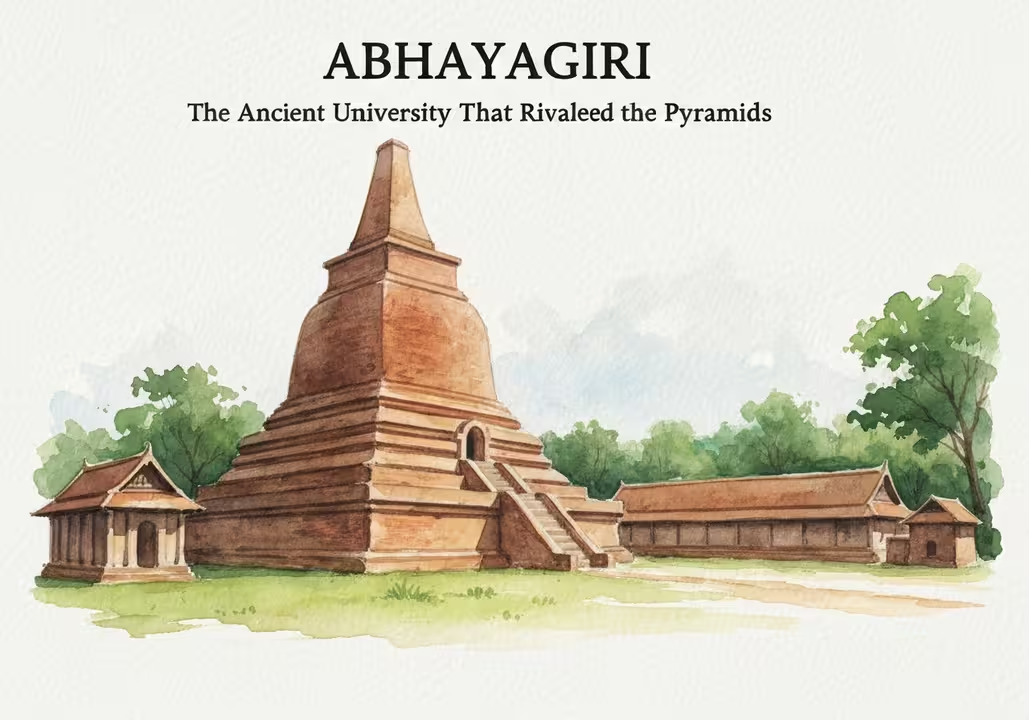
In the shadow of a colossal brick stupa that once rivaled the pyramids of Giza in height and grandeur, thousands of monks and scholars gathered to pursue knowledge that would shape Buddhist thought across Asia. This was Abhayagiri Vihara, one of the world’s first universities, a beacon of learning that illuminated the ancient city of Anuradhapura for over a thousand years.
A Vow Fulfilled in Victory
The story of Abhayagiri begins not in peace, but in the chaos of war and exile. In 103 BCE, King Vaṭṭagāmaṇi Abhaya ascended to the throne of Sri Lanka, only to be driven from power by invading Tamil forces. For fourteen years, he wandered his own kingdom as a fugitive, dreaming of the day he would reclaim his crown. During those years of exile, the king made a sacred vow: if he regained his throne, he would build a magnificent monastery as an offering to the Buddhist sangha.
In 89 BCE, Vaṭṭagāmaṇi Abhaya’s prayers were answered. He defeated the last Tamil king and marched triumphantly back to Anuradhapura. True to his word, one of his first acts as the restored monarch was to establish Abhayagiri Vihara on the site of the Giri monastery. He appointed Mahatissa Thera of Kupikkala as its first Chief Incumbent, a gesture of gratitude to a monk who had supported him during his darkest days.
What began as a king’s vow would evolve into something far greater than either could have imagined—a center of learning that would attract scholars from China to Java, and preserve knowledge that might otherwise have been lost to history.
The Architecture of Enlightenment
The centerpiece of Abhayagiri was its massive dagoba (stupa), a structure of breathtaking ambition. According to the Chinese monk Fa-Hsien, who visited in 412 CE, the original stupa soared to a height of 400 feet (approximately 122 meters), making it one of the tallest structures in the ancient world. Decorated with gold and silver, studded with precious gems and crystals, it must have been a sight that left pilgrims speechless as they approached the ancient capital.
But Abhayagiri was far more than a single impressive monument. Archaeological excavations have revealed a vast monastic complex that functioned as a comprehensive educational institution. Multi-story buildings with lower floors constructed of brick and lime mortar, reinforced with stone pillars, rose above the tropical landscape. The upper floors were made of timber plastered with lime, topped with terracotta tile roofs that were manufactured in workshops within the complex itself.
Each major building complex was designed with education in mind. Libraries stood at the center of these structures, alongside images of the Buddha, creating spaces specifically meant for teaching and scholarly work. These were not mere meditation cells—they were classrooms, debate halls, and research centers where the Buddhist intellectual tradition flourished.
Recent excavations have unearthed a treasure trove of artifacts that illuminate daily life at this ancient university: ornaments and jewelry made of gold and studded with gems, coins from the pre-Christian era, metal objects, molds and crucibles used in manufacturing, ceramics, pottery, glass, tiles, and sculptures. These finds reveal an institution that was not only spiritually and intellectually vibrant but also economically sophisticated.
A Curriculum Without Borders
What made Abhayagiri truly revolutionary for its time was its open-minded approach to Buddhist learning. Unlike the more conservative Mahāvihāra monastery that stood across the city, Abhayagiri welcomed intellectual discussion on various schools of Buddhist thought. It became a center where Theravada, Mahayana, and Vajrayana Buddhism coexisted, where monks could study the Tripitaka alongside tantric texts like the Tattvasaṃgraha Tantra.
This intellectual pluralism was virtually unheard of in the ancient world. While other institutions enforced strict orthodoxy, Abhayagiri encouraged debate and exploration. Scholars worked in both Sanskrit and Pali, ensuring that knowledge could be shared across linguistic boundaries. The monastery’s library held manuscripts representing the full spectrum of Buddhist philosophy, making it an invaluable resource for anyone seeking to understand the dharma in all its complexity.
The curriculum was comprehensive and rigorous. Monks and scholars studied Buddhist philosophy, meditation practices, monastic discipline, logic, grammar, medicine, and the arts. They engaged in formal debates, a tradition that sharpened minds and tested understanding. The best students eventually became teachers themselves, perpetuating a cycle of learning that lasted for generations.
The World Comes to Abhayagiri
By the 5th century CE, Abhayagiri had developed into a truly international institution. The Chinese monk Fa-Hsien’s account provides us with vivid details of the monastery at its height. He reported that more than 5,000 monks resided at Abhayagiri, surpassing even the prestigious Mahāvihāra. These weren’t just local monks—they came from across Asia, drawn by Abhayagiri’s reputation for scholarly excellence and philosophical openness.
Fa-Hsien himself spent two years at Abhayagiri, dedicating his time to copying Buddhist texts that he would eventually carry back to China. In a poignant moment recorded in his travel diary, he encountered a white silk fan in the monastery, produced in his homeland that he had not seen for ten years. Such artifacts reveal the extensive trade networks and cultural exchanges that connected Abhayagiri to the wider world.
The monastery established formal relationships with Buddhist centers in China, Java, and Kashmir during the 5th and 6th centuries CE. Chinese nuns came to Sri Lanka for ordination, as the bhikkhuni lineage had been lost in China. Knowledge flowed in multiple directions: Sri Lankan monks traveled to Southeast Asia and beyond, establishing branches of the Abhayagiri tradition and carrying with them the texts and teachings they had mastered.
Among the notable scholars who worked at Abhayagiri were Upatissa, who wrote the Vimuttimagga (Path of Freedom), an important meditation manual; Kavicakravarti Ananda, author of the Saddhammopāyana; and the renowned philosophers Aryadeva and Aryasura. Tantric masters like Jayabhadra and Candramāli also called Abhayagiri home, developing practices that would later spread throughout the Buddhist world.
A Legacy Written in Stone and Silk
For over a millennium, Abhayagiri served as the intellectual heart of Sri Lankan Buddhism. It was a place where farmboys could become philosophers, where foreign monks could find a home, where difficult questions were not avoided but embraced. The texts copied in its libraries, the monks trained in its halls, and the ideas debated in its courtyards influenced Buddhist practice from Tibet to Indonesia.
The monastery’s role in preserving and transmitting Buddhist texts cannot be overstated. At a time when a single manuscript might take months to copy by hand, Abhayagiri’s monks painstakingly reproduced sacred texts, creating multiple copies that were distributed across Asia. When invaders destroyed libraries in India, some texts survived only because copies existed in Sri Lanka, preserved by the dedicated scholars of Abhayagiri and similar institutions.
The Twilight of Giants
However, even the mightiest institutions are subject to the impermanence that Buddhism teaches. The beginning of Abhayagiri’s decline came not from foreign invasion but from internal religious politics. In the 12th century, King Parakkamabāhu I (1153-1186 CE) decided to “purify” Sri Lankan Buddhism by enforcing a single orthodox interpretation.
The king gave his political support to the Mahāvihāra tradition and ordered the abolition of both the Abhayagiri and Jetavana monastic traditions. Monks who had spent their lives at Abhayagiri were defrocked and given an ultimatum: return to lay life permanently or accept re-ordination as novices under the Mahāvihāra tradition. Centuries of distinct philosophical traditions and scholarly lineages were erased by royal decree.
The Culavamsa, the ancient chronicle of Sri Lankan kings, describes this as a “unification” and “purification” of the sangha. Modern scholars have noted the darker reality: it was, in effect, the forced dissolution of a great intellectual tradition in favor of religious uniformity.
When the capital of Sri Lanka moved from Anuradhapura to Polonnaruwa in the 13th century, Abhayagiri was finally abandoned. The jungle slowly reclaimed the great university. Trees grew through the ruins of libraries. Vines covered the sculptures and inscriptions. The dagoba, once gleaming with gold and silver, crumbled under the weight of centuries.
Rediscovery and Remembrance
For hundreds of years, Abhayagiri lay forgotten, its history preserved only in ancient texts. In the late 19th century, archaeologists began to explore the ruins, initially misidentifying the site as Jetavana Vihara. Systematic excavation and conservation work began in the early 20th century under the Department of Archaeology.
In 2015, after a comprehensive fifteen-year conservation and restoration project by the Sri Lankan Central Cultural Fund, overseen by UNESCO, the Abhayagiri Dagoba was reopened to the public. Today, the restored stupa stands 75 meters tall—shorter than its original height but still an imposing presence on the landscape.
Visitors can now walk through the ancient complex, exploring the foundations of monastic buildings, viewing artifacts in the on-site museum, and reading inscriptions that have survived for over two millennia. These physical remains offer tangible connections to the thousands of monks and scholars who once walked these same paths in pursuit of wisdom.
Lessons from the Past
The story of Abhayagiri holds profound relevance for our own time. Here was an institution that thrived for over a thousand years not by enforcing rigid orthodoxy but by welcoming diverse perspectives. It shows us that centers of learning flourish when they embrace intellectual freedom, when they build bridges between cultures rather than walls.
The international character of Abhayagiri—with Chinese, Indian, Southeast Asian, and Sri Lankan monks studying side by side—prefigured the global universities of today. The monks of Abhayagiri understood something that we are still learning: that knowledge is enriched when it crosses borders, when different traditions dialogue with one another, when curiosity is valued over conformity.
As one of the world’s first universities, Abhayagiri reminds us that the pursuit of higher learning is not a modern invention but an ancient aspiration. Long before the founding of Bologna, Oxford, or al-Qarawiyyin, scholars gathered in ancient Sri Lanka to read, debate, and teach. They left behind not only ruins and artifacts but also a legacy of intellectual courage and cross-cultural exchange that continues to inspire.
The great dagoba still stands, weathered but unbowed, a testament to human ambition and spiritual aspiration. And though the libraries have long since turned to dust, the ideas once nurtured within them continue to echo through the centuries, carried forward by the lineages of practice and understanding that Abhayagiri helped to forge. In the end, that may be the truest measure of any great university—not the height of its buildings, but the enduring power of the wisdom it cultivates and shares with the world.