Introduction
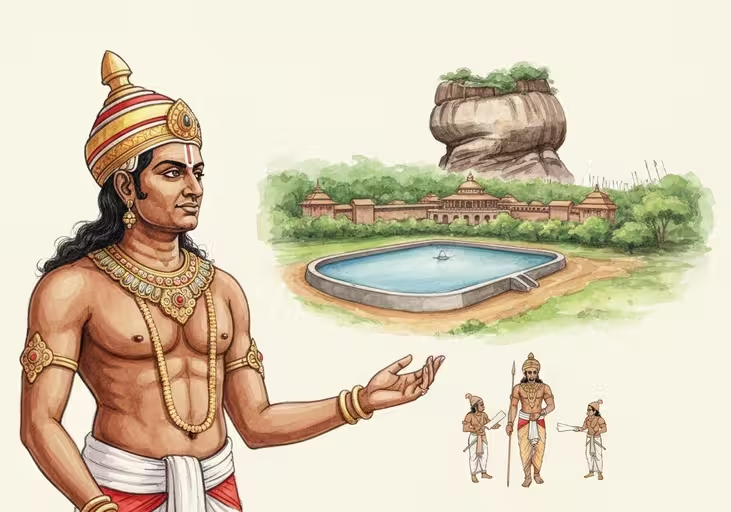
King Valagamba, also known as Vattagamini Abhaya, was a Sinhalese king who ruled Lanka from 103 to 77 BCE, with Anuradhapura as his capital. Although he lost his throne just 5 months after ascending due to rebellions and South Indian invasions, he managed to defeat the invaders and regain the throne after 14 years. The first-ever commitment of the Tripitaka to writing at Aluvihara in Matale was a magnificent undertaking that occurred under his royal patronage. He also initiated the construction of large monasteries and temples such as the Abhayagiri Vihara and Stupa, and the Rangiri Dambulla Rajamaha Vihara.
Early Life and Accession to the Throne
King Valagamba was the fourth son of King Saddhatissa, the brother of King Dutugemunu. His elder brothers, Kings Lajjitissa, Thulaththana, and Khallathanaga, reigned before King Valagamba. King Saddhatissa ruled for 18 years from 137 to 119 BCE. After him, King Thulaththana ruled for 40 days, and King Lajjitissa for 10 years. Subsequently, King Khallathanaga inherited the kingship. However, King Khallathanaga was assassinated by a general named Maharatta (Maharakkatha), who then seized the kingdom. Within a few days, Prince Vattagamini Abhaya killed General Maharatta, who had murdered his brother, and ascended to the throne for the first time in 103 BCE under the name ‘Valagam Abha’ or ‘Valagamba’. His chief queen was Queen Soma Devi, and his son was Prince Mahanaga. King Valagamba created Somawathiya in memory of Queen Soma Devi.
Rebellions and Invasions
When King Valagamba ascended the throne, the country was in a state of political turmoil. In the first year of his reign, a Brahmin named Thiya, or Tissa, from Nakula village in Ruhuna, launched a rebellion seeking the throne. It is also mentioned that before this rebellion, Brahmin Thiya had controlled the Ruhuna region for 16 years. During the same period, an army of seven thousand led by seven Dravidian invaders invaded Lanka (known as the Pancha Dravida invasion or Saptha Dravida invasion). They defeated King Valagamba and seized power in Anuradhapura.
King Valagamba’s plan was to defeat the seven Dravidians through Brahmin Thiya, and then kill Brahmin Thiya himself to reclaim the kingship. (This strategy makes it clear that the king did not possess sufficient military strength to defeat the seven Dravidians and their army of seven thousand at that time.) However, the king’s strategy failed when he learned that the seven Dravidians had killed Brahmin Thiya and were coming to Rajarata to imprison the king.
Retreat and Loss of the Throne
Accordingly, the king and his retinue abandoned Anuradhapura and fled to the Kandyan uplands. While fleeing, a Jain ascetic named Giri, who resided in a monastery near the northern gate built by King Pandukabhaya, saw the king and