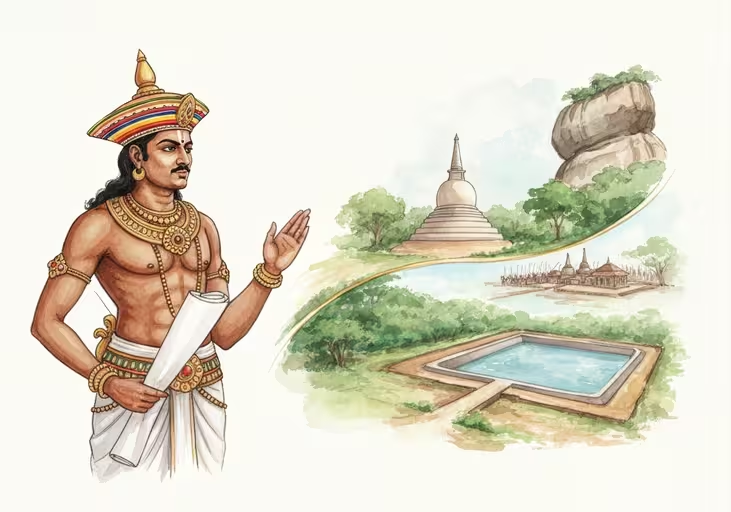
King Vijayabahu I
King Vijayabahu I (also known as Maha Vijayabahu, Vijaya Ba) was a great Sinhalese king who ruled from Polonnaruwa as his capital from 1055 CE to 1110 CE. After a long 17-year military campaign, he succeeded in completely expelling the Chola Empire, which had ruled Sri Lanka for 77 years, from the island in 1070 CE. This enabled King Vijayabahu to reunite Sri Lanka after a century. During his reign, efforts were made to re-establish Buddhism and to repair infrastructure, temples, and buildings that had been destroyed by war.
Early Life
King Vijayabahu was born in 1039 CE, under the name Kitti (Keethi), in the Kingdom of Ruhuna in Dakkhiṇadesa. He was the son of King Moggallana, ruler of Ruhuna, and Queen Lokitha. Although parts of Sri Lanka were under the control of South Indian Chola invaders at the time, Ruhuna was independently governed by Sinhalese kings who exerted pressure against the Chola rulers. At the age of 15, Prince Kitti defeated Lokissara, a leader of the invaders, with the aim of ascending to the throne of Ruhuna. Subsequently, in 1055 CE, he ascended to the throne of Ruhuna as Vijayabahu. Although Chola forces frequently launched attacks against King Vijayabahu’s army, he suppressed them and succeeded in completely liberating Ruhuna from the South Indian Chola invaders in 1058 CE, taking full control of it.
Struggle Against the Chola Empire
After making Ruhuna a secure base, King Vijayabahu, driven by a strong ambition to capture Polonnaruwa, the capital at the time, launched his first attack on Polonnaruwa in 1066, briefly bringing it under his control. However, Chola forces, reinforced by South Indian aid, counter-attacked, forcing King Vijayabahu to retreat. After regrouping at Wakirigala, King Vijayabahu launched a renewed effort to capture Polonnaruwa. He also had to face rebellions launched by other factions vying for power. Having successfully suppressed these revolts, Vijayabahu led his forces with determination to recapture Polonnaruwa, but was unable to overcome the Cholas.
Second Attack on Polonnaruwa
During the period 1069-1070 CE, a civil war broke out within the Chola Empire in Tamil Nadu, South India, unsettling the country. While the Chola army in Polonnaruwa was more or less isolated, these internal conflicts within the Chola Empire prevented the empire from focusing its attention on Sri Lanka. This provided King Vijayabahu with an opportunity to launch another attack. He received support from many kingdoms like Burma and Pandya to defeat the Cholas.
Starting from Mahanagakula, south of the Walawe River, King Vijayabahu dispatched three armies to attack Polonnaruwa from three fronts. One army was sent along the western coast of the country to Mahathittha port to deal with any reinforcements arriving from South India. Subsequently, a part of this army advanced towards Polonnaruwa and attacked from the northwest, while the other part captured the ports to prevent the arrival of reinforcements. A second army was sent from the east via Magama to attack Polonnaruwa from the east. The third and main force advanced across the country led by the King himself. Surrounded by these three armies, Polonnaruwa was besieged for seven months before King Vijayabahu’s army entered the city. In 1070 CE, King Vijayabahu became the ruler of Polonnaruwa. At that time, Sri Lanka was also known as Tambapanni.
Administration and Reforms
After the conquest of Polonnaruwa, King Vijayabahu had to face further rebellions. This led to the delay of his consecration, which took place in 1072 or 1073 CE, eighteen years after his coronation as Vijayabahu in Ruhuna and after a seventeen-year military campaign. Polonnaruwa