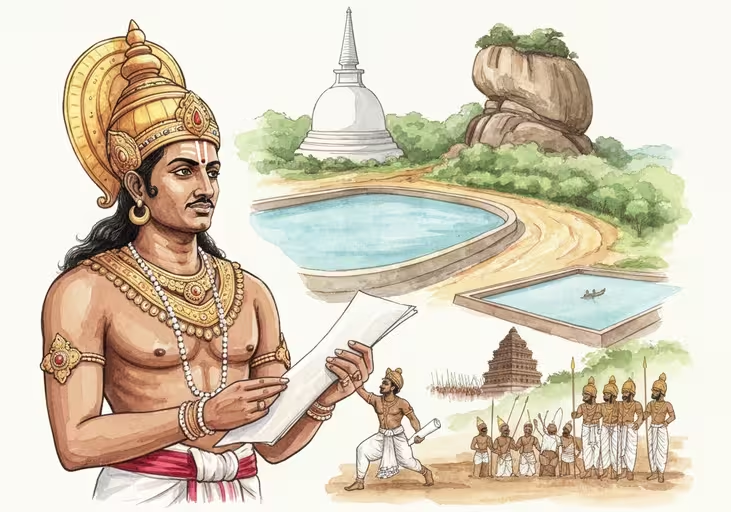
King Sirimeghavanna (Kithsirimewan)
King Sirimeghavanna, also commonly known as King Kithsirimewan, was a prominent ruler who governed the Anuradhapura Kingdom in Sri Lanka during the early fourth century. His reign, from 304 to 332 CE, marked several significant milestones in the island’s religious, economic, and social spheres. As the son of King Mahasen, he worked with great dedication to nurture Buddhism and the lives of the people, rectifying some of his father’s controversial actions.
Arrival of the Sacred Tooth Relic and the Inauguration of the Kandy Esala Perahera
One of the most significant events during King Sirimeghavanna’s reign was the bringing of the Sacred Tooth Relic of the Buddha to Sri Lanka. Around 310 CE, the Tooth Relic, brought from Kalinga in India, was received by him with great devotion and ceremony. The Sacred Tooth Relic was initially enshrined at what was then known as “Meghagiri Vihara,” now the Isurumuniya Vihara. From then on, the tradition of holding the annual Kandy Esala Perahera began under the patronage of King Sirimeghavanna. This is considered an extremely important milestone in Sri Lankan Buddhism and culture.
Religious Reforms and Vihara Constructions
King Sirimeghavanna’s reign can be considered a period of religious resurgence. He undertook the reconstruction of the Mahavihara and Lovamahapaya, which had been destroyed by his father, King Mahasen. This act demonstrated his deep devotion and commitment to Buddhism.
In addition, he patronized several other religious constructions:
- Egoḍa Kelaniya Vihara: This vihara was built to enshrine the Jalasaṭikā Dhatun Vahanse (the bathing cloth of the Buddha). A footprint of the Buddha is also enshrined here.
- Valbodhiya: A place specifically dedicated to meditation.
- Ariyavamsa Sutta Deshanawa: He patronized the Ariyavamsa Sutta sermon, which led to the highest number of people attaining the Sotapanna stage.
The Thonigala Inscription and the Ancient Banking System
Another notable feature of King Sirimeghavanna’s reign is the Thonigala Inscription, which provides information about one of the world’s oldest financial deposit and management systems. This inscription is carved on a rock slab at ground level in the village of Kudakachchakodiya, on the border of the Vavuniya and Anuradhapura districts. The name “Thonigala” is derived from the small canoe-shaped ponds nearby (‘thoni’ means canoe in Tamil).
Significance of the Inscription: This inscription was first reported by Henry Parker in 1886 and later read and published by Professor Senarath Paranavithana in 1933. Consisting of 17 lines of script, this inscription is considered by archaeologists to be the oldest document describing an ancient banking system in the world.
Financial System: The inscription refers to an institution called “Kalahumanaka Niyamathana.” Similar to a modern banking system, it accepted deposits from customers, invested them to earn profits, and paid a portion of these profits as annual interest to depositors. This system operated not with money, but with grains. Grains such as paddy, black gram (undu), and green gram (mung) were kept as deposits.
Simple Meaning of the Inscription: The inscription states that in the third regnal year of King Sirimeghavanna Abhaya, grains were deposited at the ‘Kalahumanaka’ merchant guild (bank). The interest income from these deposits was used to provide the four requisites (food, robes, lodging, medicine) to monks for conducting the Ariyavansa sermon at the Yahisa Parvata Vihara (present-day Madukanda Sri Dalada Vihara). For instance, when 50 amuṇas of paddy were deposited, 25 amuṇas of paddy were received as interest over the three seasons (Maha, Yala, and Meda). For dry-land crops like black gram and green gram, the annual interest rate was 25% (1/4th of the deposited grain). This demonstrates a unique economic system adopted for the maintenance of viharas during the barter era.
Legacy
King Sirimeghavanna’s reign can be considered a golden age in Sri Lankan history. Through his exceptional contributions, such as bringing the Sacred Tooth Relic, initiating the Kandy Esala Perahera, reconstructing viharas, and the Thonigala Inscription, he solidified the country’s religious and cultural identity. His actions vividly illustrate the religious devotion, economic acumen, and statesmanship of ancient Lanka.