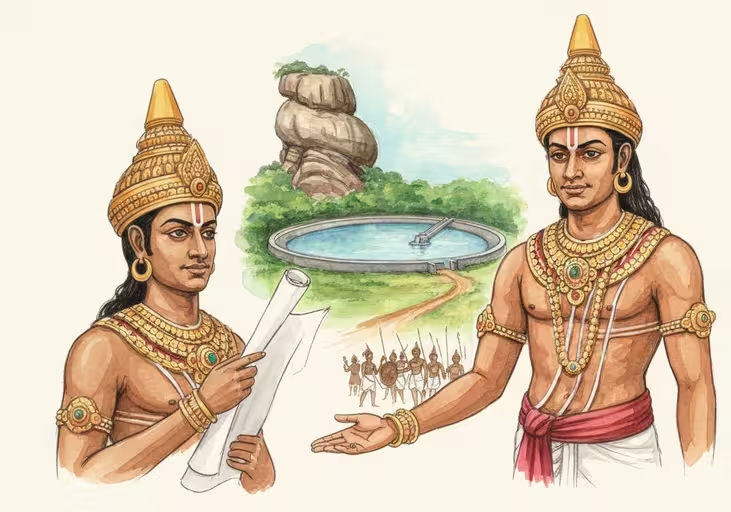
The Nayakkars of Kandy were a royal dynasty that ruled the Kandyan Kingdom with Kandy as its capital from 1707 AD to 1815 AD, and they were also the last royal lineage to rule Sri Lanka. They descended from the royal families of the Vijayanagara Madurai Nayaks of Telugu origin, belonging to the Kapu Balija caste. There were four kings in this lineage, and the last king was exiled by the British to Vellore Fort in India. They came to power as kings of Kandy through marital alliances and the prevailing Marumakkathayam law. Although initially Hindus, they later embraced Buddhism and took significant responsibility for its revival.
Origin and Royal Relations
The Kandyan royal lineage preceding the Nayakkar dynasty consistently married wives from South Indian royal families, such as the Madurai Nayaks or Thanjavur Nayaks. The origin of the Nayaks in South India began in the 14th and 15th centuries as governors of the Vijayanagara dynasty. They also ruled parts of Tamil Nadu, and after the decline of Vijayanagara suzerainty in the 16th century, these governors declared independence in their respective territories. Subsequently, they established their kingdoms in Gingee, Thanjavur, Madurai, and Chandragiri, and all of them were of Telugu origin. This was one reason for the larger Telugu population in the western parts of Tamil Nadu.
When the last Sinhalese king of the Kandyan royal lineage died without an heir, his chief queen’s brother was chosen for the throne according to the ‘Marumakkathayam’ law. Subsequently, all kings who ascended the throne belonged to the Madurai lineage. It is clear that there were also military ties with the South Indian Nayaks, as in 1620 AD, the Karaiyar military chiefs of Jaffna sought help from the Thanjavur Nayaks to expel the Portuguese. The head of these branches of the Madurai Nayaks is recorded as Bangaru Thirumalai. His son was adopted by Queen Annima Nayak, Meenakshi. Bangaru Thirumalai was a direct descendant of Thirumalai Nayak’s younger brother. He was also the military governor of the Thirunelveli and Madurai provinces.
Accession of the Nayakkars to the Throne
Before the Nayakkar dynasty came to power, the last Sinhalese king of the Kandyan royal lineage was King Sri Veera Parakrama Narendrasinghe, who ruled Kandy from 1707 AD to 1739 AD. Ascending the throne in 1707 AD, he was considered learned and devout. In 1708 AD, he married the daughter of Pitti Nayakkar, a princess from the royal family of Madurai. Again in 1710 AD, he married another princess from Madurai. The king had no children from these two queens. He had another wife from a high-ranking family in Matale, who bore him a child. The king also had another high-caste concubine who bore a son named Unambuwe. Although Unambuwe was alive, his mother’s lack of royal status prevented him from ascending to the kingship.
Therefore, King Sri Veera Parakrama Narendrasinghe named his first queen’s brother as his successor. This brother had resided in the royal palace since the day his sister was married to the king. According to the prevailing law of succession in Sri Lanka, the throne always belonged to the son (of the chief queen) from the father, or from brother to brother, and so on. Thus, the path for the Nayakkar dynasty to ascend the throne was opened.
Religious Policies
Although the Nayakkar kings were initially Hindus, they embraced Buddhism after ascending the throne in Sri Lanka. They bore the responsibility of working for the revival of Buddhism and played an important role in preserving the Sasana (Buddhist dispensation).
Rule and End
The Nayakkars of Kandy ruled the Kandyan Kingdom from 1707 to 1815, and during their reign, the country faced foreign influences. The last king of this dynasty was King Sri Vikrama Rajasinha, who was exiled to Vellore Fort in India after the British conquered the Kandyan Kingdom in 1815 AD. Consequently, the Nayakkars of Kandy became the last independent royal dynasty to rule Sri Lanka.