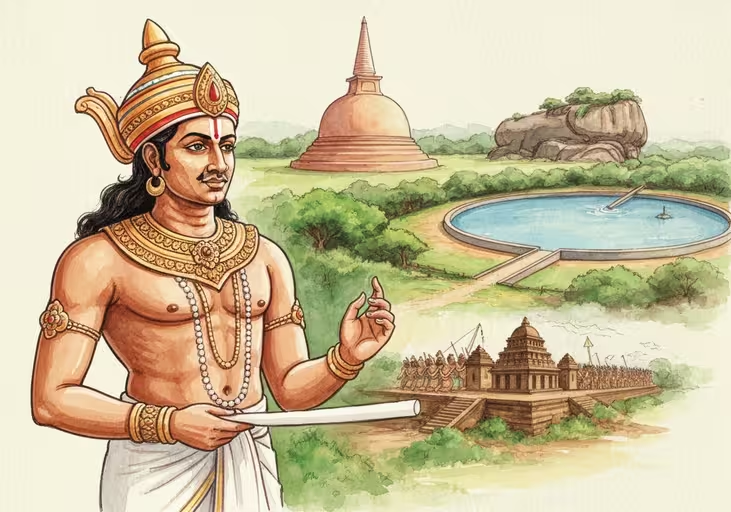
King Mahadatika Mahanaga
Introduction
After the demise of King Bhatika, his younger brother, King Mahadatika Mahanaga, ascended the throne. He ruled for twelve years. Undertaking various meritorious deeds, he rendered great service to the Buddhist Sasana and the people.
Services Rendered to the Maha Seya
King Mahadatika Mahanaga arranged for lotus-carved stones, known as Kinjakka, to be laid below the stone Pesa Wall of the Maha Seya (Ruwanweliseya). He also ordered the expansion and construction of the sand courtyard.
The Ambasthala Maha Seya and Giribhanda Mahapuja
One of King Mahadatika Mahanaga’s foremost religious undertakings was the construction of the Ambasthala Mahathupa at Mihintale. When the stupa’s foundation was unstable at protruding points, he lay down there, sacrificing his life while recalling the virtues of the Buddha, thereby establishing the stupa’s foundation firmly and completing its construction.
He also had four jeweled pillars, finely carved by skilled artisans, erected at the four entrances of the Ambasthala Maha Seya. The king arranged for the stupa to be adorned with a jeweled covering made of golden fabric and a pearl necklace made of golden bubbles.
Giribhanda Mahapuja
The exceptionally beautiful grand offering made by King Mahadatika to the Ambasthala Maha Seya is known as the ‘Giribhanda Mahapuja’. For this offering:
- Four beautifully adorned pathways were constructed around the Sagiriya mountain for a distance of approximately a yojana (about 8 miles), with four gates on each side.
- Stalls were set up on both sides of the street, and each place was decorated with flags, flower baskets, archways, and other embellishments.
- Every surrounding area was made to gleam with rows of lamps.
- Arrangements were made for dancers’ performances, songs, and instrumental music.
- Mats were laid from Kolomhoya to Sagiriya along the path, allowing people to walk with cleansed feet.
- Dances, songs, instrumental music, and dramas were also performed along that path.
- Great alms were given at the four gates of the city.
- The entire island of Sri Lanka was continuously illuminated with rows of lamps.
- Within a yojana around the sea, rafts were tied, pillars were erected, and lamps were lit at various points.
For this offering, the king established alms-giving places at eight locations, had golden drums beaten, and provided great alms to twenty-four thousand bhikkhus. He also offered the three robes six times.
Other Meritorious Deeds and Social Services
King Mahadatika Mahanaga had Dharma seats made for every monastery in Lanka. He freed animals that were in bondage. He always had barbers shave beards at the four gates of the city. He meticulously carried out all meritorious deeds maintained by previous kings, as well as all the meritorious deeds maintained by his elder brother, King Bhatika.
Offerings to the Sangha
King Mahadatika Mahanaga designated himself, his queen, his two sons Prince Gamini Abhaya and Tissa, his royal elephant, and his royal horse as servants of the Sangha, even when the Sangha tried to dissuade him. He also offered robes and other requisites worth six hundred thousand Kahavanu to the bhikkhus, and robes and requisites worth one hundred thousand Kahavanu to the bhikkhunis. Later, the king, skilled in reconciling matters, offered various suitable items to redeem himself, the queen, and the others from their servitude to the Sangha.
Construction of Monasteries in Ruhuna
King Mahadatika Mahanaga also constructed several monasteries in the Ruhuna province. Among them were:
- A monastery named Maninaga Parvata on the peak of a mountain called Kalayana.
- A monastery named Kalanda.
- A monastery named Samudravihara on the bank of the Kumbukandana stream.
- A monastery named Chulanaga Parvata on the peak of a mountain called Huwawa in Ruhuna itself.
Land Donations
At the Pasana Deepaka Vihara, which he had built, the king was impressed by the well-disciplined conduct of the novice monks who brought him water. He then dedicated a nindagama (a land grant) of eight yojanas (about 64 miles) around as a Sanghabhoga (property for the Sangha) to that monastery. At the Mandavapi Vihara, likewise impressed by the disciplined conduct of another novice monk who brought him water, he also dedicated a nindagama as a Sanghabhoga to that monastery.
Legacy
King Mahadatika Mahanaga rendered great service to the Buddhist Sasana in the Anuradhapura Kingdom during his twelve-year reign. Through the construction of the Ambasthala Maha Seya, the performance of the Giribhanda Mahapuja, the building of many monasteries, and numerous social services, he is recorded in history as a king who performed many meritorious deeds comparable to those of Emperor Ashoka.