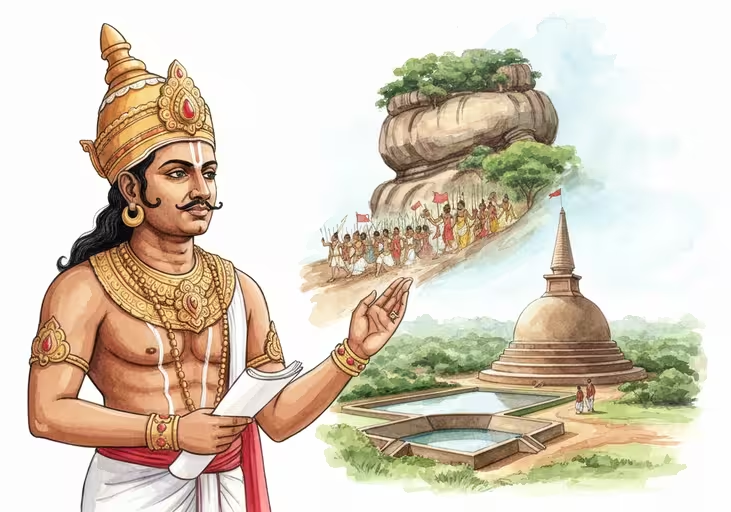
King Kashyapa I was the eldest son of King Dhatusena and was also known by the names Parvata Raja or Alakapaya Maha Raja. His mother was of a different maternal lineage, being born from a Pallava royal queen. Prince Moggallana was born to King Dhatusena and the daughter of King Kashyapa, thus he was of the same maternal lineage. According to the Hela royal tradition, the succession to the throne belonged to Prince Moggallana, who possessed purity from both lineages.
Accession to the Throne
Prince Kashyapa had to wage war against Indian forces during an invasion from South India. After this victory, he expected to be appointed as the viceroy by his father, but this did not materialize. Disappointed, Prince Kashyapa, according to the Chulavamsa, conspired with the Commander of the Vihara in CE 112, deposed King Dhatusena from the throne, and seized power.
A Patricide?
Although it can be pre-concluded that King Kashyapa was unpopular among the people due to chronicles referring to him as a patricide, a completely different view emerges from the information in the chronicles themselves. While King Dhatusena acted for the prosperity of the country, he was also cruel enough to have his own sister burned alive. Furthermore, King Dhatusena was a Mauryan who married a woman of the Pallava royal lineage, came to Lanka with a Pallava army, removed the Lambakarna dynasty who ruled at the time, and seized power. Perhaps the support of these Pallava factions was granted to Prince Kashyapa due to his maternal kinship.
If King Dhatusena had been a popular ruler, there should have been an uprising against Prince Kashyapa after his assassination. Historical legends confirm that Migara conspired with King Kashyapa’s queen, and through her, led the king to the top of Sigiriya Rock and either pushed him down or killed him by other means. Another view is that Kashyapa killed King Dhatusena by burying him alive in the embankment of Kala Wewa because Dhatusena did not give him the treasure he requested. Nevertheless, it is mentioned that King Kashyapa was greatly troubled by the act of killing his father and therefore accumulated much merit.
Creation of Sigiriya
According to the chronicles, King Kashyapa built Sigiriya out of fear of a perceived threat from Moggallana. However, based on its ruins, Professor Senarath Paranavithana states that considering the seven crores of wealth spent on Sigiriya’s construction and the immense human labor, its value as a fortress is limited. Mr. Paranavithana points out that features like the Sigiriya Mirror Wall, the colossal lion sculpture at the end of the platform, the staircase extending from within the lion’s body to the summit of the rock, and the paintings of celestial maidens on the rock face had no connection to a military fortress.
According to the ruins at the summit of Sigiriya Rock, there was only a single-room dwelling for human habitation. Therefore, Sigiriya must have been an art museum or a pleasure palace. Legends reveal that King Kashyapa, being an art lover and desiring a beautiful environment, created Sigiriya more exquisitely than Kubera’s Alakamanda. It is also remarkable that such a vast amount of artistic work was completed within a single reign of just 18 years. We can observe a collection of centuries-worth of artistry within Sigiriya.
Religious and Social Activities
Pidurangala Vihara, located near Sigiriya, is also a religious construction attributed to King Kashyapa. It is mentioned that he was greatly troubled by the act of killing his father and therefore accumulated much merit.
Reign and Legacy
The author of the Chulavamsa states that King Kashyapa, who ruled for eighteen years, gained great popular acclaim. Considering this information, it can be said that many factors remain to suggest that King Kashyapa was not an unpopular ruler, and that Sigiriya was not merely a fortress. King Kashyapa remains immortal in Sri Lankan history as an artistic, visionary, and widely admired ruler.