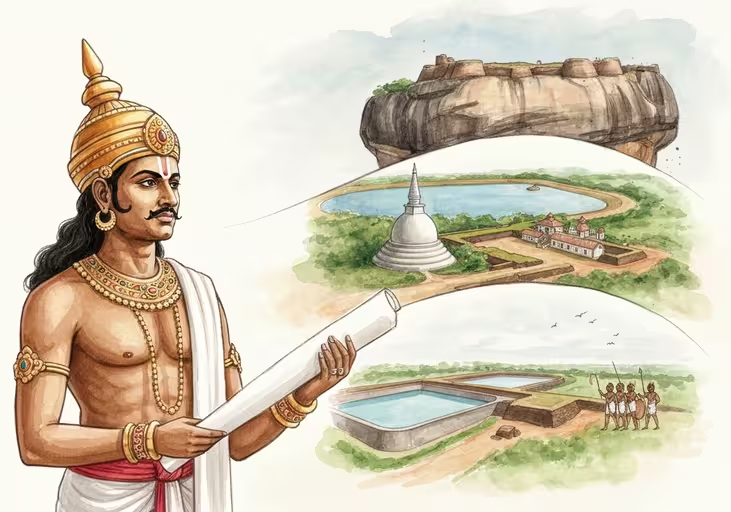
King Kashyapa I is one of the most controversial and fascinating rulers in Sri Lankan history. He ascended to the throne after killing his father, King Dhatusena, and built the Sigiriya rock fortress, an extraordinary feat of artistry and engineering.
Birth and Background
Kashyapa was born as the son of King Dhatusena by a Pallava queen. His younger brother, Moggallana, was born to a queen of royal blood, thus having a stronger claim to the throne.
Accession to the Throne
In 479 CE, Kashyapa imprisoned his father, King Dhatusena, and attempted to forcibly extract information about his royal treasury. According to ancient Sri Lankan history, when King Dhatusena declared, “The Kalawewa (tank) is my greatest wealth,” Kashyapa had him walled up.
Moggallana fled to South India and prepared for revenge and to reclaim his rightful inheritance.
Construction of Sigiriya
Fearing retaliation from his younger brother, Kashyapa relocated his kingdom from Anuradhapura and built his new capital on a massive rock column called Sigiriya.
The Rock Fortress
Sigiriya was built on a 200-meter-high rock column:
- Upper Palace: An exquisite royal palace on the summit of the rock
- Mid-Level Terrace: Mid-level courtyards with the Lion Gate
- Lower Gardens: Highly sophisticated water gardens and hydraulic mechanisms
- Mirror Wall: The famous frescoes known as the Sigiriya Apsaras
Sigiriya Frescoes
The Mirror Wall at Sigiriya features unique frescoes:
- Originally nearly 500 paintings, but only 22 remain today
- Depict beautiful, elegant women
- Utilise vibrant colours and delicate artistic techniques
- Among the oldest preserved frescoes in the world
Mirror Wall Poetry
The Mirror Wall at Sigiriya contains over 1,500 ancient Sinhala poems and writings inscribed by visitors returning between the 8th and 10th centuries. These are important evidence of the ancient Sinhala language and literature.
Water Gardens
The lower gardens of Sigiriya are some of the oldest landscaped water gardens in the world:
- Formal pools and islands
- Fountains and hydraulic features
- Symmetrical designs and pathways
- Sophisticated water storage and distribution system
Reign
Kashyapa’s 18-year reign was fraught with challenges:
- Constant threat from his younger brother
- Controversies surrounding his accession to the throne
- Resources required for massive construction projects
Nevertheless, the construction of Sigiriya and other projects demonstrate the efficiency and vision of his administration.
Death and Defeat
In 497 CE, Moggallana returned with South Indian forces and battled Kashyapa. According to the Mahavamsa:
- The battle took place near Dambadeniya.
- As Kashyapa led his army, he encountered an unforeseen obstacle and his advance faltered.
- He believed his soldiers were betraying him and turned back in the midst of the battle.
- Facing utter defeat, Kashyapa decided to end it all and committed suicide on the battlefield.
Legacy
Kashyapa’s parricide forever made him a controversial figure, but Sigiriya remains his enduring legacy:
- Architecture: A magnificent architectural marvel built on a single rock
- Engineering: Sophisticated water systems and construction techniques
- Art: Sigiriya frescoes and Mirror Wall poetry
- Landscaping: Ancient water garden designs
Today, Sigiriya is:
- A UNESCO World Heritage Site
- Sri Lanka’s most popular tourist attraction
- A symbol of ancient Sri Lankan craftsmanship and engineering prowess
Kashyapa’s complex legacy—his parricide and the creation of Sigiriya—makes him one of the most fascinating and contentious figures in Sri Lankan history.