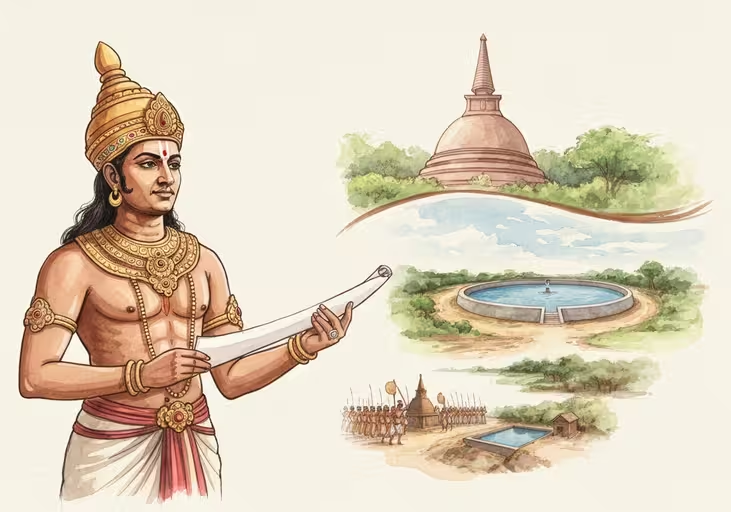
King Kalinga Magha: The Legacy of a Cruel Ruler
Kalinga Magha, also known as Kuru Magha (Cruel Magha), was a medieval king who ruled Sri Lanka from 1215 to 1255 CE. He is primarily remembered for his cruel and oppressive reign. Magha, who came from the Kalinga region of Eastern India, invaded the island in 1215 and deposed Parakrama Pandyan from the throne.
The Invasion and Nature of His Rule
Magha’s invasion marked a significant turning point in Sri Lankan history. Due to his oppressive rule, large numbers of indigenous Sinhalese people migrated to the southern and western parts of Sri Lanka, as well as to the central highlands of the interior. Magha was the last king to gain power in the ancient northern region known as Rajarata, and his efforts to destroy Sinhalese power in the north were so profound that every subsequent Sinhalese dynasty that came to power from Rajarata primarily existed in the southern part of the island.
The Destruction of Rajarata and the Shift of Power
Magha’s invasion brought immense destruction to the Rajarata Kingdom, which was then the heart of the island’s governing power. The great cities created by ancient kings were swallowed by the jungle and were only rediscovered in the 19th century. Indigenous ruling power thereafter shifted like a kaleidoscope of changing scenes to the south and central provinces of Lanka. Although the northern region eventually evolved into the Kingdom of Jaffna, it was subjugated by the Portuguese in 1619.
Social and Political Impacts
Ancient Sri Lanka was divided into Rajarata, Dakkhina Desa, and Ruhunu, which later evolved into Rajarata - Patithadesa, and Dakkhina Desa - Maya Rata. However, after Magha’s invasion, these practices faded, and geographically smaller kingdoms centered around fortified cities like Yapahuwa and Gampola emerged. States like Sitawaka also lasted for only a short period.
The bitter memories of Magha’s invasion damaged the close ties that previously existed between the Sinhalese and the South Indian Chola, Kerala, and Pandyan kingdoms. In the past, high-ranking families in Rajarata had royal connections through extensive marital relations between branches in India and Lanka, and medieval royal families were, in the modern sense of the word, distinctly Sinhalese. However, this does not mean that the South Indian influence in Sri Lankan politics completely disappeared; the Nayakkar royal lineage of Kandy stands as proof. Nevertheless, this marked the end of the era of great Indo-Lankan clans such as the Maurya and Lambakarna.
Legacy
Even before Magha’s invasion, indigenous rule in Sri Lanka was gradually declining. After this invasion, the country remained in a state of near anarchy for about three centuries. This historical era in Sri Lanka concluded with the arrival of European imperialists, who subsequently subjugated both the great empires of South India and the kingdoms that existed in Lanka.