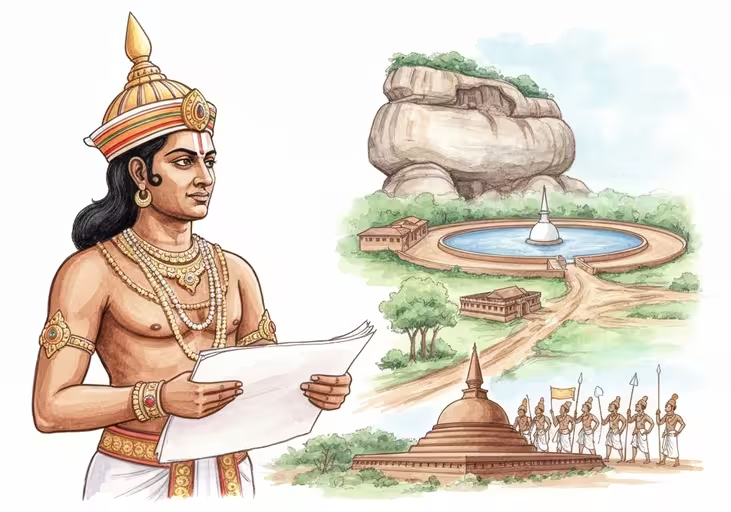
King Jettatissa I
King Jettatissa I (B.E. 805 - 815, 267-277 CE) ruled the Anuradhapura Kingdom. He was the eldest son of King Gotabhaya and ascended the throne after his father. His reign lasted for ten years.
Accession to the Throne and Early Challenges
Although King Jettatissa I ascended the throne after the demise of King Gotabhaya, the beginning of his reign was marked by a severe political crisis. Towards the end of King Gotabhaya’s rule, some ministers and state officials held differing opinions towards the king and even refused to attend his funeral.
Accordingly, after ascending the throne, King Jettatissa sent his younger brother Prince Mahasen ahead to intercept and execute (impale) the ministers who were unwilling to participate in King Gotabhaya’s funeral procession. This act, carried out around the king’s tomb, led to public displeasure. The unpopularity King Gotabhaya had garnered for the assassination of King Sirisanghabo is also considered a reason for such events. The conspiratorial practices of Thera Sanghamitta, an expert in demonology, may also have exacerbated this situation.
Influence of Thera Sanghamitta
As King Jettatissa I consolidated his power, Thera Sanghamitta returned to Jambudvipa (India). According to the Mahavamsa Tika, he did so after discussing with Prince Mahasen and informing him that Mahasen would seek him out after ascending the throne. This is considered a precursor to a future political conspiracy.
Religious and Civil Works
Like his father, King Jettatissa was very loyal to the Mahavihara monks. During his reign, numerous remarkable services were rendered in both religious and civil spheres.
-
Religious Constructions: He constructed four Mahaviharas and completed the renovation work of the Lovamahapaya, which had been started by his father. He also erected two beautiful arches (thoranas) for the Jaya Sri Maha Bodhi and offered a precious gem to the Maha Saya (Ruwanwelisaya). A major religious undertaking was the relocation and enshrinement of a Buddha statue from Thuparamaya to Pacina Tissa Pabbata Vihara. The ruined area currently located above the Nuwara Wewa embankment, north of the Mihintale road, surrounded by a moat, has been identified as the Pacina Tissa Pabbata monastery.
-
Civil Constructions: King Jettatissa constructed six tanks, contributing to the irrigation needs of the people.
State Administration
Despite taking drastic measures such as the early assassination of ministers, King Jettatissa I gradually managed to establish his authority throughout the country. During his reign, no significant mention or special information about Prince Mahasen is revealed in historical sources. Furthermore, no inscriptions established during King Jettatissa’s reign are known. Nevertheless, his rule remained stable, and it is clear that he made a significant contribution to the country’s development and religious affairs.