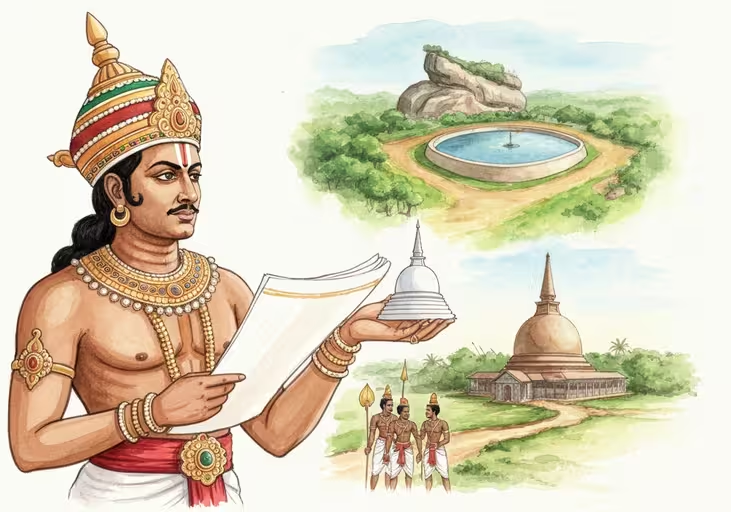
King Sena I
Introduction
Sena I was a king who ruled Anuradhapura in the 9th century CE, and his reign lasted from 846 CE to 866 CE. He was appointed king of Anuradhapura after his brother, Aggabodhi IX. His reign was marked by a Pandyan invasion, which brought massive destruction to the island of Lanka.
Accession to the Throne
King Aggabodhi IX, who ruled after King Dappula II, died within two years. Subsequently, around 846 CE, King Sena I ascended the throne of Anuradhapura.
The Pandyan Invasion and the Fall of Anuradhapura
During the reign of King Sena I, the island of Lanka once again fell victim to a Dravidian invasion. At this time, a powerful kingdom had been established in much of South India by a Pandyan king named Jatila Parantaka. His successor, King Sri Mara Sri Vallabha, intended to further expand his dominion and prepared to invade Lanka. For this purpose, he assembled a large army and a navy.
The Pandyan army, which landed on the northern coast of Lanka under King Sri Mara, gradually advanced towards Anuradhapura. During this time, the Tamil people living in the north sided with their South Indian Dravidian relatives and joined their forces. Due to disunity among the Sinhala generals, a proper army organization could not be put in place to face the enemy forces. Advancing without much difficulty, the Dravidian army destroyed villages, raped women, plundered, and reached the vicinity of Anuradhapura.
Prince Mihindu bravely came forward to face them, but the Sinhala army was not strong enough to fight against the overwhelming Tamil forces. However, the courageous prince faced the enemy forces and fought fiercely, but his army was destroyed and scattered. Believing that it was better to die honorably than to be captured by the enemy, the prince took his own life. The Tamil army, having defeated the remaining Sinhala forces that blocked their advance, entered Anuradhapura. The royal palace, monasteries, temples, and homes of Sinhala chiefs were destroyed, and all their wealth was plundered by the Tamil soldiers. Women were raped, and all who opposed them were killed. Anuradhapura had not been subjected to such a plunder for many centuries.
The Peace Treaty and the Effort to Rebuild the Country
As King Sena I, who had fled to save his life, was preparing to board a ship, envoys from the Pandyan king came to him. The envoys informed him that King Sri Mara was willing to return the kingdom of Lanka and return to his country with his army if Sena agreed to pay all the wealth plundered by his army, along with a large indemnity. King Sena agreed to these proposals, and the Pandyan king departed for his country with his army, taking a large war indemnity. Thus, the Pandyan army left Lanka, preventing the complete destruction of the kingdom.
The Promise Made to His Son
Upon returning to Anuradhapura, King Sena found the royal palace, monasteries, and the entire Rajarata region destroyed by the Tamils, looking like a fresh tomb. He had to rebuild everything anew. However, restoring its former glory was not an easy task. Above all, the humiliation caused by his inability to defeat the Tamil invasion brought great pain to the king’s heart. He took his infant son on his lap and said:
“Son… like a true man, like a true Sinhalese, someday you must avenge this humiliation, defeat, and destruction that your motherland and your father had to face. You must do this for your father. You must restore the pride of this motherland and the glory of Rajarata.”
The young son swore to his father that he would fulfill it. Thus, King Sena I entrusted his son, Sena II, with the weighty responsibility of avenging the Pandyan Empire in the future.
Demise and Succession
King Sena I, who rebuilt the country to the best of his ability with the support of the Sinhala people, passed away in 866 CE. Subsequently, his son, Sena II, was crowned king. History records that he fulfilled the promise he made to his father, later launching a successful war against the Pandyan Empire.