Introduction
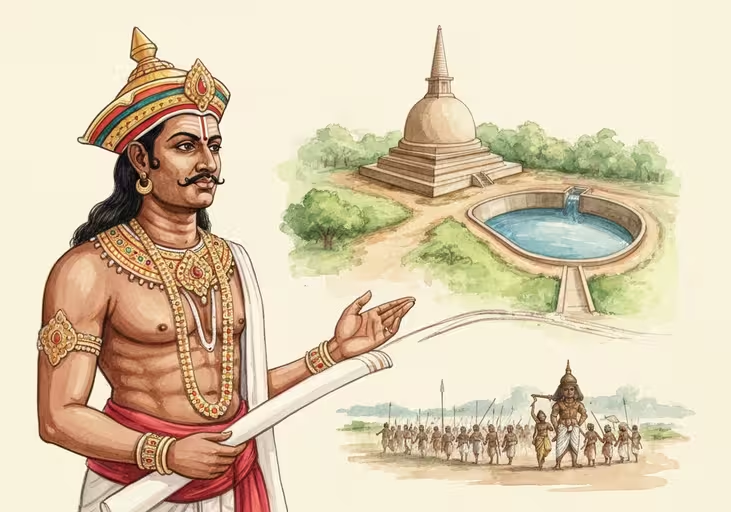
King Rajasinghe II (Prince Maha Asthana before his coronation) ruled as the third Sinhalese king of the Kandyan Kingdom in Sri Lanka from 1635 to 1687 CE. He sought the assistance of the Dutch to expel the Portuguese from the island, which marked a crucial turning point in Sri Lankan history. Conflicts with the Portuguese and later the Dutch during his reign significantly impacted the political and social conditions of the kingdom.
Birth and Early Life
Prince Maha Asthana was the son of King Senarat and Queen Kusumāsana Devi. King Senarat was the second ruler to establish Senkadagala (Kandy) as the capital of Sinhale, at a time when most coastal areas of the island were under Portuguese control. This made the Kandyan Kingdom the only independent indigenous state on the island. Frequent battles led to deep resentment among the Kandyans towards the Portuguese. Brief victories achieved by the warrior kingdom of Sitawaka about a century earlier had led many in the kingdom to believe that expelling the colonial rulers was achievable.
At a very young age, in 1612, Prince Rajasinghe assisted in launching a counter-attack during a Portuguese invasion of the Kandyan Kingdom. He succeeded his father to the throne in 1635 CE (some sources also mention 1629).
Reign and Key Events
King Rajasinghe II’s reign was marked by constant conflicts with European powers.
Battle of Gannoruwa
In 1638, the Portuguese Captain-General Diogo de Melo invaded Kandy with a large army. At Gannoruwa field, King Rajasinghe II’s forces surrounded the Portuguese army and launched a powerful attack. The Portuguese suffered a devastating defeat in this battle, which is considered a prominent military victory of King Rajasinghe’s reign.
Arrival of the Dutch
King Rajasinghe sought the help of the Dutch to expel the Portuguese from Sri Lanka. In 1656, the Dutch succeeded in completely expelling the Portuguese from the island. However, it had by then become clear to the Kandyans that the true objective of the Dutch was not merely to expel the Portuguese, but to become the dominant colonial power on the island. This is a prime example of how seeking the assistance of another European power to get rid of one proved to be a pitfall for the Kandyan Kingdom.
From 1645, King Rajasinghe was intermittently engaged in battles with his former allies (the Dutch). He reigned for a long period in the Kandyan Kingdom, with his rule extending over 52 years.
Significance and Legacy
The era of King Rajasinghe II marks a crucial period in Sri Lanka’s colonial history.
- Shift in Colonial Powers: The expulsion of the Portuguese by the Dutch was a highly significant event during his reign. However, the Kandyan Kingdom soon realized that they would face similar troubles with the Dutch as they had with the Portuguese. Although the Dutch were not as aggressive as the Portuguese in forcibly converting the local population to their religion or imposing their cultural dominance, it became evident that Europeans were cunning and did not act honorably.
- Internal Instability: During Rajasinghe’s era, powerful families involved in Kandyan politics gained more influence in the 18th century. It is reported that attempts to assassinate King Rajasinghe were common.
- Change in the Concept of State: The gradual erosion of the dream for Sri Lanka to become a unified, indigenously established state was also observed during Rajasinghe’s reign.
King Rajasinghe II’s reign serves as a prime example of the challenges and strategies faced by Sri Lanka during an era of increasing European influence.