Introduction
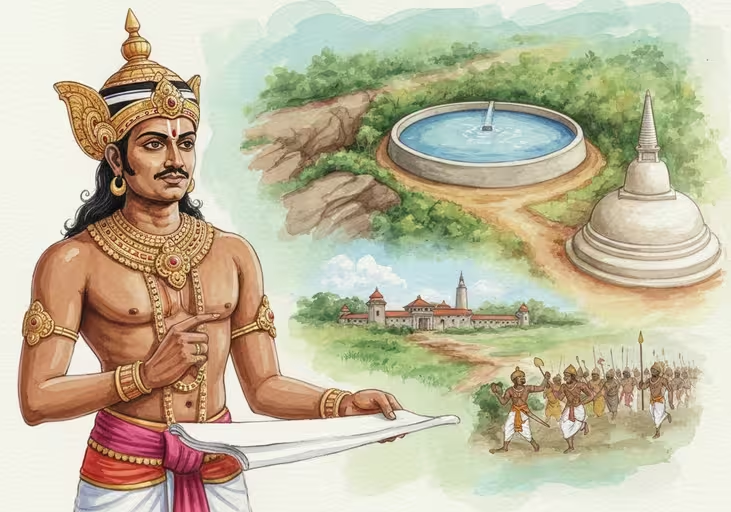
King Dhatusena was a great Sinhalese king who ruled Sri Lanka with Anuradhapura as its capital from 455 to 473 CE. He is considered the first king of the Moriya Dynasty in Sri Lanka. In some historical records, King Dhatusena is also referred to by the name ‘Dasankeli’.
Reign and Unification
King Dhatusena’s reign is marked by his successful handling of numerous challenges faced by the country. During his rule, he managed to defeat the South Indian invaders who were controlling a part of Sri Lanka. Following this victory, King Dhatusena succeeded in reunifying the entirety of Sri Lanka after 26 years, which was a pivotal milestone of his reign.
Irrigation Works
King Dhatusena was a ruler who made a significant contribution to the advancement of Sri Lanka’s irrigation civilization. During his reign, 18 major irrigation works were constructed. Among these, Yoda Ela (Giant Canal), Kala Wewa, and Balalu Wewa are prominent. According to the Mahavamsa, King Dhatusena constructed 18 tanks, including Yoda Wewa, Nuwara Wewa, Mora Wewa, Kaudulla Wewa, Allai Wewa, Ampara Wewa, Ekagal Aru Wewa, Irakkamam Wewa, Kondawattavaan Wewa, Navakiri Aru Wewa, Debarawewa, Ridiyagama Wewa, Balalu Wewa, Kandalama Wewa, Iranamadu Wewa, Muthuaiyankaddukulam Wewa, Akkarayankulam Wewa, Pavikulam Wewa, Unnichchai Wewa, Rukam Wewa, and Pimburattava Wewa. These massive irrigation projects greatly supported the country’s agriculture and the livelihoods of its people.
Religious and Artistic Activities
During King Dhatusena’s reign, significant creations were also made in the religious and artistic spheres. The Avukana Buddha Statue, an extremely important Buddhist statue in Sri Lanka, was also a large Buddha statue constructed during his rule. This stands as a perfect example of his religious devotion and patronage of the arts.
Death
King Dhatusena’s life came to a tragic end. His son, King Kashyapa, who later made Sigiriya his capital, had his father, King Dhatusena, buried alive by entombing him in the bund of Kala Wewa. This incident is considered one of the most shocking events in Sri Lankan history.
Subsequent Events
After King Kashyapa seized power, it is mentioned in the Mahavamsa that Prince Mugalan, another son of King Dhatusena, fled to India in fear. Although the Mahavamsa does not explicitly state where Mugalan fled, it is widely believed that he likely fled to the Pallava country where his maternal relatives resided. This event greatly influenced the future political course of the Sri Lankan state.